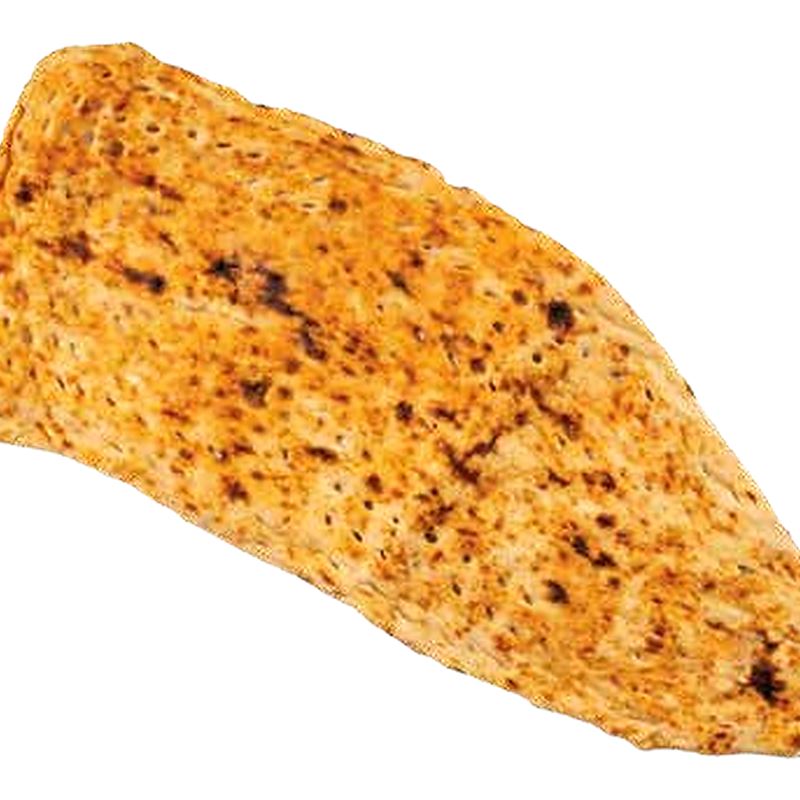
What is nan-e barbari?
Barbari is the thick, ridged Persian breakfast bread: a long oval loaf, deep gold on top, soft and open inside, with sesame and nigella scattered over the crust. It is the bread people carry home warm in the morning and tear over cheese, butter, herbs and tea. Sangak, its opposite number, is thin and chewy and belongs in broth.
You can bake a very good barbari in an ordinary kitchen. It is more forgiving than sangak, because barbari is supposed to be thick, and the one move that makes it look right is easy: the roomal, a cooked flour-and-water glaze you brush on before it goes in the oven.
What is roomal, and why does barbari need it?
Roomal is that glaze. The name describes wiping something over a surface, which is what the baker does with it. Flour is whisked into water, cooked until it thickens to a thin, glossy paste, cooled, then painted edge to edge over the shaped dough.
It does three things. The cooked starch dries into a lacquer, and that is where the sheen comes from. It takes colour faster and deeper than bare dough, so the crust goes mahogany before the crumb dries out. And it keeps the surface soft and stretchy through the first minutes of baking, so the loaf climbs instead of setting hard and staying flat.
Leave it out and you get an honest flatbread, but not barbari. It will be pale, matte and low.
What goes into the dough, and what goes on top?
Two loaves, three short lists. Nothing here is specialist except the nigella seeds, and Iranian and Arabic grocers in Dubai usually stock those.
The dough
- 4 cups plain flour, plus extra for dusting
- 2 teaspoons instant yeast
- 2 teaspoons fine salt
- 1 teaspoon sugar
- About 1 and a half cups of hand-warm water
- 1 tablespoon oil, for the bowl
The roomal glaze
- 1 teaspoon plain flour
- Three quarters of a cup of water
- Half a teaspoon of sugar
- A pinch of bicarbonate of soda, optional, for a deeper colour
On top
- 2 teaspoons sesame seeds
- 1 teaspoon nigella seeds, siah daneh
How do you shape, groove and bake barbari at home?
- Stir the yeast and sugar into the hand-warm water and leave it until the surface turns cloudy and starts to foam.
- Mix the flour and salt in a wide bowl, pour in the yeast water, and bring it together into a soft, slightly tacky dough. Knead about ten minutes, until a piece stretches thin without tearing straight away.
- Oil the bowl, turn the dough in it, cover it, and leave it until doubled in size, roughly ninety minutes.
- Make the roomal. Whisk the flour and sugar into cold water in a small pan, then cook it, stirring, until it thickens to a pourable, glossy paste. Take it off the heat and let it cool completely.
- Divide the dough in two. On a floured surface, press and stretch each piece into a long oval, thicker down the middle than at the ends. Set each on a floured tray, cover, and rest twenty minutes.
- Put your heaviest tray or a baking stone in the oven and set it as hot as your oven will go, preheated with the tray in it. The oven side of any flatbread is the same story, and our honest sangak recipe works through the stone-and-steam part in detail.
- Brush the roomal over the loaf, all of it, edge to edge. Then wet your fingers in the glaze and draw four or five channels down the length of the dough, pressing almost to the tray but not through. Scatter the sesame and nigella.
- Slide it onto the hot tray. Bake until the ridges are deep gold and the channels a shade darker, around twelve to fifteen minutes, then cool it on a rack rather than flat so the base stays crisp.
Why does barbari have those grooves down the loaf?
They are not decoration, or not only decoration. A thick, wet, glazed dough left plain will lift in one place and blow into a balloon. The channels give the gas somewhere to go, so the loaf rises evenly along its whole length.
They also build the texture barbari is loved for. The ridges stay high, soft and open; the channels bake thin and crisp. One loaf gives you both in every piece. And because the lines run the length of the bread, it tears into neat strips at the table without a knife.
Draw them with fingers wet from the roomal, not dry. Dry fingers drag the surface and the grooves close up again as the dough relaxes.
Why did my barbari come out pale, flat or dense?
- Pale and matte: the roomal was too thin, or too thinly brushed. It should coat like a cream, not water.
- Flat: the oven was not hot enough when the bread went in, or the tray was cold. Preheat the tray, not just the oven.
- Dense: too much flour. Barbari dough should feel soft and slightly tacky when you finish kneading, not firm and smooth like a bread roll.
- Grooves vanished: pressed too gently, or the loaf sat too long after grooving. Groove, seed, bake.
- Seeds falling off: they went on before the glaze, or after it had dried. They should land on a wet surface.
What is barbari eaten with at breakfast?
Bread, cheese and tea is the whole answer, and it is worth taking seriously. Warm barbari torn into pieces, salty white cheese, walnuts, a handful of tarragon and basil, butter with honey or carrot jam, and black tea poured strong. That is what a Persian morning looks like in a lot of houses, in Tehran and in Dubai. If you want the full table, we have written about what a savoury Persian breakfast actually looks like.
Barbari also carries hot food better than a thin bread. A Persian tomato omelet eaten off a piece of barbari is one of the best breakfasts there is.
Which meal wants barbari, and which wants sangak?
Choose by what the bread has to do. Barbari is for spreading and stacking: it has body, so cheese, butter and egg sit on it. Sangak is for dipping and tearing into broth, thin enough to go soft in the liquid without turning to paste, which is why sangak is the bread eaten with kalle pache rather than barbari. We put all four Persian breads side by side if you want the longer version.
At Shaun the Sheep on Jumeira Street the sides list is Sangak Bread and Special Sangak, because that is the bread the food here is built around. The kitchen runs twenty-four hours, seven days a week, for delivery across 141 Dubai areas, pickup and dine-in. If you want to ask about anything not on the menu, call 04 321 8882 and ask.
