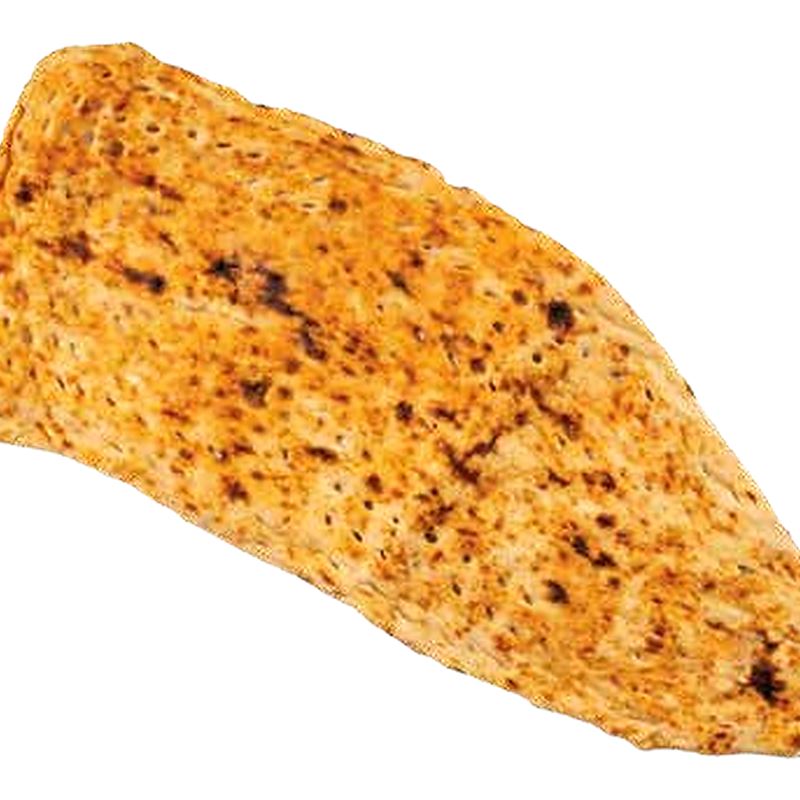
Four breads, four ovens
In Iran a bakery is usually named for the one bread it bakes, because the oven decides the bread. Sangak, barbari, taftoon and lavash start from nearly the same short list — wheat flour, water, salt, leaven — and finish as four different things, because each meets heat in a different way. That difference is not decoration: it sets thickness, crumb openness, and whether a torn piece can carry hot broth without collapsing.
Sangak is baked on stones: the oven floor is a sloping bed of small river pebbles heated until they glow, and a wet, slack whole-wheat sourdough is stretched on a wooden paddle and laid straight onto the gravel. The stones dimple and dry the underside while the top blisters, so the loaf comes out long, uneven and pockmarked.
Barbari is baked on the smooth floor of the oven instead. The baker brushes it with roomal, a cooked flour-and-water glaze that gives barbari its glossy gold crust, then scores the deep lengthwise grooves with the fingers. It comes out thick, long and soft.
Taftoon sits between them: a round sheet, thinner than barbari, slapped against the hot wall or floor of a tanoor, pale and pliable with small blisters.
Lavash is the thinnest of the four, rolled to paper and cooked in seconds against a tanoor wall or over a convex griddle called a saj. It comes off soft, then dries brittle as it cools.
The four side by side
| Bread | Baked on | Thickness | In broth |
|---|---|---|---|
| Sangak | Bed of hot pebbles | Uneven, roughly 5-10 mm | Soaks and keeps its shape |
| Barbari | Oven floor | Roughly 15-20 mm | Drinks fast, turns pillowy |
| Taftoon | Oven wall or floor | Roughly 3-5 mm | Holds a short dip, then softens |
| Lavash | Griddle or oven wall | Roughly 1-2 mm | Goes limp almost at once |
Why sangak is the bread for kalle pache
Kalle pache is lamb head and trotters simmered about fourteen hours, and the broth from that pot is hot, gelatinous and rich with fat. Traditionally it is a dawn dish, and the bread in front of it is structural, not decorative: spoon, plate and thickener at once. The classic move is tilit — bread torn into the bowl and broth ladled over it. If the dish is new to you, start with what kalle pache is.
Three things put sangak in that seat. The stones come first: the pebble bed dries the underside into a firm skin while the top stays open, so a torn piece has one face that resists and one that drinks. Then the crumb — whole wheat and a slow sourdough build a coarse, irregular network with real chew, and the bran gives it a backbone fine white crumb lacks. Last, the taste: the mild sourness of the leaven works against fat.
Drop lavash in the same bowl and it vanishes; a paper sheet in hot fat becomes a slick film in seconds. Barbari behaves differently: thick and soft, it drinks broth quickly and goes pillowy, pleasant for a short dip, poor for tilit, where bread must sit in liquid and still come up whole on the spoon. Taftoon manages a dip, then softens. Of the four, sangak is the one built to stand in broth.
What the other three are for
The others are not lesser breads, just built for other jobs. Barbari is a breakfast bread, split warm and filled with cheese, butter and honey. Taftoon is the everyday table bread, thin enough to fold and sturdy enough for stews. Lavash is a wrapper first — kebab rolled inside it, or a sheet spread with white cheese, walnut and herbs.
Handling sangak at the table
Sangak is torn, never cut. Knock the loaf against the plate first, since a stray pebble sometimes travels home with it. Fold a piece before dipping: one layer wets through faster than two. Our guide to eating kalle pache for the first time covers the rest of the table.
At Shaun the Sheep in Jumeirah, every kalle pache order comes with sangak, torshi, lime, onion and green pepper, for dine-in or delivery across Dubai. The kitchen runs 24/7, and an order can be placed for a future time. The singles and platters are on the menu, delivery is free over AED 300, and the number is 04 321 8882.
