Where the "filter full of toxins" line comes from
One sentence does most of the work in the case against organ meat: organ meats are filters, and a filter is full of what it filtered. It is a tidy sentence. It is also aimed at two organs, the liver and the kidney, that are not part of this dish at all.
Most of the confusion is a labelling problem, not a food problem. English sweeps everything that is not a familiar cut of muscle into one word, offal, and judges the bag at once. Persian cooking has no such category. There is the head, and there are the trotters, and each part carries its own name, its own texture and its own line on the menu.
What is actually on the plate
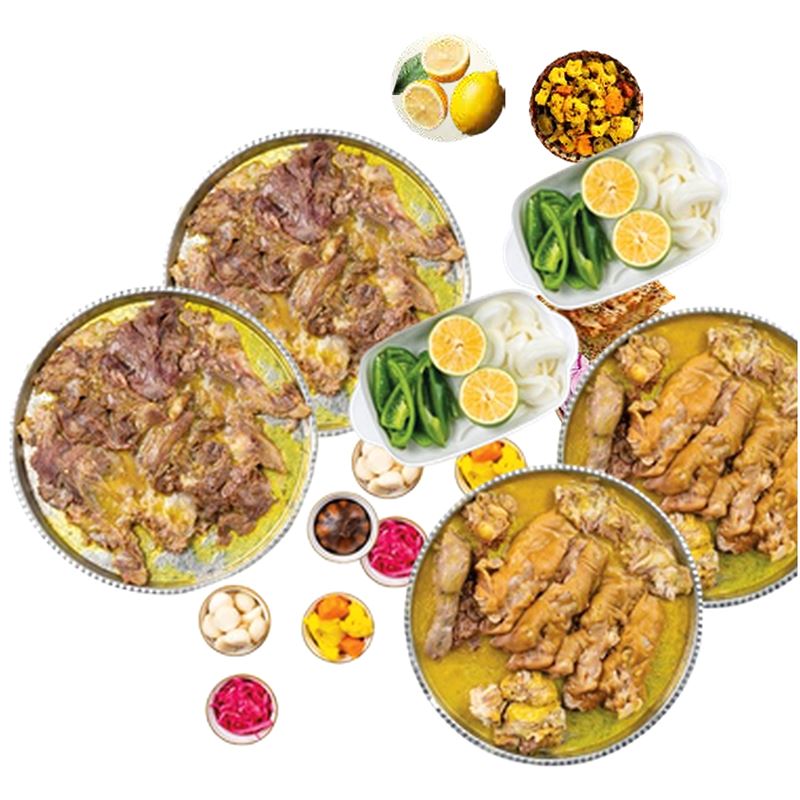
Kalle pache means head and trotters, and that is the whole of it: a lamb's head and its feet, cleaned with care and simmered for about fourteen hours. If the dish is new to you, a plain description of it covers the basics first. Here is what each named part is, anatomically.
| Part | What the tissue is |
|---|---|
| Lamb cheek | Jaw muscle, worked hard, so it needs long heat |
| Tongue | Muscle, outer skin peeled after cooking |
| Meat | Muscle lifted from the rest of the head |
| Trotters | Skin, tendon, cartilage and bone, no organ at all |
| Tripe | Stomach lining, scrubbed and blanched first |
| Brain | Nervous tissue, soft and fatty, gently poached |
| Eye | Small muscles, connective tissue and fluid |
Read that second column again and the argument thins out. Muscle, skin, tendon, cartilage, stomach lining, nervous tissue: not one of them is a filtering organ.
Liver and kidney are not in this dish
The claim is really about liver and kidney, and neither is served here. Liver in Iranian cooking belongs somewhere else: grilled on a skewer over coals, it is a dish of its own with its own name, jigar. Kidney is not part of kalle pache either.
As for the metaphor, writers who examine it usually make the same general point: these organs mostly act on substances chemically and pass them along rather than storing them like a sponge, with details differing by substance. That discussion has its own place. It does not reach this pot, because the organs it argues about were never in it.
What fourteen hours does
Cleaning is most of the work, and it happens before the heat. The head and feet are scraped and washed repeatedly, then blanched, and the first water is thrown out; as the pot comes up, the foam is skimmed off. Over the hours the tendon and cartilage in the trotters break down into gelatin, which is why the broth thickens as it cools and why the method cannot be rushed. Kalle pache is traditionally eaten at dawn, which is where the long overnight cooking put it. Not every part stays in the pot for the whole simmer, and why each kalle pache part has its own cooking time explains how trotters, brain and tongue are timed separately.
Nutrition, in general terms
Nutrition here can only be general, because the honest answer changes from person to person. Broadly, the muscle cuts, cheek and tongue and meat, behave like any other slow-cooked lamb. Brain is a soft, fatty tissue, closer to cream than meat in texture. Sangak, torshi, lime, raw onion and green pepper come alongside; the sour and sharp elements are tradition, not a nutritional prescription.
None of this is health advice, and nothing here treats or prevents anything. If you have a condition, a medication, a pregnancy, or dietary guidance already given to you, whether a particular part suits you is a question for your doctor, who knows your history. If pregnancy is the reason you are asking, kalle pache during pregnancy goes through the same liver-versus-head distinction and the gentler parts of the platter, as culinary information only.
Ordering it in Dubai
We cook kalle pache in Jumeirah, around the clock, for dine-in and delivery across Dubai. The parts are sold singly, eye, brain, meat, tongue, trotters, tripe, lamb cheek, brain soup, soup and the special mix known as mojoon, and the guide to the singles explains what each one is like. Shared platters run from the Single Dish for one person up to The Khan's Platter, which is portioned for six, so one order covers a table of six. Payment on the website is card prepay only, there is no cash on delivery, and delivery is free over AED 300. An order can be placed for a later hour if your gathering has a set time. Phone 04 321 8882.
