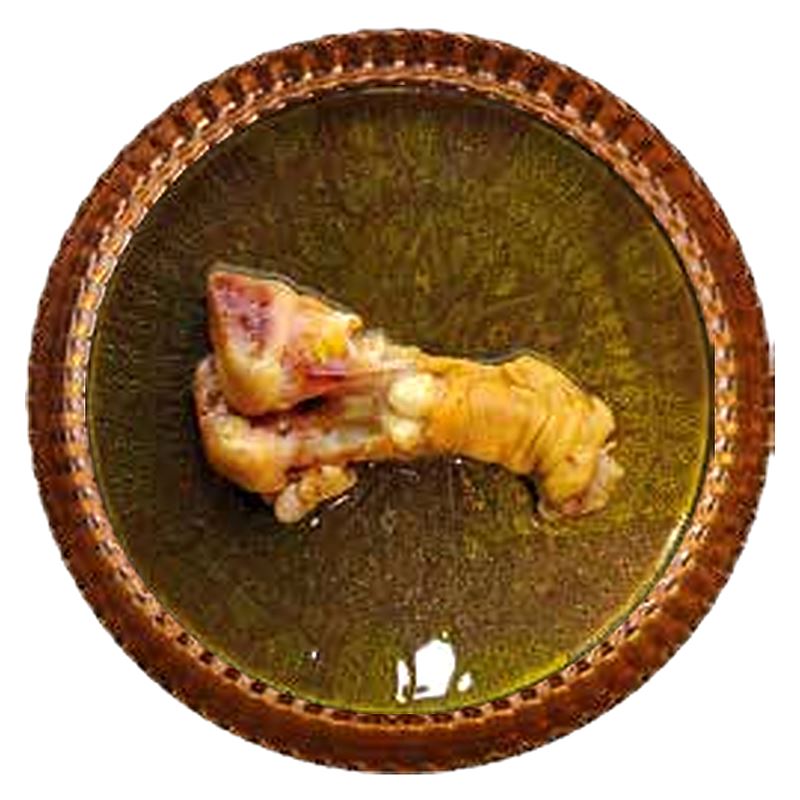
Why is kalle pache linked to collagen, skin and joints?
If you have spent any time reading about bone broth online, you will have seen the promises: glowing skin, healthier joints, stronger nails. Kalle pache, the Tehran-style broth of slow-cooked lamb head and trotters, gets swept into the same conversation, because it is one of the most collagen-heavy dishes in Persian cooking. At Shaun the Sheep in Jumeirah we simmer it the traditional way — hand-cleaned before dawn, about fourteen hours in a copper pot with onion, turmeric and garlic — and the result is a broth thick with gelatin. This article takes an honest look at where that reputation comes from, and where the science actually stands. The short version: it is a wonderful, nourishing food with deep cultural roots, but it is not a skincare product or a joint treatment, and we will not pretend otherwise.
What happens to the bones and trotters during the long simmer?
The trotters (paye), bones and connective tissue in kalle pache are rich in collagen, the main structural protein in animal cartilage, skin and tendons. When you cook them low and slow for many hours, that collagen slowly breaks down into gelatin — the same substance that makes a good broth turn silky on the spoon and set to a soft jelly when it cools in the fridge. That transformation is real and you can see it with your own eyes. It is exactly why trotter-based dishes around the world, from Persian paye to Korean seolleongtang, share that unmistakable body. So the first part of the popular story is true: kalle pache genuinely is a gelatin-rich, collagen-derived broth.
Why do people connect collagen with skin and joints?
The link makes intuitive sense. Collagen is the scaffolding of your skin and the cushioning in your joints, so the reasoning goes: eat collagen, replace what you are losing. It is an appealing idea, and the marketing for collagen powders, cartons of bone broth and beauty drinks leans on it heavily. Persian food culture has its own version of this thinking too — kalle pache has been prized for generations as a fortifying, restorative meal, the kind of thing you eat before a hard day or while getting your strength back. That reputation is centuries old and worth respecting as tradition. But tradition and marketing are not the same thing as proof.
Does eating collagen broth actually reach your skin and joints?
Here is the honest part. When you eat collagen or gelatin, your body does not ship it, intact, up to your face or your knees. Your digestion breaks it down into amino acids and small peptides, which are absorbed and then used wherever your body decides — and that is not something a bowl of soup gets to direct. There is some research on concentrated, purified collagen peptide supplements suggesting possible effects on skin or joint comfort, but that evidence is limited, mixed, often funded by supplement companies, and based on standardised doses — not on a traditional broth whose collagen content varies from pot to pot. In plain terms: there is no good evidence that eating kalle pache improves your skin or your joints. Enjoy it because it is delicious and comforting, not because it is a treatment.
How does bone broth compare with collagen supplements?
People often ask whether a bowl of real broth is as good as a scoop of collagen powder. They are simply different things, and the honest comparison looks like this:
| The claim | Where it comes from | Honest status |
|---|---|---|
| Better skin / a glow | Collagen is a skin protein; supplement marketing | No good evidence food broth does this; digestion breaks collagen into amino acids |
| Healthier joints | Cartilage is collagen; some supplement studies | Limited, mixed evidence for concentrated supplements; none specific to kalle pache |
| A warming, restorative meal | Centuries of Persian tradition | A genuine cultural belief and real comfort — best understood as tradition, not medicine |
| Real, minimally processed food | Whole lamb cuts simmered with aromatics | Fair to say — it is a whole-food, home-style dish, and that is the honest selling point |
What about the Persian idea of "warm" and "cold" food?
In Iranian food culture, kalle pache is considered a "warm" (garmi) food, thought to build strength and to suit cold mornings. This is a traditional cultural framework, passed down through families, not a scientific classification — and we share it here as part of the dish's heritage, not as a health claim. It is one of the lovely things about Persian eating: food carries meaning and memory. You can honour that tradition and still keep a clear head about what a meal can and cannot do.
So how should you think about kalle pache?
Think of it as what it is: a rich, warming, protein-forward comfort food with real cultural weight and a genuinely gelatinous, collagen-derived broth — full stop. It is not medical or cosmetic advice, it will not cure or treat anything, and if you have specific concerns about your skin, joints or diet, the person to ask is a qualified doctor or dietitian, not a menu. With that settled, the best reason to order kalle pache is the oldest one: it tastes wonderful. We are one kitchen at 64 Jumeira Street in Jumeirah 1, open twenty-four hours a day, delivering to every part of Dubai, with free delivery over AED 300 and secure online card payment. Browse the menu and order page to pick your cuts, or reserve a table if you would rather eat it fresh at the source.
