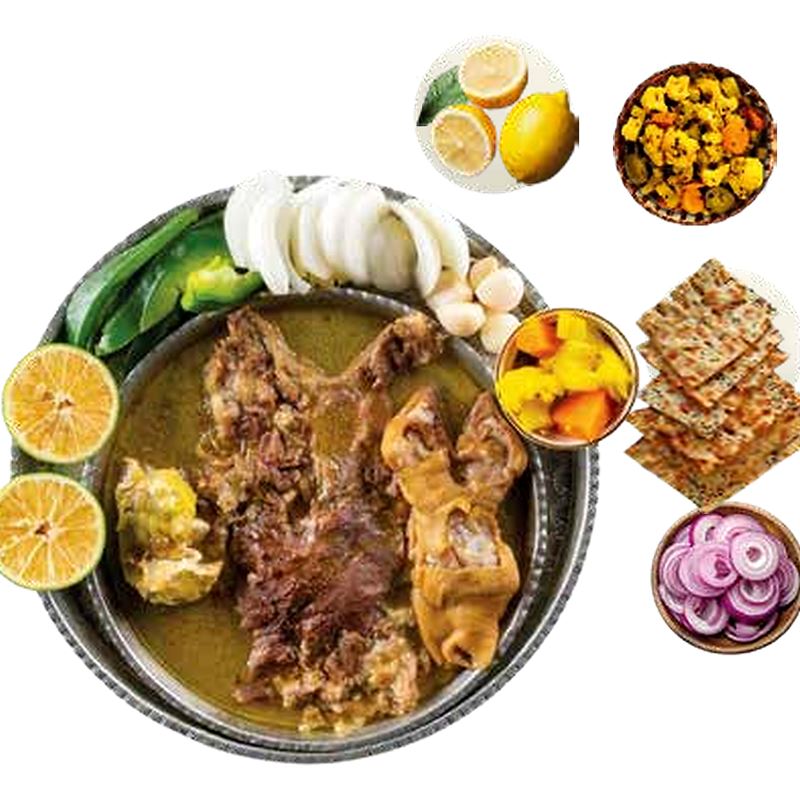
It is ten at night on Jumeira Street, you want kalle pache, and one small question is in the way: can you just walk in, or were you supposed to arrange something first? You can walk in, and most people do. The longer answer is worth two minutes, because a few situations are easier with one phone call first.
Can you simply walk in, or does the table have to be arranged in advance?
You can walk in. There is no list you need to be on and nobody at the door asking whether you called. Turning up unannounced is not the exception here. It is how the room fills.
A lot of that comes from the dish itself. Kalle pache is not an occasion meal you plan an evening around. It is a bowl you want when you want it: before a long day starts, after a shift ends, or because somebody mentioned it an hour ago. A kitchen that runs 24 hours has to take people who arrive unannounced, because most do. You can arrange a table if you would rather, but it is a convenience for particular situations rather than a condition of getting in.
What happens in the first minute after you come through the door?
Less ceremony than you may be bracing for. You come in, you are greeted, you sit down. The order is taken at the table rather than at a counter, so nothing has to be decided in the doorway with your keys still in your hand.
The most useful thing you can say in that first minute, if the dish is new to you, is that the dish is new to you. Instead of pointing at a name and hoping, you get asked what actually decides it: how hungry you are, whether you want it rich or light, and whether you are sharing. Every part eats differently, and the gap between an easy first bowl and an overwhelming one is usually just which part you got. Our first-timer’s guide walks through the table, and the ordering vocabulary is written out in Arabic and Farsi too.
Does walking in as two people work differently from walking in as a group of six?
It does, for a plain reason. A table for two is nearly always findable. A table for six is a different request: a room can have eight seats free and still not have six of them together.
So two of you, at any hour, walk in and think no more about it. Three or four, much the same. From about five or six upwards, a call before you set off costs nothing and saves you the evening where half the group sits at one table and half at another.
What you order shifts with the numbers too. Two people do well with a double dish. A bigger table is better served by a platter in the middle, the three-person or the six-person, with sangak torn and passed around and torshi on the side. Eating as a group goes through how that is put together.
What if every table is taken when you arrive, and is a walk-in ever turned away?
Nobody is turned away for not having booked. The only real limit is physical: how many seats are free the moment you come through the door. If the room is full, you have three sensible moves.
- Wait a little. Kalle pache is eaten while it is hot, not sat over for three hours, so tables here move rather than settle in for the night.
- Take it with you. Pickup turns a full room into a non-problem.
- Come back later. The kitchen does not close, and an hour later is a different room.
Is walking in at 2am or 4am as normal as walking in at 9pm?
Completely normal, and for this dish arguably more so. Kalle pache has traditionally been a dawn food, eaten before the day begins rather than at the end of it, which is a habit with real reasons behind it. Plenty of people walk in when most kitchens in the city are dark, and those hours are the easiest for a walk-in: fewer people, more free tables.
So if you have come off a night shift, or your body clock has you awake at four in the morning, this is not an odd time to eat. It is the traditional one. We have written separately about the small hours and night-shift eating.
When is it genuinely worth phoning ahead instead of just turning up?
Rarely, but not never. The number is 04 321 8882, and these are the cases where it earns its thirty seconds.
| Who is turning up | Just walk in? | Worth doing first |
|---|---|---|
| Two of you, no fixed schedule | Yes, at any hour | Nothing at all |
| Six or more together | Better to call | Say how many you are and roughly when |
| You want one specific part, such as brain or tongue | Yes, but ask when you call | Specific parts can run out on a busy night |
| Eating against a fixed hour, a flight or a shift | Order ahead instead | An order can be placed now for a time you choose |
The point about parts surprises people most. One head carries only one brain and one tongue, so a busy night can exhaust those while there is plenty of everything else, and how many portions come out of one head has the arithmetic. If what is fixed is the hour rather than the table, an order can be placed now for a time you choose, which is what pre-ordering is for.
What is the quickest thing to order if you have walked in hungry and undecided?
Do not read the whole menu standing up. Pick one of these and let the table do the rest.
| If you want | Order | Why it works when you cannot decide |
|---|---|---|
| The lightest possible start | Soup | Warm broth, and nothing to decide |
| Something familiar in texture | Tongue or meat | Sliceable, mild, closest to lamb you know |
| The full experience in one go | Single dish | A bit of everything, portioned for one |
| The richest thing on the table | Brain | Soft and delicate, what many regulars come for |
| To bring someone who will not eat offal | Deezi | A lamb and chickpea stew, no head or trotters |
Whatever lands in front of you, add sangak, torshi and a doogh: that is the dish as it is actually eaten. Which single to order compares the parts one by one.
We are at 64 Jumeira Street, Jumeirah 1, open 24 hours a day, seven days a week, and the lamb is halal. Walk in, sit down, and say it is your first time. The menu is there to read first, and delivery reaches addresses across Dubai if you would rather not move.
