You do not have to order in English. Every step of ordering from Shaun the Sheep — the menu, the checkout, and the order page you follow afterwards — works in English, Arabic and Farsi, and a language switcher at the top of the site moves you between the three whenever you want.
The site opens in English. One tap on the switcher changes that, and the device you are using remembers your choice, so next time the menu is already in the language you read most easily. Nothing to install, no account to create, no setting buried inside a profile: the switcher is the whole mechanism.
What actually changes when I switch language?
Everything you read. Dish names, descriptions, buttons, the checkout fields, the confirmation, and the order page you watch after the kitchen accepts your order. Pick Arabic and the platters are described to you in Arabic. Pick Farsi and the singles carry the names you would use at home — on the button, in the cart, and on the page you follow afterwards.
What does not change: the food, the menu, what the kitchen has ready right now, the delivery areas, or what anything costs. Language is a lens on the same kitchen at 64 Jumeira Street in Jumeirah 1 — not a different shop with a different list.
Why does language matter more for kalle pache than for most food?
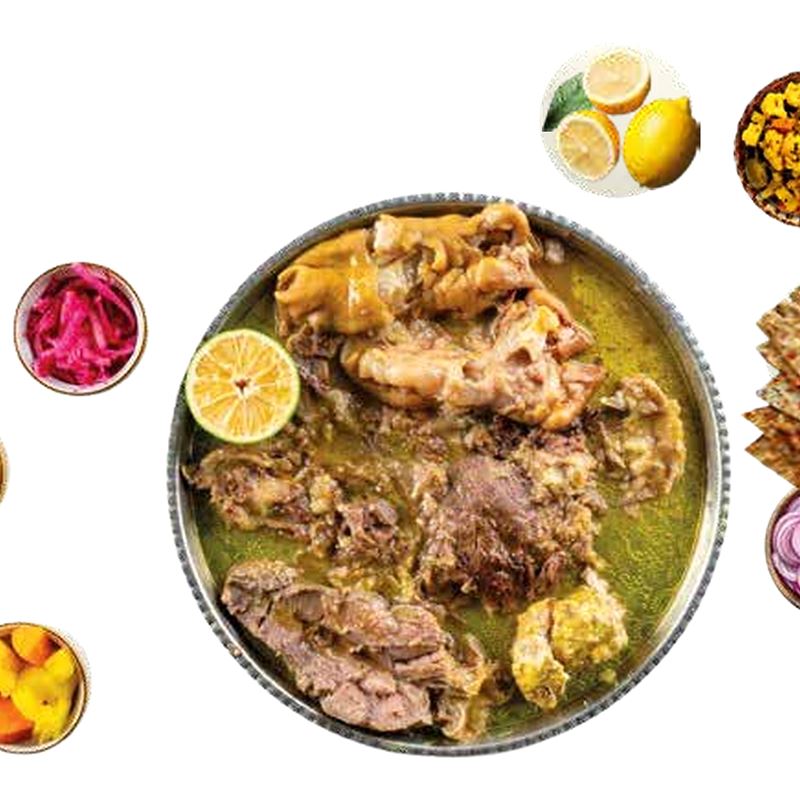
Because the parts of this dish have names people learned in Persian and Arabic long before they ever met them in English. Lamb Cheek is an accurate translation of بناگوش, but nobody who grew up on this food thinks lamb cheek. They think bonagoosh, and that one word already carries the texture, the fat, the way it gives up at the first push of a spoon. The same is true of pacheh for the trotters, maghz for the brain and zaban for the tongue — and of الكوارع, المخ and اللسان on the Arabic side.
An English-only menu asks you to translate backwards before you can decide, and that half-second of translation is exactly where the wrong order happens. Somebody skips the single they actually came for because the English word rang no bell, or ticks something they were never sure about. Seeing سیرابی — or الكرشة — printed on the button removes the guesswork completely. You stop interpreting a menu and start recognising food you already know.
It helps even more when you are ordering for other people. If you read in Farsi and the person beside you reads Arabic, hand over the phone and switch: they read the same menu, in their language, before anyone pays. New to the dish itself? Start with what it actually is, then come back.
What is each part called in Persian and Arabic?
The site shows one of these names at a time — whichever language you chose. The table below is for the moments you want all three side by side.
| On the menu (English) | Persian speakers say | Arabic speakers say |
|---|---|---|
| Soup (the abgoosht broth) | آبگوشت | الشوربة / المرق |
| Trotters | پاچه (pacheh) | الكوارع |
| Brain | مغز (maghz) | المخ |
| Brain Soup | سوپ مغز | شوربة المخ |
| Tongue | زبان (zaban) | اللسان |
| Lamb Cheek | بناگوش (bonagoosh) | خد الخروف |
| Eye | چشم (cheshm) | العين |
| Meat | گوشت (goosht) | اللحم |
| Tripe | سیرابی (sirabi) | الكرشة |
| Special Mix | معجون (mojoon) | الخليط الخاص |
| Sangak Bread | نان سنگک | خبز سنكك |
| Doogh | دوغ | الدوغ (لبن مملح) |
| Mixed Torshi | ترشی مخلوط | المخلل المشكل |
The extras follow the same rule. Capsicum, onion, fresh chili, pickled green chili and extra sangak are a separate row you tick alongside your dish — they are not added automatically — and they are labelled in the language you picked, so you never add a mystery item. If you are torn between the singles, the guide to choosing one goes through them bowl by bowl.
And the platters — do those names travel?
They do, because they are mostly arithmetic. Single Dish is one, Double Dish is two, The Full Dish is three. The Khan's Platter is the big one: four lamb cheeks, eight trotters, two brains, three tongues, four eyes and five breads — a table's worth of food rather than a person's. Those quantities read identically in all three languages, and the parts inside them carry the names in the table above, so you know exactly what is coming before you pay. If you are weighing the big platter against a handful of singles, there is a full walk-through of it.
Bread and drinks are worth a glance in your own language too. Sangak, Special Sangak, mixed torshi and garlic torshi sit together on the menu; doogh, fresh lemonade, tea, black tea, water and soft drinks all travel. The Kettle of Tea is dine-in only and is not delivered — the kind of detail you notice instantly when you are reading in the language you think in, and skim past when you are not.
Do Arabic and Farsi read right-to-left on the site?
Yes. Both are right-to-left languages and the site lays out accordingly: text aligns to the right, the reading order flips, and the menu, the cart and the checkout mirror with it. It is not an English page wearing an Arabic coat; the page runs the direction your eye already runs. The phone number and the map you drop your delivery pin on stay exactly as clear as they were.
Are the delivery details harder to fill in in another language?
No — there is less to fill in than most people expect. Checkout asks for your name and your phone number. If you want delivery you also pick your Dubai area from the list and drop a pin on the map, so the rider reaches the right door; both are needed, and a map is a map in any language. Choose pickup or dine-in and neither is required at all — no area, no pin — and if you would rather sit down, a table can be reserved.
Scheduled orders behave the same way: pick a future time, up to about two days ahead, in whichever language you are reading, and the kitchen holds your order for that slot. If you would rather do the whole thing by voice instead, 04 321 8882 is answered at any hour. There is a step-by-step walk-through of the ordering flow if you want to see it laid out.
Does the language I choose change prices or availability?
No. Not one dirham, not one dish. Language changes what you read and nothing else. All of this is identical in all three:
- One kitchen, no branches, open 24 hours a day, delivering across Dubai.
- Delivery, pickup or dine-in, with a table you can reserve if you want to sit down.
- No account and no sign-up — your name and phone number, plus the Dubai area from the list and a pin on the map if you want delivery. More on ordering without an account.
- Free delivery over AED 300.
- Secure online card payment at checkout — that is how orders are paid.
- Scheduled orders: pick a future time, up to about two days ahead.
What about after I pay — is that in my language too?
Yes, and this is the part people are usually most anxious about. Once the card payment goes through, the kitchen confirms your order and sets an estimated time. Your order then has its own page you can keep open and follow, and that page is in the language you chose: the status, the estimate, and any later adjustment to it. When the rider reaches you, they phone you — nothing depends on you reading a screen quickly in a second language.
If the kitchen cannot fulfil an order — it happens; a particular cut can run out at four in the morning — the order is refunded automatically to the card that paid, and the reason appears on your order page in the language you are reading. That matters more than it sounds. A refund you understand is a completely different experience from a refund you have to decode.
What if I would rather just speak to a person?
Then phone. 04 321 8882 is the kitchen's line, it is answered around the clock because the kitchen is open around the clock, and it is the only way to reach us. For some things it is simply the fastest route: asking what is coming off the fire right now, checking a detail before you commit to six people's worth of food, or changing something on an order you have already placed — a change is made by calling the kitchen.
If you need to avoid an ingredient, or you want to know how hot the fresh chili really is, phone and ask before you order rather than guessing in any language. Everything is cooked in one kitchen, so nobody can make you promises about cross-contact. And none of this is medical advice — if you have a genuine allergy or a health question, ask your doctor.
Which language should I choose?
The one you would use to describe this food to a friend. If you learned kalle pache in Persian, read it in Farsi and let the menu sound the way the dish already sounds in your head. If Arabic is your first language, read it in Arabic. If English is your working language and this is new territory, read it in English and keep the table above open — those are the words the rest of the table will be using anyway.
You can change your mind at any point; the switcher is on every page. Start from the homepage, set the language before you browse, and order in the words you actually think in. Or pick up the phone: 04 321 8882, any hour of any day.
