Start with the count, not the craving
Kalle pache is one of the few dishes where anatomy writes the menu. A lamb has one brain and one tongue, two eyes and two cheeks, and four trotters. But the meat that falls off a head after around fourteen hours in the pot is not countable: it is a soft mass that divides into as many portions as the table needs. See that difference and ordering for a group stops being guesswork.
No kitchen invented this - it is the animal's anatomy. A cook can put more heads in the pot, but nobody finds a second brain inside the first. Planning a table means counting two ways at once: one for the parts that come in ones and twos, another for the parts that stretch over however many sit down. If the dish is new to you, start with what kalle pache is.
What one head yields
This is the whole count, as a cook holds it.
| Part | Per head | How it behaves |
|---|---|---|
| Brain | One | One soft portion; halving it costs its shape |
| Tongue | One | Sliced across, so two can share one tongue |
| Eye | Two | A pair: two guests, not four |
| Cheek | Two | A pair of dense, hard-working muscles |
| Head meat | Not counted | Weighed, not counted; divides as finely as you like |
| Trotters | Four per animal | Countable, but enough to go round a table |
| Tripe | Its own count | From the stomach, not the head: a separate count |
Three menu items sit on top of that count. Plain soup is broth, and broth grows with the pot: the easiest thing to order for a crowd. Brain soup carries a brain inside it, so it counts as a single. The special mix, mojoon, brings several parts together at once, for anyone who wants a taste of everything.
Decide who actually wants the brain
Brain is the part people feel strongly about, in both directions: some came for nothing else, some will not touch it. With one per head, that split matters more than any other. Two brain-lovers among six is an easy table; six is a different order, and better known while you are deciding than after the tray arrives.
The pairs work the same way, more gently: eyes come two to a head, and so do cheeks, so they land on two people, not four. Go round the table once with three questions - brain, eye, tongue - and the hard part is settled. Our guide to which single to order helps guests who do not yet know what they like.
Let a platter carry the rest
Everything else behaves like a quantity, not a number - which is what platters are for. The Single Dish is built for one person, the Double Dish for two, The Full Dish for three, and The Khan's Platter for six; a platter is sized around the parts that divide well.
So build a table in two moves: pick the platter that matches the number of people, then add the scarce singles by name for whoever asked. One brain beside a Full Dish for three is a normal, balanced order; so is a Khan's Platter with two eyes and a tongue. See how singles and platters sit side by side on the menu. For a late table in the last ten nights of Ramadan, the same two moves apply: size the platter while you are still thinking clearly, and fix the hour in advance.
When several people want the same part, set a time
Here the arithmetic becomes a planning tool. If three people at one table all want brain, the request is three heads deep, and the kitchen is better off knowing the day before. Pre-orders for a set future time exist for this: you name the parts and the hour, and the kitchen works backwards from it. The kitchen runs around the clock, every day, so your hour can be dawn before work, a Friday mid-morning, or late at night - which also suits a birthday or a family gathering. Match nights are the clearest case: kalle pache for match night sets that pre-order to the final whistle and sizes a platter for a full room.
Putting the order together
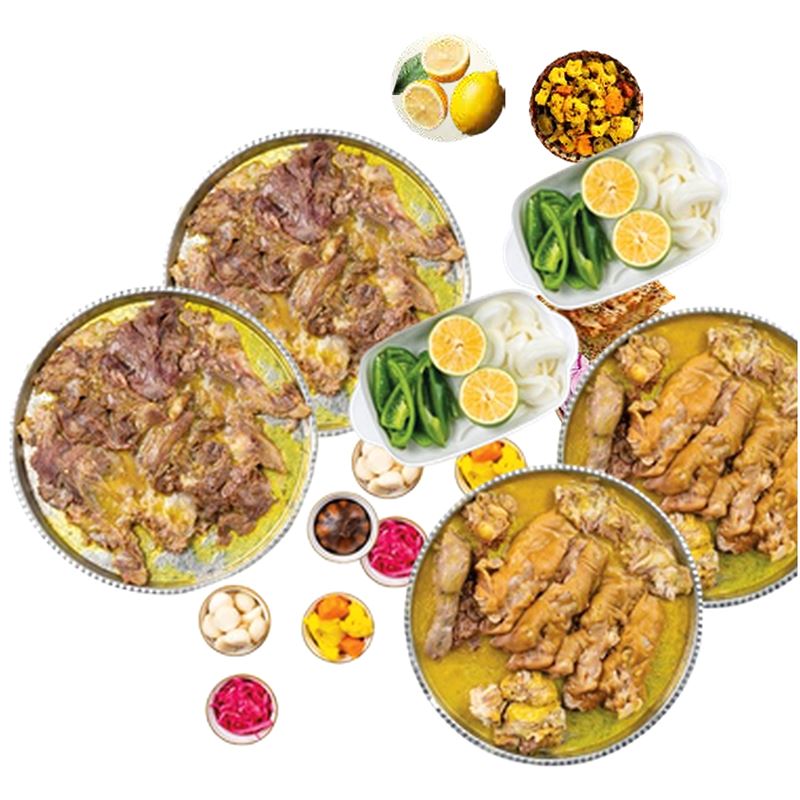
Kalle pache arrives with sangak, torshi, lime, onion and green pepper; they come with the food, not per person, so they never enter the arithmetic. In Jumeirah or delivered across Dubai, the plan is the same: a platter for the numbers, singles for the names, a set time if one single is stacking up. Ordering on the website is paid by card in advance, and delivery is free over AED 300. If you would rather talk it through, call 04 321 8882. For how it travels, see our notes on kalle pache delivery in Dubai.
