The clock arithmetic comes first
Dubai runs on UTC+4 and never shifts its clocks. Almost every country the big fixtures come from does shift, so the gap is not a fixed number: it moves twice a year. Check it the week of the match rather than trusting last season.
The sums, roughly, in the European summer. London is three hours behind Dubai: a kick-off at eight there begins at eleven here, and the final whistle falls a little before one in the morning. In winter London is four hours behind and the same fixture ends closer to two. Central Europe starting at nine in the evening is eleven here. The Americas are further out again: eight in the evening on the United States east coast is four in the morning in Dubai, and half past nine in Buenos Aires is half past four here. From kick-off to final whistle a football match takes about two hours once half-time and stoppages are counted, and roughly half an hour more if it runs to extra time and penalties.
None of that is really about football. The point is that the hour you will be hungry can be worked out days in advance, and it lands in the small hours, when many kitchens in the city are shut.
A pot that went on the fire long before
Kalle pache cannot be started when the hunger arrives. Lamb head and trotters go into water and simmer for something like fourteen hours: long enough for the collagen in the trotters to break down and leave the broth thick and faintly sticky on the lip, long enough for cheek and tongue to come off the bone under a spoon. That is why it has always been a dawn dish in Iran — the pot goes on at night and is ready as the city wakes. The way it is made sets out the stages properly.
So the clock works twice in your favour. The dish belongs to the hour a late match ends, and the kitchen here is open around the clock in any case, dine-in and delivery both, three in the morning included.
Setting the order for a fixed hour
A match hands you the one thing a pre-order needs: a known end. Pre-orders for a future time are supported, so you can name the hour — the final whistle, or half an hour after it if you would rather not eat the moment it ends — and the kitchen works to that hour rather than to whenever the order came in.
Work it out in this order: take the kick-off in Dubai time, add two hours for the match, add extra time if the fixture can go that way, then set the result as your hour. A pot that has simmered fourteen hours is untroubled by a half-hour margin.
Two practical notes for a night order. Payment on the website is by card in advance — there is no cash on delivery, so nothing is settled at the door at three in the morning. And delivery is free over AED 300.
Platter arithmetic for a room
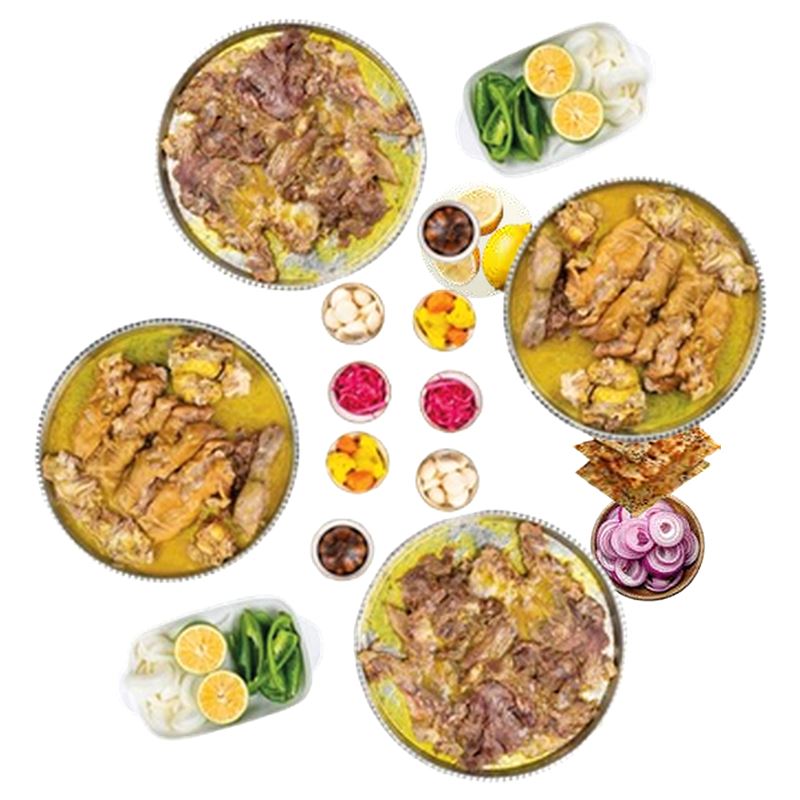
The platters are sized by head count rather than by weight, which makes a room easy to solve. Single Dish feeds one, Double Dish feeds two, The Full Dish feeds three, The Khan's Platter feeds six. Six people in a room is therefore one order — one hour to name, one delivery, one payment — instead of six separate ones.
Any other number is only addition. Four: The Full Dish and a Single Dish, or two Double Dishes. Five: The Full Dish and a Double Dish. Seven or eight: The Khan's Platter with a Single or a Double alongside. If someone at the table wants one particular cut rather than a share of everything, the singles cover it — eye, brain, meat, tongue, trotters, tripe, lamb cheek, brain soup, plain soup, and the special mix known as mojoon. A guide to the singles goes cut by cut.
Laying it out at that hour
What comes alongside is as much the meal as the meat: sangak bread, torshi, fresh lime, raw onion and green pepper. Broth is hottest at the table, because it cools on the way; if it is coming to the house, keep the lid on until the bread is torn and the plates are down, then pour. Lime goes in at the last moment, since the sharpness fades as it sits in hot broth.
The whole menu is there to read through before you set the hour, and delivery across Dubai covers how night orders travel. For a table rather than a delivery, dine-in runs at that hour too, and the phone is 04 321 8882.
