Why the kitchen goes quiet
When an Iranian family in Dubai loses someone, the house does not close. It opens. Within hours the door is on the latch, chairs come from the neighbours, and people arrive: relatives, then friends, then colleagues and acquaintances who heard by telephone. It goes on for days and keeps no timetable. Someone comes at ten in the morning; someone else lands from Tehran and comes from the airport before dawn.
The custom that matters most to anyone trying to help: the bereaved household does not cook. Nobody forbids it, but the family is not expected to stand over a pot while the room fills. Feeding the house belongs to everyone else — a sister-in-law, a neighbour, a cousin who quietly takes the kitchen as his job.
Sevom, haftom and chehelom
Three gatherings mark the calendar under the daily coming and going. The sevom is the third day, traditionally the largest, with the widest circle attending. The haftom is the seventh. The chehelom is the fortieth, and a year after the death comes the first anniversary, the saal. Each falls at a fixed hour on a fixed date, often at a mosque or hall and continued at the house, or at the house from the start.
The difference is practical. The days in between need something that sits warm and is served to whoever walks in. The sevom, haftom and chehelom need food that has arrived before a known hour, for a known room.
Tea, dates, halva, and something warm underneath
The circulating tray is the constant: tea poured all day, dates, and halva — the dark saffron-and-rosewater flour halva tied in Iran to mourning more than to any other occasion.
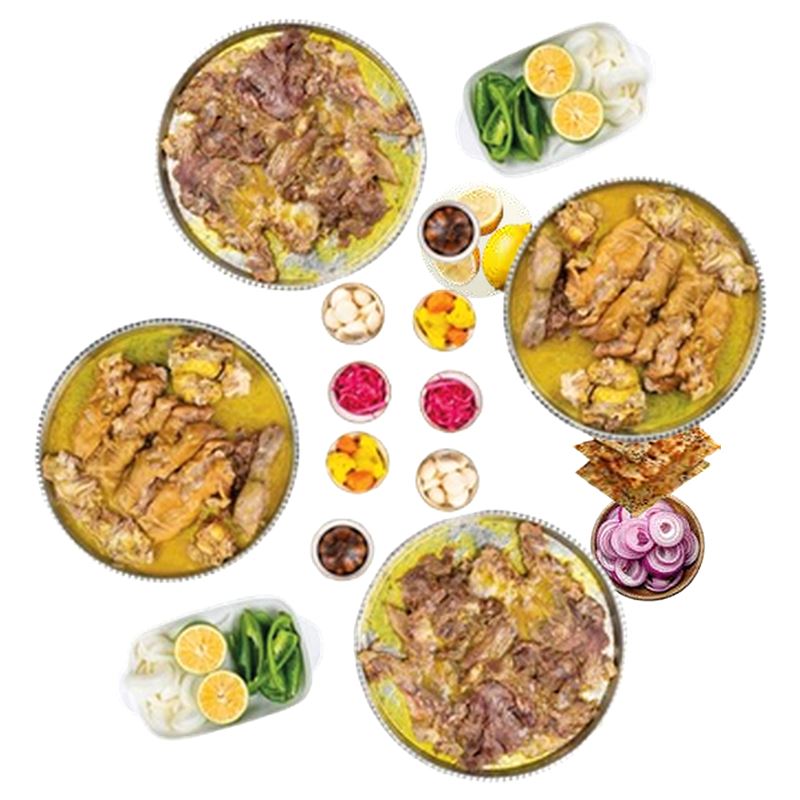
Underneath the tray there has to be real food, usually warm and long-simmered rather than assembled at the table. Broth-based dishes suit this: they hold, they reheat, they ask nothing of the person eating. Kalle pache sits in that family — lamb head and trotters simmered about fourteen hours until the broth thickens on its own, served with sangak bread, torshi, lime, raw onion and green pepper. Tradition puts it at dawn, the hour a mourning house is quietest and somebody finally sits down. If the dish is unfamiliar, what kalle pache actually is is worth reading before you order for others.
Ordering for a house where people arrive at all hours
We are open twenty-four hours a day, every day, which is what matters: a two-in-the-morning arrival is not a problem to feed. Food goes out across Dubai — how delivery across Dubai works is set out separately — and it can be eaten in at our place in Jumeirah if the family wants an hour out.
For the sevom, haftom or chehelom, order in advance for a set time rather than on the day and hoping. Orders can be placed for a future hour, so the food is fixed to the gathering rather than to the moment you remembered it.
Sizing for a room that keeps refilling
Do not size for the people you can see; a mourning house has a rolling population, not a fixed one. Our platters stack: the Single Dish feeds one, the Double Dish two, the Full Dish three, the Khan's Platter six. For a gathering, count Khan's Platters against the room and add one. For the ordinary days between, two smaller platters spread across the day beat one large order going cold on a side table.
You can also order by the part rather than the platter: eye, brain, meat, tongue, trotters, tripe, lamb cheek, brain soup, plain soup, or the special mix called mojoon. Soup alongside a platter is a lighter option to have on the table. The full menu guide sets out what each part is.
Sending it to the family's own door
Order to the family's own address. You do not have to be there, hand anything over, or be dealt with at the door beyond someone taking the bags in. Payment on the website is by card, prepaid; there is no cash on delivery, so nothing is ever collected from the family. Delivery is free over AED 300.
To arrange it by voice — the address, the hour, which door to use — call 04 321 8882. Otherwise the menu is there and the order can be placed without adding another call to a house that is on the phone all day.
