The Persian pantry that kalle pache walks past
Persian cooking travels abroad on its perfumes: saffron bloomed in a spoonful of hot water and poured over rice, rosewater in the sweets, barberries scattered red over a mound of white rice, dried limes knocking about in a pot of ghormeh sabzi. Set that pantry beside what actually goes into kalle pache and it can look as though something has been left off the list. Nothing has. Kalle pache belongs to an older, plainer branch of the same cuisine, a water-and-lamb tradition that is seasoned at the table rather than perfumed in the pot.
Water, lamb, and about fourteen hours
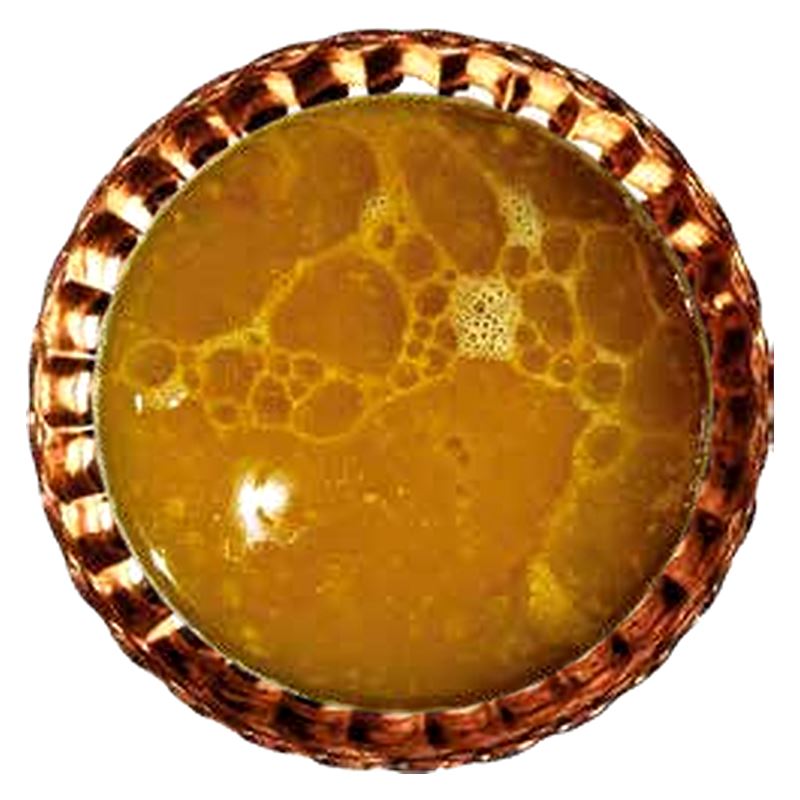
The method is almost embarrassing to write down. Lamb head and trotters, cleaned and scrubbed with attention, covered with water, and held at a bare tremble for around fourteen hours. An onion. A little turmeric. Salt, added late. That is close to the whole of it, and how the pot is run matters far more than anything you could add to it.
The long simmer is the seasoning. Head and trotters are mostly skin, sinew, cartilage and bone, connective tissue that is rubbery at four hours and soft at fourteen. Collagen turns to gelatin, so the broth thickens without flour or cream. Bone and slow-cooked meat release savoury compounds on their own, which is why a pot holding almost no spice still tastes deeply of something. Adding saffron to it would be like spraying perfume on a wood fire.
What the few aromatics are actually doing
Onion, garlic, a pinch of turmeric, sometimes a stick of cinnamon or a bay leaf. These are not flavour in the way saffron is flavour; they are correctives. Head and trotters smell strong if they are handled casually, so the work is front-loaded: a long soak, hard scrubbing, a first boil whose water is thrown away, then fresh water with onion and turmeric. Turmeric at that dose adds almost no aroma; it takes the edge off and warms the colour. Cinnamon, where a cook uses it, is a whisper rather than a statement. The rest is subtraction: foam skimmed off early, fat skimmed later, because a clean broth is the point.
Seasoned at the table, not in the pot
The pot is deliberately under-seasoned, and the finishing is left to the eater. Lime squeezed straight into the bowl cuts the fat. Torshi brings vinegar sharpness. Raw onion and green pepper bring heat and crunch against soft meat. Salt, black pepper and cinnamon sit within reach. Sangak, the long flatbread baked on hot pebbles, is torn and used as both spoon and sponge, and its faint sourness is part of the seasoning too. What the bowl ends up tasting like is therefore partly your own decision, which is not true of a saffron dish.
Why saffron would be wrong, not merely absent
There is a chemical reason and a cultural one. Saffron's aroma sits in volatile compounds that are coaxed out gently: ground with a little sugar, bloomed in hot water or ice, stirred in near the end. Fourteen hours over heat would carry most of that out of the pot, and whatever survived would be flattened under fat and gelatin.
The cultural reason weighs as much. In Iran, saffron belongs to the register of celebration: wedding rice, kabab with rice, sholeh zard. Kalle pache belongs to the register of dawn and of work, an awkward cut made valuable by nothing but time and attention. It is traditionally eaten early in the morning, and it has long carried a reputation as a fortifying meal, which is folklore about the dish rather than a health claim. Perfuming it would file it in the wrong drawer.
Coming to it from the saffron side
Expect savoury and clean rather than fragrant, and let the table do the work: lime first, then torshi, then adjust. The soups are the most legible place to meet the broth on its own; the singles, meaning eye, brain, tongue, trotters, tripe, lamb cheek, meat and the mojoon special mix, let you meet one texture at a time; and the platters, from the Single Dish up to the Khan's Platter for six, put the range on one table. It is all on the menu. We are in Jumeirah, open around the clock for dine-in and delivery across Dubai, with pre-orders if you want it at a set hour; the website takes card payment in advance only, and delivery is free over AED 300.
