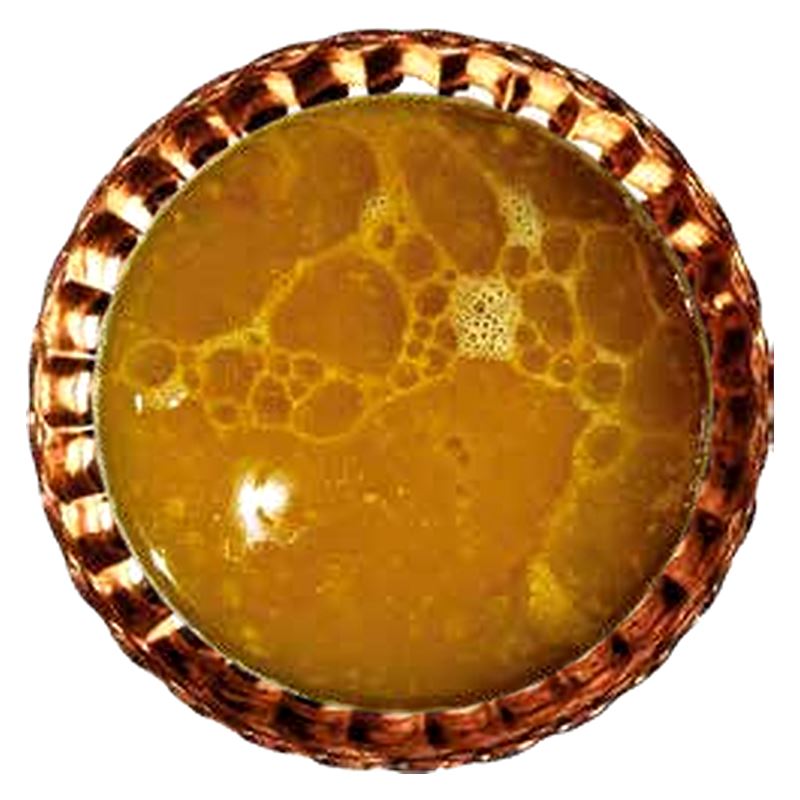
The question the first spoonful raises
A proper spoonful of kalle pache raises an obvious question: if there is barely any spice in here, where is the flavour coming from? It is a fair question in Dubai, where slow-cooked lamb usually arrives loud: deep in a spice blend, reddened with tomato, carrying a line of chilli heat. Kalle pache goes the other way. The pot is close to bare on purpose, and that bareness is the technique. Fourteen hours of lamb head and trotters make the flavour; everything else stays out of the way.
The short list: what goes in
Written down, the seasoning fits on one line. Onion, turmeric, cinnamon, garlic, salt added late.
- Onion, whole or halved, in from the start. It rounds off the sharp mineral edge bone gives up over a long simmer, and leaves a faint sweetness under it.
- Turmeric, a modest spoon, early enough to lose its raw, dusty note. It carries the warm colour and quiets the metallic edge long-cooked marrow can develop.
- Cinnamon, in stick form, and the one that looks out of place. It is not there to taste of cinnamon; at the right amount you should not be able to name it. It stands behind the lamb and stops the broth going flat in the last hours.
- Garlic, whole cloves rather than paste, so it dissolves slowly and never announces itself.
Why the salt goes in late
A pot simmering for around fourteen hours loses a lot of water. Salt it at the start and you season a volume that will not exist by morning: the salt concentrates as the broth reduces, and there is no way back. Texture matters too. Early salt tightens the proteins and slows the gelatin coming out of the trotters and skin, and that gelatin is what gives the broth its weight on the spoon. So the salt waits, then is adjusted once at the end. We walk through how the pot is built elsewhere.
The long list: what never goes in
The exclusions run far longer than the ingredients, and each is a decision, not an oversight.
- Tomato, fresh or paste. Acid and sugar push to the front of the palate, and it clouds a broth that should read like strong tea against the light.
- Chilli heat. Heat is a sensation, not a flavour, and it flattens the differences between cheek, tongue and trotter the dish exists to show.
- Flour, cornflour, cream, any thickener. Body here comes from collagen alone; a thickened broth is a short simmer in disguise.
- Herb and coriander-garlic pastes. Green pastes are opaque in flavour as well as colour, and sit on top of everything.
- Masala blends and curry powder. Excellent on other slow-cooked lamb here; in this pot you get a competent spiced broth and lose kalle pache.
- Saffron and rosewater. Persian, certainly, but they belong to rice, sweets and stews.
- Lime or vinegar in the pot. Acid has a real job here, but the job belongs at the table.
Restraint is the technique
Fourteen hours of head, trotters, marrow and slowly rendered fat make a broad, low, deeply savoury flavour, easy to bury. It does not fight for the front of the mouth the way a spice blend does, so anything loud covers it rather than adds to it. The work is mostly subtraction: skim honestly, hold the heat where the liquid barely trembles, resist the urge to fix a quiet pot by putting something in. There is a longer description of what kalle pache actually tastes like if you have not eaten it.
The seasoning moves to the table
None of this leaves the bowl under-seasoned. The seasoning has moved to where the person eating can judge it. Lime lifts everything at once; raw onion and green pepper give a cold, sharp crunch against warm fat; torshi carries the vinegar edge the pot refused; sangak is a tool as much as bread, torn, dipped, used to lift a piece of cheek or tongue out of the broth. And because every part eats differently, the eye, the brain, the tongue, the cheek, the trotters, the tripe, the meat, seasoning in the kitchen would take a decision that is not the kitchen's. See the parts side by side on the menu, whether you eat in at Jumeirah or have it sent across Dubai.
