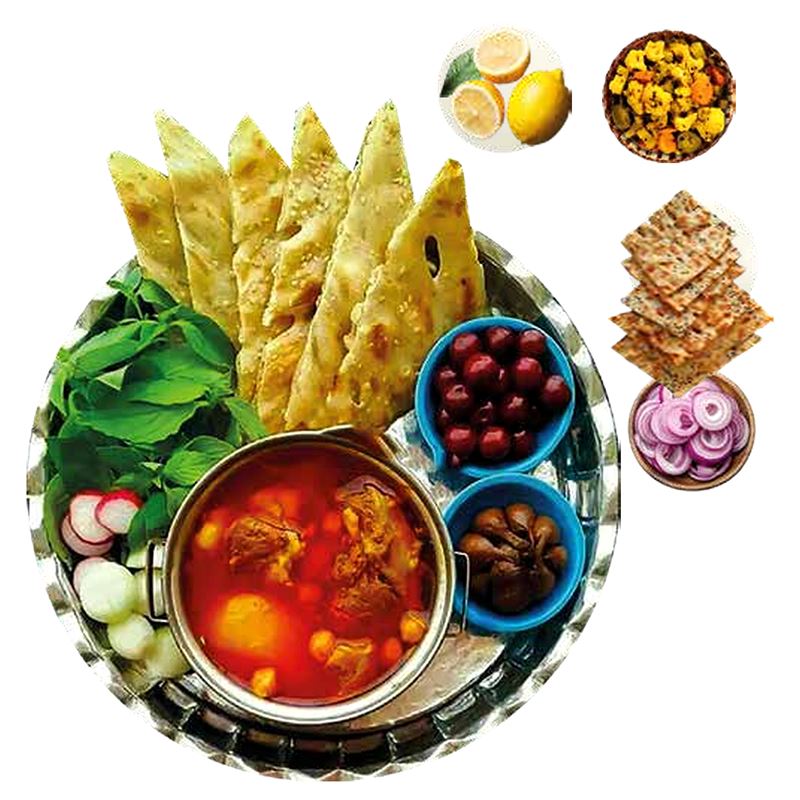
When should you stir a Persian pot, and when should you leave it alone?
Here is the rule our recipes follow constantly and never state: stir what can catch and scorch, and leave alone what you want to keep whole. That one sentence settles almost every contradiction in Persian cooking, where one recipe says keep the spoon moving and the next says do not touch the pot for hours.
Both are right. They are describing different pots. A pot thickened with starch, flour, ground nuts or dairy holds something that will settle on the base and burn there, and the spoon is what keeps it lifted. A pot of soft beans, layered eggplant, poached meatballs or long-cooked trotters has nothing to burn and everything to break, so the spoon is the risk rather than the remedy.
What is stirring actually for?
Four jobs, and it helps to know which one you are doing.
- Moving heat. The base of a pot is hot and the top cooler. A stir evens that out so one part is not racing ahead of the rest.
- Stopping a scorch. Anything heavier than the liquid drifts down and sits. One pass across the base lifts it back into circulation before it sticks.
- Holding things together. Fat and liquid separate when left standing. Warm a set pot of broth and stir, and the fat folds back in — the same movement that carries kashk through a hot ash without it turning grainy.
- Waking a spice in fat. Turmeric tipped into liquid tastes raw and dusty. Stirred into hot oil with the onions for half a minute, until the smell changes, it becomes the backbone of a dish.
None of them is done better by stirring more; each has its moment, and after it the spoon adds nothing.
What does stirring cost you?
Every stir is a small demolition. That is the part cooks forget, because a spoon feels like care.
- Soft pieces break. Split peas mash, beans burst their skins, fried eggplant collapses into the sauce, meatballs shed their edges, and slow-cooked lamb goes from yielding to shredded.
- Starch turns to paste. Rice grains rub against one another and release starch on contact. Stirred rice is gluey rice, every time.
- Layers flatten. A dish built in layers — potato and meat, or rice and sour cherries — is one stir away from being a single muddy thing.
So the question is not whether to stir, but what for, and what it costs in this pot.
How can you tell a pot needs a hand right now?
Sound comes first: a comfortable pot makes a soft, wet blip. A pot in trouble goes quieter and drier, with a faint tick or hiss underneath as something meets the metal and stays there.
Then the surface. A thin liquid moves in visible currents. A thick one stops moving, and instead of a lazy blip you get slow craters opening in the same spot — heat is no longer travelling and the base is taking all of it.
Then smell: there is a toasty stage before the bitter one, and it is a warning rather than a verdict.
The test that settles it: draw a spoon flat across the base once and lift it. Clean spoon, walk away. A film that drags and resists, and you were needed a few minutes ago.
Why do starch and dairy need a hand when broth does not?
Starch is the main offender. Rice in a milk pudding, barley in ash-e jo, lentils in adasi, flour in halva, ground walnuts in fesenjan: as it swells it thickens everything around it, and thick liquid stops circulating. Once circulation stops, the base is heated alone and whatever settled there cooks dry. A thickening pot needs more attention as it goes on, not less.
Dairy is the other. Kashk and yogurt tighten and go grainy where heat reaches them unevenly, so they go in gently and late, and the movement spreads warmth rather than mixes.
Broth is the opposite on both counts. It stays thin, the water moves on its own, and nothing in it is heavy enough to settle. A pot of it can be left to itself for hours and be none the worse.
How much should you stir onions at the start?
Almost every Persian dish opens with sliced onion in fat, and this is where people manage to stir too much and too little at once.
Too little, and the pieces touching the base darken while the ones on top stay pale. Too much, and nothing sits still long enough to colour, so you end up with soft onions and no depth. Leave them for a stretch, move them, leave them again, and judge by colour rather than by the clock.
Listen for the change from a wet sizzle to a drier, softer one: that is water leaving and browning starting. Fried herbs behave the same way, and our ghormeh sabzi recipe rests on that stage entirely, because scorched herbs turn a whole stew acrid.
Does a khoresh need stirring through its middle hours?
Mostly not. Once a khoresh is assembled, with the herbs fried, the meat browned and the beans in, the middle stretch is the leave-it-alone part. Keep the surface at a bare tremble, the lid on, and check the base rather than the surface: one gentle pass every so often tells you everything and does no damage.
Two exceptions are worth memorising. Ground nuts settle and catch, so a walnut sauce wants regular passes for its whole cooking time. Noodles release starch straight into the pot and weld themselves to the base within minutes; our ash reshteh recipe asks you to keep stirring from the moment the reshteh goes in, and that is not fussiness.
Why is a pot of trotters left alone for hours?
Because nothing in it can catch, and everything in it can break.
The pot holds water, lamb head and trotters, an onion and a few aromatics. No flour, no starch, no dairy, nothing heavy enough to settle on the base. Meanwhile the skin, tendon and joints soften the whole time, and by the later hours they are held together by very little. A spoon dragged through them turns distinct pieces into threads — exactly what you do not want on a platter where tongue, cheek and trotter are meant to arrive as themselves.
So the work in a fourteen-hour pot is not stirring. It is skimming what rises early, topping the water up, and holding the surface at a bare tremble rather than a rolling boil so the meat relaxes instead of seizing. Our honest fourteen-hour kalle pache recipe walks through it, and the home troubleshooting guide covers what goes wrong when a pot is hurried.
What if you would rather not stand over a pot at all?
Then don't. Shaun the Sheep is at 64 Jumeira Street, Jumeirah 1 — one kitchen, open 24 hours a day, seven days a week. Order from the menu for delivery across 141 Dubai areas, with your area's fee shown at checkout, or choose pickup or dine-in. You can also schedule an order for a later time, including dawn. Anything else: call 04 321 8882 and ask.
