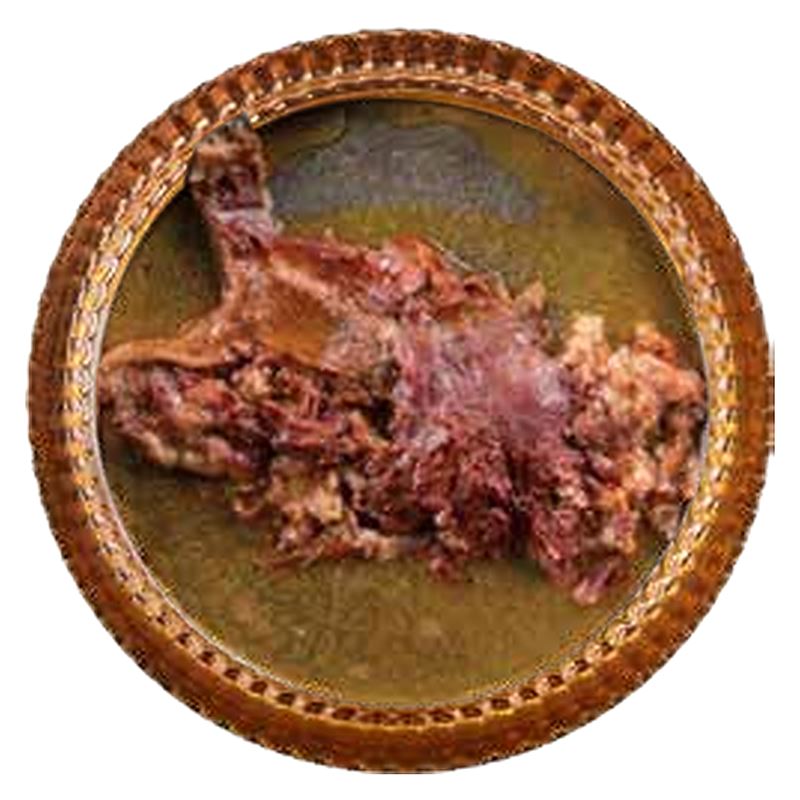
When the menu simply says meat, which part of the animal is that?
It is the plainest word on the menu and the one people ask about last. Brain announces itself. Tongue and trotters explain themselves. But meat sits there looking like the safe option, and almost nobody asks what it actually is.
On a kalle pache platter, meat means head meat — the muscle carved off the skull after the head has simmered long enough to give it up. The bulk of it is cheek and jaw: the broad chewing muscles on either side of the face, plus the smaller ones around the temple and behind the jawline. Persian gives the cheek its own name, bonagoosh — prized enough that we write about it separately — while plain goosht is the mixed head meat as it comes.
Because these muscles wrap around bone, head meat never comes off as neat steaks. It arrives in irregular pieces, and no two heads yield the same set, so no portion has a fixed composition. What is consistent is its character: dense, close-grained, deeply savoury muscle that spent a whole life doing one repetitive job.
Why is a jaw muscle so different from a leg or shoulder cut?
A grazing animal chews almost continuously. The jaw is not a muscle that sprints and rests — it works in a steady rhythm, hour after hour, for the animal's entire life. Muscles built for that endurance are made differently from muscles built for movement: the fibres are shorter and finer, the colour is darker, and connective tissue runs through them in far denser sheets and threads.
That is the whole story of head meat in one sentence. Raw, a cheek is among the toughest things on the carcass. Cooked properly, it becomes one of the softest and most flavourful — which is why cooks everywhere, from kalle pache to slow-braised beef cheek, treat the hardest-working muscles as the best.
What does it taste like next to the tongue and the trotters?
Head meat is the most straightforwardly meaty thing on the platter. It tastes like a very good slow-braised lamb: rich, savoury, gently sweet from onion and warm from turmeric, with a depth that leaner cuts never reach. It pulls into short strands rather than slicing into neat rounds, and it carries broth beautifully.
Against its neighbours, the differences are easy to feel:
| On the platter | Texture | Flavour | How it eats |
|---|---|---|---|
| Meat (cheek and jaw) | Dense, fibrous, falls into strands | The deepest and most obviously meaty | Pull apart with two forks, pile onto bread |
| Tongue (zaban) | Smooth and firm, slices cleanly | Mild and lean, like a fine slow roast | Cut into rounds, eat like cold cuts |
| Trotters (pacheh) | Glassy, sticky, gelatinous | Delicate and silky, all broth | Spoon it, with plenty of broth |
| Tripe (sirabi) | Springy and ribbed | Clean and light | The one piece you really chew |
In texture-guide terms, the meat is the anchor of the platter — the familiar note everything else is measured against.
Why does this meat need hours rather than minutes?
Because the thing that makes cheek and jaw tough is not the muscle, it is the connective tissue holding it together. Cook a hard-working muscle quickly and that tissue tightens and squeezes, and the meat only gets drier. Give it low, patient heat instead and the opposite happens: the connective tissue relaxes and turns to gelatin, the fibres loosen, and a cut you could barely cut becomes one you lift apart with a spoon.
That transformation is why our copper pots run for hours, not twenty minutes, and it is the same gelatin that gives the broth its body and makes it set like jelly when it cools. There is no shortcut. Time is the recipe.
How do you recognise the cheek pieces on a shared platter?
Look for the dark one. Cheek is browner and denser than everything around it, with a visible grain running through it. It has no bone in it and no glassy gelatin sheath, which immediately separates it from the trotters. And where tongue is a smooth tapering muscle that holds its slices, cheek surrenders to two forks and comes apart in strands.
A quick sorting rule for the table:
- If light passes through it, that is a trotter.
- If it wobbles, that is brain.
- If it is ribbed, that is tripe.
- If it slices cleanly into rounds, that is tongue.
- If it is dark, firm and shreds under a fork, that is the meat.
Our guide to telling the parts apart covers the rest of the tray.
Who at the table usually reaches for it first, and why?
Two people, usually, and for opposite reasons.
The first is whoever is nervous. Someone who has never eaten kalle pache scans the platter for whatever looks most like ordinary lamb and starts there — rightly. Head meat is the gentlest introduction on the tray, with nothing unfamiliar in the texture and nothing to navigate around. Plenty of regulars began exactly this way and worked outwards.
The second is the person who has been eating this dish their whole life and knows perfectly well that the hardest-working muscle is the best-tasting one. They are not being cautious. They came for the cheek.
How should you order if meat is the part you actually came for?
Order it directly. A single dish is a plain portion of the part you name; a double dish is the same, larger. If you want the meat but also a taste of everything else, the special mix gives you the range without committing the whole table, and the 3-person and 6-person platters are built for sharing. If you would like your order weighted towards the meat, say so in the notes when you check out — that is what the field is for.
Round it out the way regulars do: warm sangak to pile the strands onto, torshi to cut the richness, and a glass of cold doogh. And because kalle pache is traditionally a dawn dish, remember that you can choose a future time at checkout and have it arrive when you actually want it.
We are at 64 Jumeira Street, Jumeirah 1, Dubai, open 24 hours a day, seven days a week, with delivery across Dubai (the fee depends on your area and is shown at checkout), pickup and dine-in. The lamb is halal, in line with UAE law and standards. Browse the full menu, or call +971 4 321 8882 if you would like a hand deciding. With anything left over, treat it as you would any cooked meat and broth — use your own judgement and follow local food-safety advice.
