What is a lid actually for?
A lid is a liquid control, and that is very nearly all it is. It does not tenderise anything, and whatever speed it adds is small. What it decides is how much water leaves the pot and how much stays. On, cracked open and off are three answers to one question: does this dish need to lose liquid, or does it need to hold on to it?
Ask that first and most pot problems answer themselves. A stew that came out thin and a broth that came out sticky and over-concentrated are usually the same mistake made in opposite directions.
What does an uncovered pot actually do?
Everything that leaves an open pot leaves as steam, and steam is water. With the surface free, the pot loses liquid the whole time it cooks. The level falls, the sauce tightens, and whatever is dissolved in that liquid gets stronger, because there is less water left to carry it. That is why a sauce reduced too far tastes salty when nobody added salt.
Two side effects come with it. The surface is reachable, so you can skim, lift fat and taste whenever you want. And the kitchen fills with the smell, which is pleasant, and is also aroma leaving the food. Uncovered is a finishing setting more often than a starting one.
Why is a cracked lid a real setting and not indecision?
Rest the lid on with a gap at one side and you have made a third thing, not a compromise. The gap lets a fraction of the steam go and sends the rest back down. A pot that would run dry uncovered, and never thicken covered, will sit exactly where you want it with the lid ajar.
Cooks make that gap deliberately: the lid pushed off-centre, or laid across a wooden spoon on the rim so it cannot settle. Widening the gap by a finger is a smaller and faster adjustment than moving the flame, and it changes the water without disturbing the simmer. Thickening too fast, close it. Too slow, open it. That is a dial, and an easy one to forget you have.
What happens to the water that condenses on the lid?
Under a closed lid, steam rises, meets the cool underside, turns back into water and runs. Some travels down the walls of the pot; some gathers into drops on the lid and falls straight back in. Either way it returns, so the level holds and a dish can sit for hours without being topped up.
Those drips are the hidden half of the lid, and nobody notices them in a wet dish. Falling onto something whose whole point is to stay dry — rice, a crust, a browned base — they are the problem, and Persian cooking has a specific answer to it further down this page.
Why is a long broth covered but not sealed?
Our kalle pache pot runs about fourteen hours. Left open that long it would need refilling all night, and a broth topped up over and over never settles into itself. So the lid goes on.
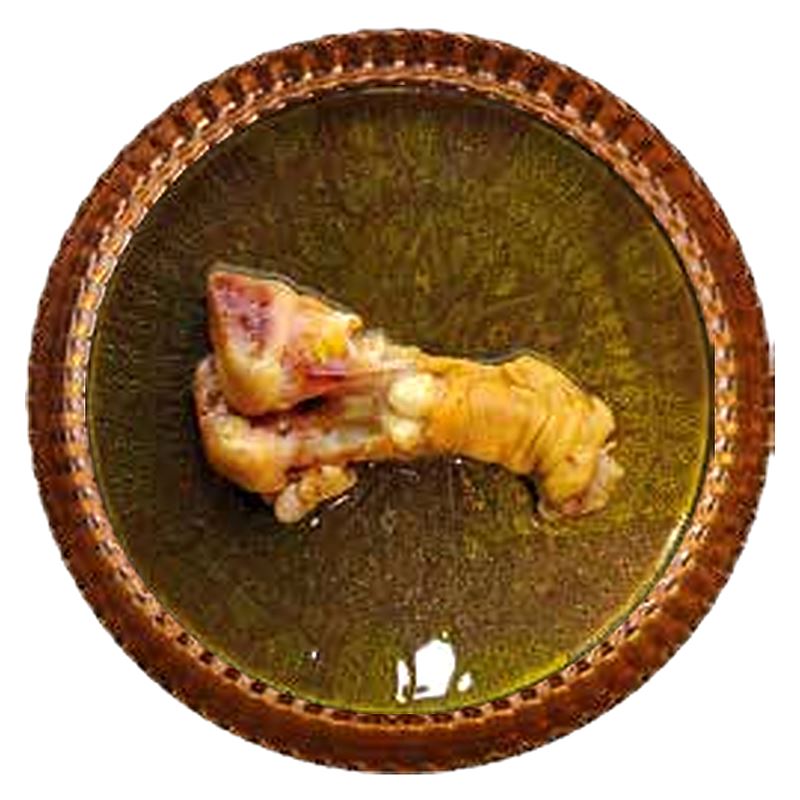
It does not go on tight, and that distinction is the whole thing. A sealed pot removes the three habits a long broth depends on: you cannot skim the foam that rises in the early hours, you cannot see the surface, and you cannot taste and adjust. So the lid rests rather than clamps, it comes off completely for each skim and goes back afterwards, and the level is watched and topped with hot water rather than cold — the same practice as in our recipe for lamb paye at home, which keeps the trotters submerged the whole way. What a genuinely sealed lid takes away is its own subject, and it has its own article: what a pressure cooker can and cannot do for kalle pache.
Which dish wants which setting?
A rough map. The pot tells you what it is trying to become.
| What the pot is doing | Lid | Why |
|---|---|---|
| Coming up to the simmer, foam rising | Off | You need the surface to skim it |
| A long bone broth over many hours | On, resting loose; off for each skim | Hold the water, keep the surface reachable |
| Meat and pulses working towards tender | Cracked open | Slow loss, so it thickens without drying |
| A sauce that must tighten at the end | Off | Water has to leave before it will coat |
| Rice at the steaming stage | On, wrapped in a cloth | Keep the steam, lose the drips |
Abgoosht is a useful case because its broth is traditionally served as a course in its own right, so there is nothing you want to reduce away. It stays covered and gets topped up with hot water when the level drops, which is what our abgoosht and dizi recipe asks you to do.
Why do Persian cooks wrap the lid in a cloth?
This is the kitchen's most distinctive lid. A clean tea towel is spread over the lid, the corners folded up over the handle so they stay clear of the flame, and the lid is set firmly on the pot. The cloth has a name of its own: damkoni.
It exists because of the drips. Steam still rises and still fills the pot, but instead of collecting on cold metal and falling back as water, it is caught and held in the cloth. The pot stays humid and the surface of the food stays dry. Every other lid setting is a decision about how much water leaves; this one is a decision about where the water that stays ends up, and that is why the technique had to be invented at all.
Rice is the famous case, and the steaming stage is covered properly in our guide to fluffy chelo and a golden tahdig. The principle is all that matters here: a cloth on the lid means trap the steam and lose the drip.
How do you read a pot without lifting the lid?
Sound comes first. A lid that chatters and knocks is being lifted by steam faster than the pot can let it out, which means the heat is too high. Bring the flame down until it goes quiet. Quiet with a thin, steady wisp slipping out at the edge is a pot doing its job. Quiet with nothing escaping at all means it has stalled.
Then judge the lid itself, on weight and fit. A heavy lid sits down under its own weight and holds the water in without any help from you. A light one lifts, rattles and vents unpredictably, so you never quite know which setting you are on. A domed lid tends to run condensation down the sides; a flat one drops it into the middle. And a lid slightly too small for the pot is a permanently cracked lid whether you intended one or not, which is fine if you know it.
Every lift costs the pot a cloud of steam it then has to rebuild. Not an argument for never looking, but for looking with a purpose and putting the lid straight back.
Would you rather not stand over a pot?
Then don't. Shaun the Sheep is at 64 Jumeira Street, Jumeirah 1, open 24 hours a day, seven days a week. Order on the site for delivery across 141 Dubai areas, with the fee for your area shown at checkout, or choose pickup or dine-in. You can schedule an order for a later hour too, including dawn. Anything the site does not answer, call 04 321 8882 and ask.
