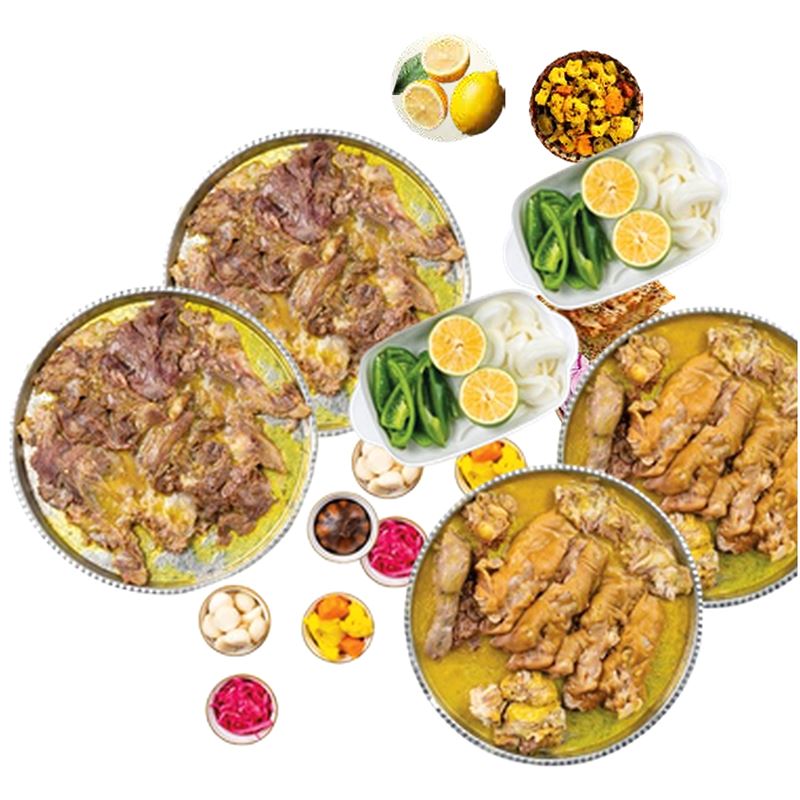
Set the table before the lid comes off
A kalle pache platter carries its heat in liquid, and liquid gives that heat away to everything it touches: the air above it, the ceramic under it, the metal of the spoon. So the useful work happens in the five minutes before the lid comes off, not after. Get the vessels out, get them warm, and the broth spends its heat on you instead of on cold dishes.
The same reasoning decides what stays apart until the last moment: broth in one vessel, the cuts in another, bread under its own cloth. If you want the eating order rather than the table setting, how to eat it covers that side.
Deep narrow bowls, warmed with hot water
Heat leaves broth mainly through its open top: steam carries energy off the surface, and the cooler air above draws more away. A wide flat plate spreads a given amount of broth over a large surface, so it loses heat quickly. The same broth in a deep, narrow bowl presents a small face to the room and keeps the rest of its volume insulated beneath.
Then there is the bowl itself. Cold ceramic is a heat sink, and the first thing hot broth does when it lands in a cold bowl is warm the bowl. Fill the bowls with hot water from the tap while you set out the rest of the table, tip the water away and dry them just before the food is served. Warm the ladle and the spoons the same way. Thick stoneware holds that warmth longer than thin porcelain, though it also takes longer to warm through.
Sangak stays under a cloth
Sangak is thin, open-crumbed and baked on hot stones, which is exactly why it dries at the edges when it sits uncovered: the thin rim loses moisture from both faces at once and turns brittle within minutes. A clean cotton or linen cloth laid over the bread traps enough steam to keep it pliable, and slows the cooling at the same time. Lay it on a wooden board or a flat tray rather than in a deep dish, and tear it by hand as you eat rather than cutting the whole sheet up in advance.
One dish for the bones, small dishes for the sharp things
Head cuts and trotters come with bone, and bone accumulates. An empty dish set in the middle of the table gives everyone somewhere to put it, which keeps the eating plate clear and stops bone collecting in the bowl you are eating from.
Torshi, lime, raw onion and green pepper each belong in their own small dish, and the reason is physical: torshi carries brine and lime carries juice, and on a shared platter that liquid runs. Sourness added in the bowl can be varied spoon by spoon; sourness that has run into the shared pot cannot be taken back out. Keep the liquids in their own dishes and the choice stays with the eater.
Why broth, cuts and bread stay apart until the table
Liquid, cuts and bread each keep better on their own, for the same reasons that govern the table. A deep sealed container of liquid holds heat far better than the same broth spread thin over cuts, meat left standing in hot liquid keeps softening, and bread near broth stops being bread. Bringing them together is the last step, at the table, in a warm bowl: tear the sangak in, ladle the broth over it, and add the cuts you want.
| What to have out | Why |
|---|---|
| Deep narrow bowls, rinsed with hot water | Less surface exposed, and no cold ceramic to heat |
| Board or flat tray, with a cloth over the bread | Traps steam, so the edges stay pliable |
| One empty dish in the middle of the table | Somewhere for bone, so the plates stay clear |
| Small separate dishes for torshi, lime, onion, pepper | Their liquid stays out of the broth |
| A ladle, warmed with the bowls | Cold metal pulls heat from every serving |
Platters run from the Single Dish for one person up to The Khan's Platter for six, so the number of bowls you set follows the platter you chose from the menu. Delivery covers Dubai and is free over AED 300, and if you would rather the food land at a set hour, order it ahead for that time and lay the table while you wait. There is more on that in delivery across Dubai. The kitchen in Jumeirah runs 24 hours a day, seven days a week, and the phone is 04 321 8882.
