What Sizdah Bedar is
Sizdah Bedar falls on the thirteenth day of Farvardin, the last day of the Nowruz holidays, and its instruction is unusually blunt for a Persian festival: leave the house. Tradition says the thirteenth is no day for indoors, so families take it outside — a park, a riverbank, an orchard, anywhere with grass and shade — and stay from morning until the light goes.
Two small rituals travel with the day. The sabzeh, the dish of sprouted wheat or lentils that has sat on the haft-sin table for two weeks quietly collecting the household's troubles, is carried out and cast into moving water. Unmarried young people knot blades of grass and make a wish, the knot standing for a tie they hope to make. Both are done lightly, with laughter, the way a family repeats what it does every year without explaining it.
How Iranian families in Dubai keep it
Here the thirteenth usually lands on an ordinary working weekday, so the shape changes, not the spirit. Families claim a corner of a public park or a stretch of beach, carry rugs, folding chairs and a samovar, and the older generation arrives first to hold the ground while the rest come after school and work. Sabzeh goes into a creek, a canal or the sea rather than a river; some households water a garden bed with it instead, which keeps the meaning and leaves nothing behind.
What Dubai really changes is the clock. The morning can be pleasant and midday punishing, and the shaded spots are taken early. Families who get out before the heat and the crowd keep the day; those who arrive at noon spend it hunting for shade. So the day is built backwards from an early start, which puts the first meal — the one before the picnic — at the centre of it.
The early warm start
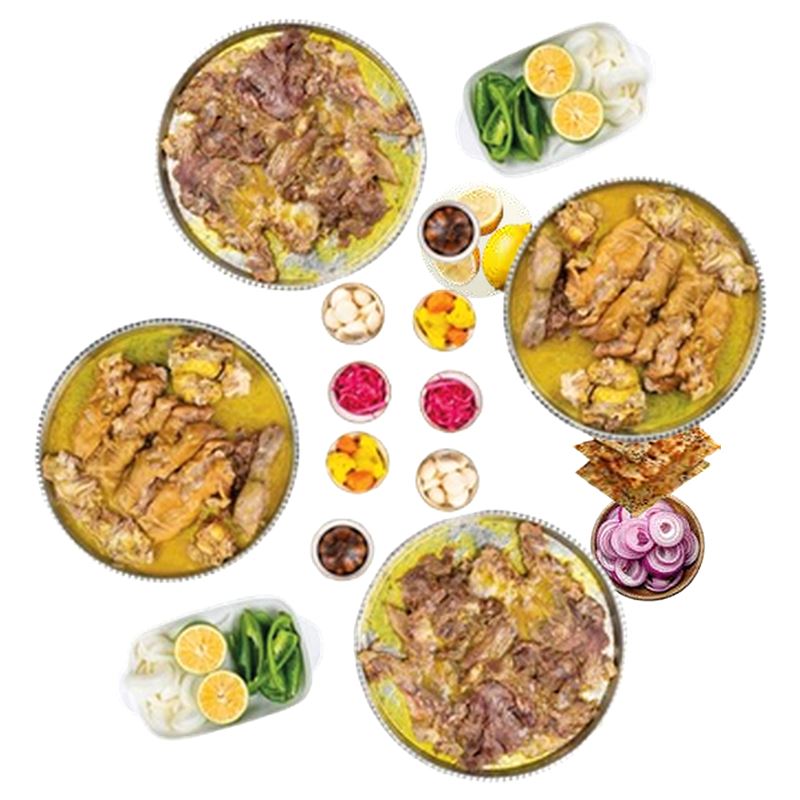
This is where kalle pache belongs. It has always been a dawn dish — eaten early, in a warm room, before the day's work — and Sizdah Bedar is one of the few mornings when a whole extended family is awake early with somewhere to be. Lamb head and trotters simmer about fourteen hours, until the broth is dark and heavy with gelatin and the meat leaves the bone under a spoon. With sangak, torshi, lime, raw onion and green pepper, it does what a big early meal has to do: it holds people to the afternoon, so nobody is hungry an hour into the picnic.
The basket carries the lighter things — fruit, nuts, herbs, tea. If part of the table is new to the dish, sons-in-law and children included, show them how to eat it the first time before they sit down, and let the cautious ones read which single to order so they choose rather than being served.
Sizing for an extended family
Sizdah Bedar is not a four-person meal. It is grandparents, an aunt's household, cousins, someone's fiancé meeting everyone at once. The sizes on the menu run: Single Dish for one, Double Dish for two, The Full Dish for three, The Khan's Platter for six. For the twelve to fifteen this day usually gathers, the honest arithmetic is two or three Khan's Platters plus a handful of singles for anyone who wants one thing only.
Singles matter more than you expect at a mixed table, since not everyone wants everything. The list runs eye, brain, meat, tongue, trotters, tripe, lamb cheek, brain soup, soup, and the special mix — mojoon — the diplomatic answer for anyone who cannot decide. Add two or three plain soups for the children and the hesitant, and the platters stop feeling like a test.
Ordering it for a set time
The kitchen in Jumeirah runs 24 hours a day, seven days a week, so an early start is no special request. It is worth ordering in advance for the time you want it: an order can be set for a future time, which on a day built around beating the crowd is the difference between eating when you planned and eating whenever. Dine-in works, and so does delivery across Dubai, free over AED 300 — a threshold a group order this size passes without effort.
Two practical notes. Payment on the website is by card in advance; there is no cash on delivery, so nobody hunts for notes at the door with the car half loaded. And if you would rather talk the order through than count it up yourself, the number is 04 321 8882 — with a large family it is faster to say the platter count out loud.
