The festival that sits between Yalda and Nowruz
Two Iranian dates travel well: Yalda, the longest night of the year, and Nowruz at the equinox. Sadeh sits between them on the same winter calendar and is far less known outside Iran. It is a midwinter fire festival — a bonfire lit at nightfall, a gathering that stays around it, and a night running from dusk through to the cold morning after. It is among the oldest festivals on the Iranian calendar, and never an indoor one: the point is to stand outside in the hardest of the cold and answer it with a fire.
When it falls, and why it is named for a hundred
Sadeh falls on the tenth of Bahman, which lands around 30 January on the Gregorian calendar. Count forward from that night to Nowruz at the spring equinox and you get roughly fifty days. The traditional explanation counts the nights too: fifty days and fifty nights, which makes one hundred. Sad is the Persian word for a hundred, and that is the naming that stuck — the festival of the hundred, counted off toward the new year.
Other readings circulate — a hundred days from the reckoned start of winter, or a hundred days before a harvest — but the fifty-and-fifty count is the one repeated most often. Sadeh is the night that says the cold is being counted down rather than simply endured.
Kerman, Yazd, and the fire itself
The clearest continuous form of the festival is kept by the Zoroastrian communities of Kerman and Yazd. There it is public: wood gathered and stacked through the day, the pile lit after sunset, prayers and readings around it as the flame takes hold. The fire is not scenery at the edge of an evening; it is the event, and the night is measured against it: lit, burning, settling, out.
Persian literary tradition carries it back further, to the legend of Hushang and the discovery of fire as the Shahnameh tells it: a stone thrown at a snake misses, strikes rock, and fire appears. Whatever sits behind the legend, the story fixes the meaning of the night — light and heat found in the darkest season, and a date set aside each year to mark the finding.
A night that ends at the hour kalle pache belongs to
This is where a Persian kitchen has something to say. Sadeh is not an evening that wraps up at ten; it is built long. The fire goes up at nightfall, the gathering stays with it, and the tradition carries the night through to the morning after — precisely the hour kalle pache belongs to. In Iran it has always been a dawn dish: lamb head and trotters over a low flame overnight, ladled out early, eaten before the working day starts. If the dish is new to you, read what kalle pache actually is before planning a table around it.
So the two halves fit without forcing: a night that ends at first light, and a bowl built for first light. Here the broth runs about fourteen hours on the heat before serving — the same overnight arithmetic the dish has always used.
Marking it in Jumeirah
The practical difficulty with a night that ends at dawn is the hour. Our Jumeirah kitchen runs 24 hours, every day of the year, so five in the morning is an ordinary service time, not an exception to arrange. Sit down with it, or have it sent across Dubai.
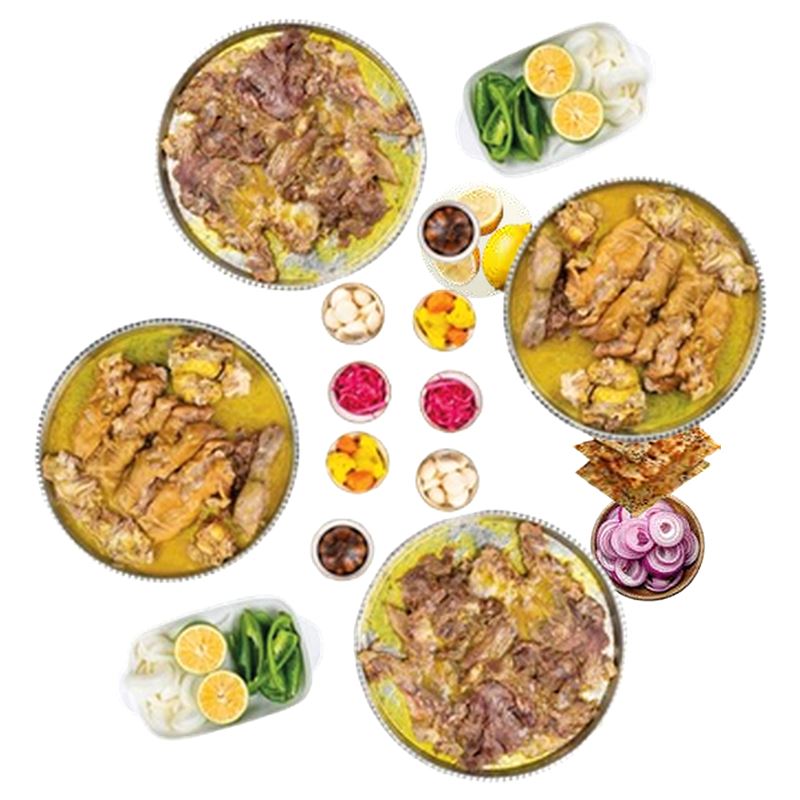
What reaches the table is the full setting: the bowl, sangak bread, torshi, lime, raw onion and green pepper. For a group coming off a long night, The Khan's Platter is built for six; there is also The Full Dish for three, a Double Dish for two, and a Single Dish for one. If you would rather take one part than the mix, the singles run through eye, brain, meat, tongue, trotters, tripe, lamb cheek, brain soup, soup, and the special mix known as mojoon — choosing between the singles is a decision of its own. It is all laid out on the menu.
Pre-ordering for a set hour
The useful thing about a fire is that you can see how long it has left. If you know when the gathering is likely to break up, the order can be placed in advance for that hour rather than started at it — pre-orders for a future time are supported, for a table and for delivery across Dubai. Delivery is free over AED 300. Payment on the website is card prepay only; there is no cash on delivery. If the timing is easier by voice, the number is 04 321 8882.
