What Chaharshanbe Suri is
Chaharshanbe Suri falls on the eve of the last Wednesday of the Persian year: the Tuesday evening of the week before Nowruz, which puts it in the second half of March. The name is literal. Chaharshanbe is Wednesday, and suri carries the sense of red and of a feast. Small fires are set in a line and jumped one after another, with the line everybody calls out: zardi-ye man az to, sorkhi-ye to az man, my yellowness to you, your redness to me. The pallor of a tired year goes into the flame and its colour comes back. Historians disagree about how old the custom is and where it began, but that one sentence is what has carried it to today.
It is the last loud night of the Iranian year. The house is already half turned over for Nowruz — the deep clean, the sabzeh sprouting on a plate, the new notes for the children — and then, days before the year turns, the street fills with smoke and noise.
Ajil-e moshkel-gosha and qashogh-zani
Ajil-e moshkel-gosha, the mix that unties knots, is the food of the night: pistachios, almonds, walnuts, roasted chickpeas, raisins, dried mulberries and dried apricots, mixed at home or bought by the kilo and sent round the circle. The name is a small prayer that a hard year will loosen its grip, and the mixture is meant to be shared rather than kept.
Qashogh-zani, spoon-banging, is the other custom of the night. You cover your head so nobody can name you, knock at a door, beat a spoon against an empty bowl and say nothing. Whatever lands in the bowl you take in silence and move on. There is fal-gush as well: standing quietly at a corner and taking the first sentence you overhear as the answer to the question you came with.
A fire night in a city of towers
The fire is the one piece that does not travel. A flat has no yard, a shared garden is no place for a bonfire, and open flame is not part of ordinary life in Dubai. The rest moves without trouble: a bowl of ajil on the table, the old songs, a call home. Dubai runs half an hour ahead of Tehran, so the fires there are lit while the evening here has already gone a little further — near enough that both rooms are awake together.
What travels best is the shape of the night. It begins late, it is loud, and it does not end at a sensible hour. That is the part worth planning for.
Why the night ends at a kalle pache table
Kalle pache is a dawn dish. Lamb head and trotters go into the pot with onion, garlic and turmeric and stay on a low flame for about fourteen hours, so a pot set in the afternoon is ready at dawn. That clock was fixed centuries before anyone thought of fitting a festival into it, and it happens to match this one exactly: a night that runs past midnight ends where the pot ends. If the dish is new to you, start with what kalle pache actually is.
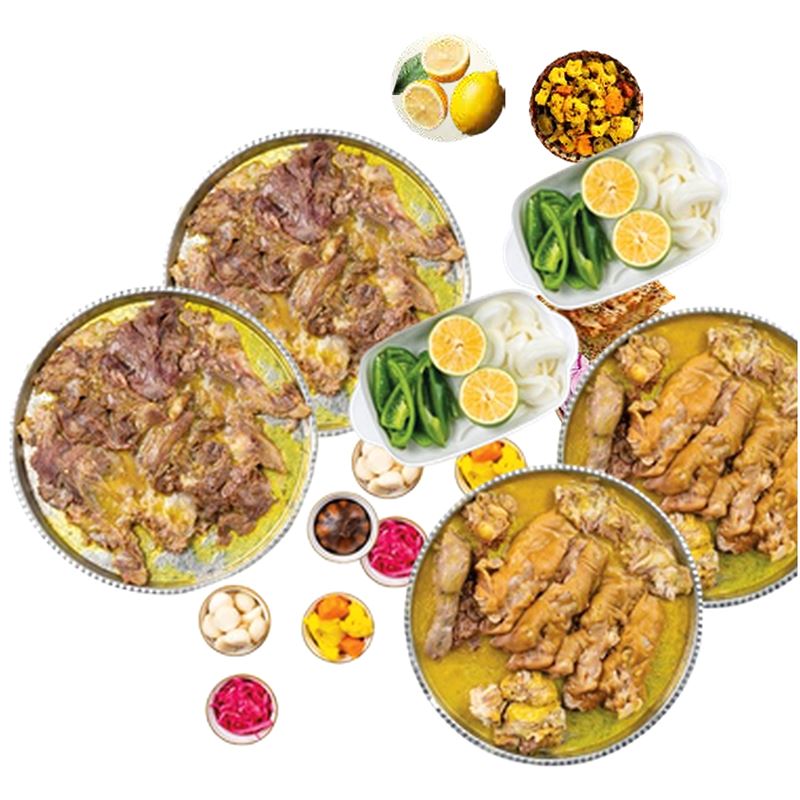
It comes to the table with sangak, torshi, lime, raw onion and green pepper. The lime cuts the fat, the torshi resets the mouth between spoonfuls, and the sangak goes under the meat to take up the broth.
What to put on the table
The singles let you build the table piece by piece: eye, brain, meat, tongue, trotters, tripe, lamb cheek, brain soup, soup, and the special mix — mojoon — which brings several parts together in one bowl. Where there is company there are the platters: the Single Dish for one, the Double Dish for two, The Full Dish for three, and The Khan's Platter for six, the size that suits a room still awake at four in the morning. They are all on the menu, and if someone at the table has never eaten it before, the first-timer's guide is short and honest.
Ordering for a set hour
The kitchen is open around the clock, every day, for dine-in and delivery across Dubai, and an order can be placed for a future time: you name the hour, and the food is made for that hour. On a night like this that is the useful part — arrange it before the evening starts, and the end of the night is already settled. Delivery is free over AED 300, and the practical notes are in the delivery guide. Orders on the website are paid by card in advance; there is no cash on delivery. For anything else, the phone is 04 321 8882.
