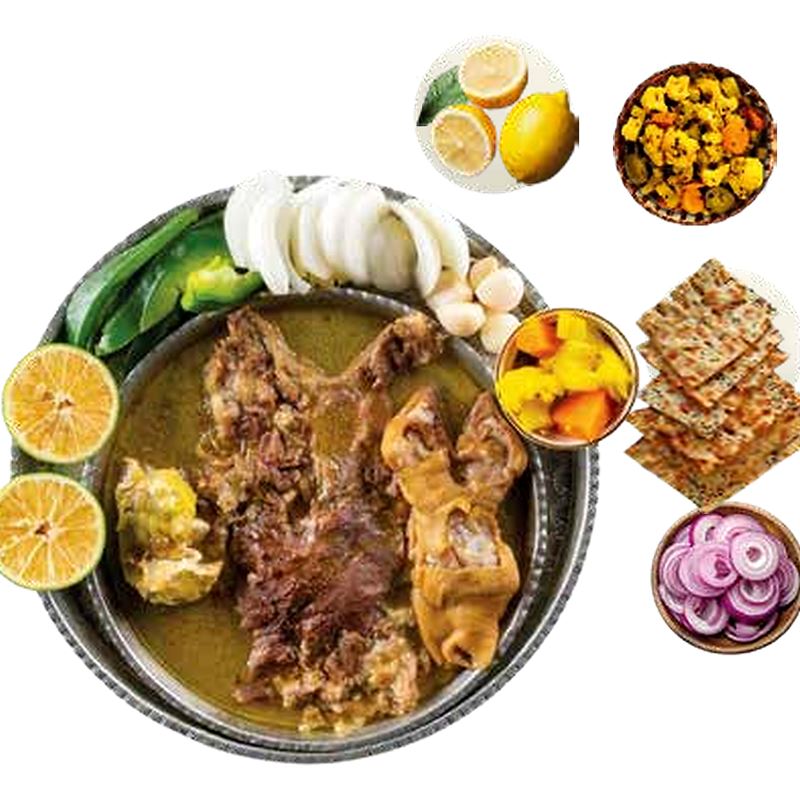
For a few weeks each winter, Dubai quietly pushes its evening back by a couple of hours. Shops stay open long past their usual closing time, the roads stay busy when they would normally be emptying, and dinner keeps getting postponed until it is not really dinner any more. If you find yourself in a car park at half past midnight with bags in the boot and nobody at home willing to cook, the useful fact is short: Shaun the Sheep is open twenty-four hours a day, seven days a week, at 64 Jumeira Street in Jumeirah 1.
So kalle pache — lamb cheek, trotters, tongue, brain, eye, simmered right through the night — is there at exactly the hour those weeks push you to. Order delivery anywhere in Dubai, collect it on the way home, or sit down at a table. The rest of this article is the practical part: how these nights behave, what a tired group should order, and where the timing traps sit.
What actually changes about Dubai nights when the city shops late?
The whole evening slides back by two or three hours, and every meal slides with it. Families who would normally be home by nine are leaving the house at nine instead. Children who are usually asleep are wide awake and negotiating for one more shop. And the last stretch of the night — everybody carrying something, nobody willing to carry it any further, the conversation turning to food — arrives at an hour that in most other months would be a strange time to sit down together.
The second change is the traffic. Roads that clear early in an ordinary week stay full, and the busiest junctions stay slow long after midnight. That matters less for the meal than for the planning around it, which is the theme of half this article.
The third change is quieter. At that hour most of what is still open is a snack, eaten with one hand on the way to the car, while a hot shared meal becomes hard to find. That is the gap a kitchen which never closes fills. We wrote about the general case in our guide to late-night food in Dubai; this article is about the weeks when the whole city is doing it at once.
Why does kalle pache suit a meal eaten after midnight?
Because it has always belonged to the edges of the day rather than the middle of it. In the households where the dish grew up it is commonly eaten very early, before or around dawn, and in Dubai the kitchen is just as open for it late at night. Either way, nobody has to explain why they want it at one in the morning. If the dish is new to you, start with what kalle pache actually is, or read about what it tastes like before you commit a whole table to it.
It is also shared by design. A platter arrives and everyone reaches for the part they like: one goes straight for the tongue, another wants only broth and bread, a third takes the lamb cheek. After hours of walking in different directions through the same building, a single dish everyone eats from does something a row of separate boxes does not.
And it is a proper meal. Bread, broth and slow-cooked meat, hot, on plates, at a table — not a stopgap eaten standing up with a bag over one shoulder. After six hours out, that difference is most of the point. Our notes on why this is winter food in Dubai go further into the cold-weather side of it.
How do you order at one in the morning?
Exactly the way you would at one in the afternoon, because the kitchen makes no distinction between the two. You choose your items on the site, choose delivery, pickup or dine-in, and pay by card online. Payment is secure online prepay only: no cash on delivery, no paying the rider at the door. There is no account to create, no password to remember, and no app to install at midnight on a phone that is already low on battery.
Once payment goes through, the order gets its own page. The kitchen accepts it and sets an estimated time, which appears on that page. When the rider reaches you, he phones. That detail matters more than it sounds after a long evening: keep the phone charged, audible, and somewhere you will hear it rather than at the bottom of a shopping bag. The full walkthrough is in how to order kalle pache online, step by step.
Delivery covers Dubai and is free over AED 300. Below that a fee applies, and it varies by area. More in our kalle pache delivery guide.
Can you schedule the order for the time you will actually be home?
Yes, and during these weeks it is the most useful thing on the site. You can pick a future time up to about two days ahead, which covers every version of the problem: you know roughly when you will leave, you know the drive takes what it takes, and you would rather the food arrive after you than sit waiting while you are still in a lift.
When you set the time, pick the moment you expect to be through the door rather than the moment you leave the car park. It costs nothing to be ten minutes late for your own dinner.
Scheduling helps at the other end of the clock as well. If someone in the house is up early anyway, an order set for dawn is a very old way to eat this dish, and the site handles it without anybody staying awake to place it. We covered that habit in pre-ordering kalle pache for dawn, and the broader question of the right hour in when to order kalle pache.
Should you order earlier than instinct tells you?
On the busiest of these nights, yes. Two things stack up at once: the roads are slower than they would normally be at that hour, and a kitchen already awake at three in the morning can be busier than usual in a season when so much of the city is awake with it. Neither is a reason to worry. Both are reasons to press the button before the moment hunger turns urgent.
We will not give you a number of minutes, and you should be wary of anyone who does on a night like that. The kitchen sets an estimate once it accepts the order, an estimate is an estimate rather than a promise, and ordering while you are still walking to the car beats ordering once everyone is home and looking at each other.
The rule of thumb for these weeks: decide what you want while you are still out, place the order before the drive home rather than after it, and let the food follow you instead of chasing it.
What should a group order coming home late?
Start with a platter: they already include the bread, the thing people forget to add and then miss. Here is what each carries.
| Platter | What is on it | Roughly suits |
|---|---|---|
| Single Dish | Lamb cheek, one trotter, half a brain, half a bread | One person |
| Double Dish | Lamb cheek, two trotters, half a brain, tongue, one eye, a whole bread | Two people, or one very hungry one |
| The Full Dish | Two lamb cheeks, meat, four trotters, a whole brain, tongue, two eyes, two breads | Three or four around a table |
| The Khan's Platter | Four lamb cheeks, two meats, eight trotters, two brains, three tongues, four eyes, five breads | A large group arriving home together |
Around the platter, a few additions do most of the work. Mixed Torshi or Garlic Torshi cuts through the richness. Extra Sangak Bread, or Special Sangak, is worth adding if your group finishes bread faster than anything else. Capsicum, Onion, Fresh Chili and Pickled Green Chili are there for whoever wants them. And a Kettle of Tea is the correct ending: it lasts longer than individual glasses and keeps everyone at the table another twenty minutes, which after a night like that is the whole reward.
For anyone particular, order singles instead: Eye, Brain, Meat, Tongue, Trotters, Tripe, Lamb Cheek, Brain Soup, Soup or the Special Mix. There is an Omelette for the person who came along but does not want kalle pache at all, and Water, Tea, Black Tea, Lemonade, Doogh and soft drinks for the table. A longer walk through the choices is in our complete menu guide.
One note on customising: it means choosing which parts and which items you order. There is no notes box for kitchen instructions, so if you need to ask about something specific, phone 04 321 8882 and speak to a person.
Is dine-in or pickup better if you are already out?
If your route home passes Jumeirah, both are simpler than they sound. Dine-in means the food arrives hot at the table with no drive between the pot and the plate, and tables can be reserved through the reservation page on the site. Pickup means you order and pay on the site while you are still walking out, then collect it on the way past, which takes the road out of the equation on a night when the road is the slow part.
Dine-in has one more advantage during these weeks. The seasoning on this dish — lime, cinnamon, garlic — is added by the diner at the table rather than by the kitchen, so eating it where it is cooked means adjusting your own bowl exactly as you like it, one spoon at a time.
What if plans change, or the kitchen cannot take the order?
Phone 04 321 8882 straight away. There is no self-service cancel or edit button on the site, and the phone is our only contact channel — no email, no chat, no form. Because the kitchen never closes, calling at an odd hour is not the problem it would be elsewhere, and the sooner you call, the more can usually be done.
If the kitchen cannot fulfil an order, it rejects the order with a reason and the refund is issued automatically. We will not promise you a number of days for that, only that it is handled without you having to chase it. And because this is one kitchen on one street with no branches, there is no other number to try.
Why does the cooking matter at this hour in particular?
Because it is the reason there is anything ready at two in the morning at all. Heads and trotters are hand-cleaned and trimmed, then blanched, with that first water thrown away. Then comes the long part: roughly fourteen hours of simmering in a copper pot with onion, turmeric and garlic, skimmed again and again as it goes. That clock does not care what time you get home, which is exactly why the kitchen does not have to.
The lamb is sourced to the UAE halal standard. If the cooking or the halal question is what brought you here, the longer answers are in how kalle pache is made and is kalle pache halal; for the wider view of the dish in this city, see kalle pache in Dubai.
The short version
For a few weeks each winter the city eats at hours it would not otherwise keep, and the honest answer is to plan the meal before the evening tires you out. Decide early, order before the drive home rather than after it, schedule it if you know your timing, pick a platter that comes with its bread, add the torshi and the Kettle of Tea, and keep the phone charged for the rider's call.
This article is about food, timing and logistics rather than health. Nothing here is medical advice — for anything to do with your own diet, ask your doctor or a registered dietitian.
