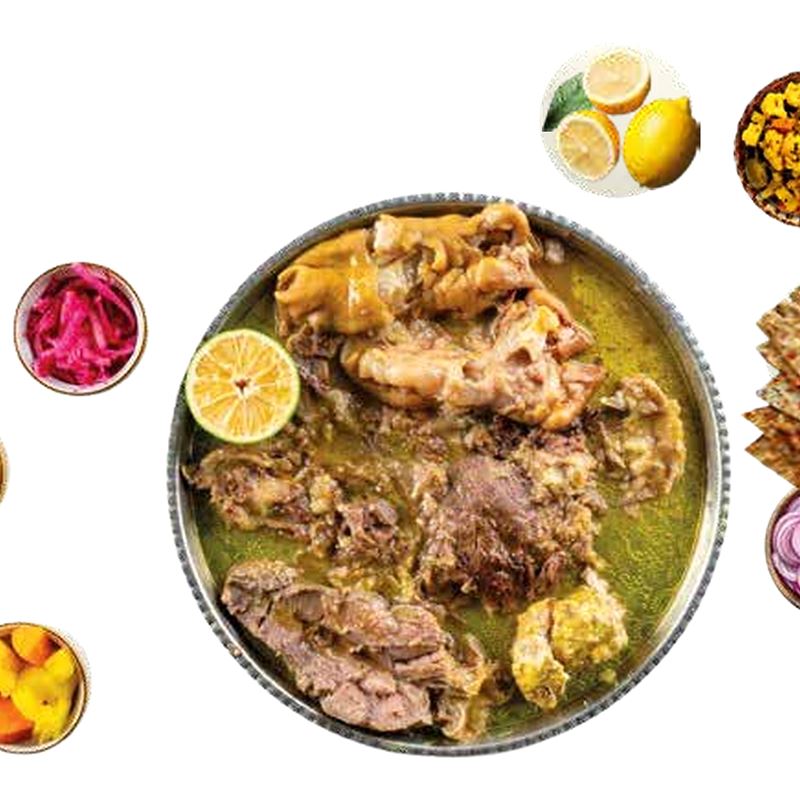
The short answer is that most people lose the friend in the first sentence. They say “it is sheep’s head”, which is entirely true, and then they watch the face change. The dish never gets a fair hearing, because the hardest fact arrived first with nothing around it to hold it up.
There is a better opening, and none of it involves hiding anything. Kalle pache is a broth simmered for about fourteen hours. It is what a great many people in Iran eat before dawn. The texture people love comes from the trotters. Start there, order the right first bowl, and answer plainly the moment a direct question arrives. This guide is for the person doing the recommending; if you want something to send your friend instead, the piece written for newcomers does that job.
Why does “it is sheep’s head” lose people?
Because it is a category rather than a description, and the category does all the work for you. When someone hears “head” they picture the animal, not the plate — not a bowl of broth with bread torn into it, not the lime squeezed over it, not the pinch of cinnamon a diner stirs in at the table. You have handed them an image to react to instead of a dish to imagine, and reactions are quick, physical and hard to walk back.
The same happens when the recommendation opens with brain or eye. Both are real parts of the menu, but as an opening line they land as a shock rather than an invitation. Someone who pictured an eye a second ago is not thinking about fourteen hours of simmering; they are thinking about how to end the conversation politely. None of this makes the parts a secret; it means the first sentence is a door, and you choose which one you open first.
What should you lead with instead?
Lead with the cooking, then the hour, then the texture. All three are honest, specific and easy to picture.
The cooking first. Heads and trotters are hand-cleaned and trimmed, blanched with that first water thrown away, then simmered for about fourteen hours in a copper pot with onion, turmeric and garlic, skimmed again and again along the way. Most people already have a shelf to put that on: they know what long, slow heat does to a stubborn cut, and they respect it. If your friend has ever waited on a braise, you are describing something they already understand, and the method is set out in how kalle pache is made.
Then the hour. This is a dawn food. In Iran it commonly belongs to the early morning — the queue before work, a shared table while the city is still quiet. That single fact tells your friend the dish has a place in ordinary life rather than being a curiosity, and it turns a challenge into an occasion. In Dubai the hour is yours, since the kitchen runs around the clock.
Then the texture, which is the part people actually fall for. The trotters give the broth its body: that soft, lightly sticky, lip-coating quality that makes bread worth tearing into the bowl. Call it rich rather than heavy, silky rather than fatty, and you are being accurate rather than generous. What kalle pache tastes like and the texture guide go further if your friend wants detail first. That is a note about mouthfeel and nothing more: it is not a health claim and it is not medical advice, and anyone with a dietary condition should ask their doctor or a registered dietitian.
Is there a script that actually works?
There is a shape, and it is worth keeping loose. Three moves: compare it to something they already like, name the hour, and offer to order it with them.
“You know how a lamb shank goes when it has been cooked for hours and the meat gives way? There is a Persian dish in that family — a broth that simmers overnight and gets eaten in Iran at breakfast. There is a kitchen here that makes it around the clock. I am ordering Friday morning — come and have a bowl.”
Each move does something. The comparison gives a familiar landing point, the hour turns a floating idea into a plan, and the offer removes the two things that quietly stop people: not knowing what to order, and not wanting to be the only one eating it.
Keep all of it phrased as a suggestion rather than an instruction. “I think you would like this” invites agreement; “you have to try this” invites resistance. And if a direct question arrives at any point — what is in it, which parts, what am I actually eating — answer it plainly, right then, ahead of everything else.
Which first order gives a sceptical friend the best chance?
Start with Soup, or with Lamb Cheek and Sangak Bread. Both are broth and meat in a familiar shape, and neither puts a brain or an eye in front of someone who is still deciding how they feel.
The platters are generous by design, they come with bread, and they do include the confronting parts: the Single Dish is lamb cheek, one trotter, half a brain and half a bread; the Double Dish adds a second trotter, tongue, an eye and a whole bread; The Full Dish and The Khan’s Platter scale up from there. Superb orders for a table that already knows the dish, and exactly the wrong first order for a newcomer.
| Who you are ordering for | Start with | Why it works | Leave for later |
|---|---|---|---|
| Curious, has never eaten offal | Soup with Sangak Bread | Broth-led and familiar in shape | Brain, Eye |
| Loves slow-cooked lamb | Lamb Cheek with Special Sangak | Closest to the braise they already like | Tripe |
| Wants to understand the texture | Trotters with Sangak Bread | The gelatine is the whole point, tasted directly | Brain Soup |
| Already eats offal happily | Brain Soup, or Special Mix | No easing in required | Nothing |
| A mixed table | Singles ordered separately, plus bread and Mixed Torshi | Everyone chooses their own plate | One shared platter |
Whatever you order, put Mixed Torshi or Garlic Torshi in the middle of the table: sharp pickles cut the richness, so a newcomer who finds a bowl heavy halfway through has somewhere to go. Mention the seasoning too, because lime, cinnamon and garlic are added at the table by the diner rather than by the kitchen. Say that out loud — people relax when they learn there is a dial they can turn.
The complete menu guide, the guide to the singles and the piece on ordering for a mixed group cover the combinations.
When should you mention the brain and the eye?
After they have eaten, if they have not asked. Never instead of answering a direct question, and never by putting something in front of someone who has not agreed to it.
The line is simple: sequencing is fine, concealment is not. You may decide which true thing you say first. You may not let a person eat something they would not have chosen. If they ask what is in the bowl, tell them completely, before the spoon moves; if you are ordering for the table, name each dish as it lands. A friend who works out afterwards that you steered them into something will not come back for a second bowl, and they will be right not to.
Done in the right order, the later conversation is easy. Someone who has just finished a bowl of Soup and half a bread can hear that the brain is commonly described as the softest thing on the menu, and that tongue is closer to a good slow-cooked cut than anything else on the list. The parts are information now rather than a warning.
What do you say if they ask whether it is halal?
Say what is true and stop there: the lamb is sourced to the UAE halal standard. Do not embroider it, and do not turn a question about food into a religious ruling — the customs around this dish are customs, and they are best described as such. Is kalle pache halal covers it in more detail if your friend would rather read it themselves.
The other common question is simply what the dish is. What kalle pache is gives the plain explanation and kalle pache in Dubai puts it in local context. Sending a link often beats talking: it lets your friend decide without your face in the room.
How do you make the ordering part easy?
Do the ordering yourself: a newcomer scrolling a list of parts alone is a newcomer talking themselves out of it. Order from the Shaun the Sheep kitchen: no account, no sign-up, no password. You choose exactly which parts and items you want, pay securely by card online, and the order gets its own page. The kitchen accepts it and sets an estimated time, and the rider phones you on arrival.
Delivery covers Dubai and is free over AED 300. Pickup and dine-in are both available, and a dine-in table can be reserved. The kitchen is at 64 Jumeira Street in Jumeirah 1 and open 24 hours a day, seven days a week, so “Friday at seven in the morning” is a real plan rather than a joke.
Two practical notes. Scheduled orders are real: you can pick a future time up to about two days ahead, which turns “we should do this sometime” into a fixed arrangement. And there is no cancel or edit button, so if anything changes — the time, the address, the order itself — phone 04 321 8882 straight away; that number is the only contact channel, with no chat and no email. The steps are in how to order online and kalle pache delivery in Dubai. If the kitchen cannot fulfil an order, it rejects it with a reason and refunds automatically.
What if they try it and do not like it?
Say “fair enough” and mean it. Ask one gentle question rather than starting an argument: which part put them off. Often it is the richness, which torshi and bread would have fixed. What to do if you do not like it works through the possibilities without pressure.
What if they say no before trying anything?
Let it go the first time. This is where recommendations die twice over: you push, you win the argument, and you lose the meal — and with it the second attempt six months later, when they might be more curious. A no today is very often a not-yet; a no that was argued with usually hardens into a permanent one.
Some people will simply never want it, and that is an ordinary preference rather than a failure of nerve. Treating it as anything else turns a shared meal into a small test, and nobody enjoys being tested at breakfast.
Things that cost you the second attempt:
- Framing it as a dare or a test of courage. It is breakfast, not an ordeal.
- Filming the first spoonful. The camera says the point is their reaction, not the food.
- Dwelling on how strange it is. Exoticising the dish tells them it is not for people like them.
- Teasing anyone who declines.
- Ordering the largest platter to make a point rather than to please the person in front of you.
The best recommendation is usually the quietest one. You mention the fourteen hours and the hour of the morning, you order a bowl of Soup and a bread, and you let your friend decide what they think. Do that and sooner or later they are the one saying “we should go again” — which is how this dish has travelled from table to table for as long as anyone has been cooking it.
