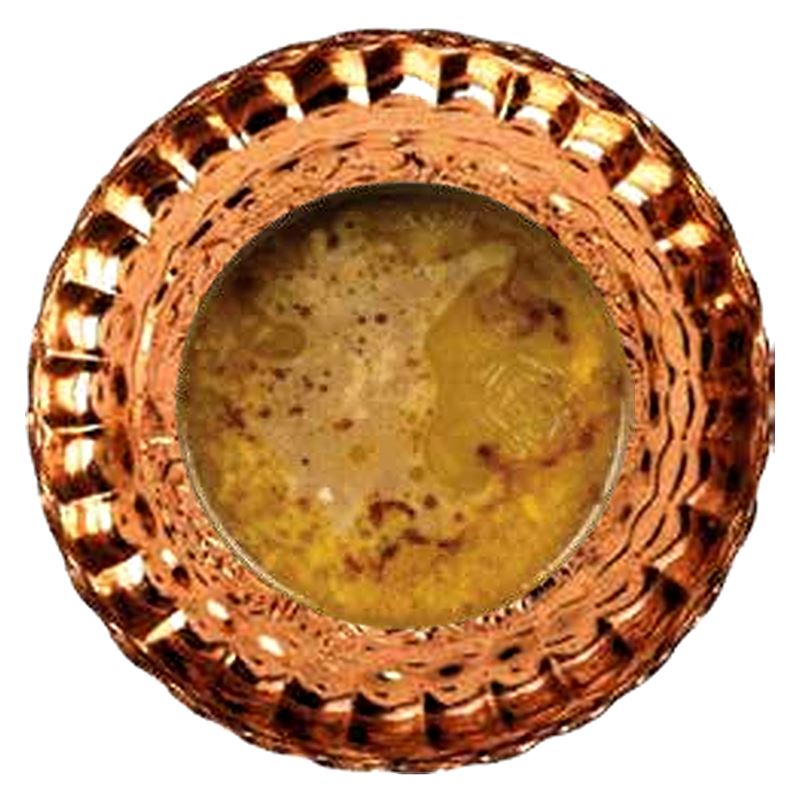
You already know the bowl: rice cooked so long it stops being rice, soft and warm and asking nothing of you. So when somebody calls kalle pache "the congee of Iran", the hesitation arrives instantly — it sounds like congee with the volume turned all the way up, built from parts you have never put on a spoon, and far too heavy for a morning. That hesitation is fair. The honest answer has three parts: yes, it is richer; no, it is not the same dish; and yes, there is a genuinely light way in.
This is a bridge, not a sales pitch. We cook kalle pache and we do not serve congee, so nothing here argues that one bowl beats the other.
What is congee, actually?
Congee is rice and a lot of water held at a low simmer until the grains give up and the starch thickens the pot into a savoury porridge. That is nearly the whole technique. What makes it endless is what comes after: the base is deliberately mild, so it becomes a canvas — ginger, spring onion, soy, white pepper, pickles, chilli oil, an egg, whatever the house keeps.
It has many names and many rules: juk in Korea, okayu in Japan, chao in Vietnam, bubur in Indonesia and Malaysia, lugaw in the Philippines, kanji in parts of South India and Sri Lanka, and several distinct versions inside China alone. Listing them in one line is shorthand, not a claim that they are interchangeable: each has its own argument about texture.
And what is kalle pache?
Kalle pache is lamb head and trotters — kalle is head, pache is trotters — cleaned carefully and simmered for many hours, usually overnight, until the broth turns thick on the lip and every part is soft enough for a spoon. No thickener, no cream: the body comes from bone and connective tissue giving themselves up to time.
The structural difference is what you notice first. Congee is one uniform texture. Kalle pache is a broth plus distinct pieces, and here you can order those pieces separately by the bowl: the soup itself (abgoosht broth), trotters, brain, tongue, lamb cheek, eye, meat, tripe, or a Special Mix. So it is not an all-or-nothing decision. For the longer background, here is an explainer on what kalle pache is.
Where do the two genuinely rhyme?
- Both are made of time, not money. Rice and water; bone and water. Neither uses a luxury ingredient. The cost is hours of low heat and somebody paying attention.
- Both are dawn food. Congee feeds breakfasts and night shifts across Asia. Kalle pache is traditionally eaten very early, sold by kitchens that were awake while the city slept.
- Both are what gets cooked when someone is cold or tired. That is a custom in both cultures — a custom, not a medical claim.
- Both are finished by the eater. The kitchen makes the base; you build the bowl at the table.
- Both lean on a starch. Congee keeps it in the pot; kalle pache keeps it at the table, as sangak bread torn and dipped.
So where do they actually differ?
Mostly in the base, the richness and the shape of the thing.
| Aspect | Congee | Kalle pache |
|---|---|---|
| Base | Rice broken down in water | Lamb head and trotters in water |
| Texture | One smooth porridge | Thick broth plus separate soft pieces |
| Richness | Light; richness comes from toppings | Rich by nature; the broth carries it |
| Cooking | An hour or two | Many hours, usually overnight |
| Classic occasion | Breakfast, night shifts, slow mornings | Pre-dawn breakfast, cold mornings, gatherings |
| Starch | In the pot | At the table — sangak bread |
| Table seasonings | Soy, white pepper, ginger, spring onion, chilli oil, pickles | Cinnamon, lemon, torshi, raw onion, fresh or pickled chilli |
| Ordered as | One bowl, many toppings | Singles by the bowl, or a platter |
If congee is my comfort level, is kalle pache too rich for me?
Straight answer: yes, a full plate of kalle pache is richer than a bowl of congee, and we will not pretend otherwise. But kalle pache on a menu is not one fixed dish, and the gap narrows a lot if you start in the right place.
The closest thing to a congee-shaped experience is Soup on its own — the abgoosht broth, no parts, nothing to negotiate texturally. Warm, savoury and clean, and you thicken it yourself with torn sangak much the way you would stir something into a congee. Some people order nothing else; here is the full case for starting with soup only.
The second gentle route is Brain Soup. If the word puts you off, that is completely understandable — but the texture is the softest and mildest thing on the menu, closer to a set custard than to anything chewy, and it arrives in broth rather than alone. To compare the singles, this guide walks through each one.
One honest note: this is rich food, and how often it suits you is a question about you, not the dish. None of this is medical advice. If you are watching fat or cholesterol, if you are pregnant, or if a doctor has already given you rules, ask your doctor or a registered dietitian rather than a restaurant blog. We will not print a number of bowls per week: we do not know you, and nobody honestly can.
How is it seasoned at the table?
This is the part congee lovers recognise fastest. In congee you reach for soy, white pepper, ginger, spring onion, chilli oil, pickles. In kalle pache the shelf differs but the instinct is identical: cinnamon over the broth, lemon to cut the fat, mixed torshi or garlic torshi for sourness, raw onion, fresh chilli or pickled green chilli for heat, capsicum if you like it, and extra sangak because the first bread never lasts. Tea alongside — black tea, or a kettle of tea if you are sitting in. Doogh, the salted yoghurt drink, does roughly what a sharp pickle does: it resets the palate between spoonfuls. New to it? The first-timer's guide covers the order of operations.
Can I eat it at breakfast time in Dubai?
Yes, and at any other hour. The kitchen at 64 Jumeira Street, Jumeirah 1, is open 24 hours, every day, so the pre-dawn bowl and the 2am bowl are equally available. If you want it waiting at a set time, the website takes scheduled orders up to about two days ahead — the practical way to have the dawn version without setting an alarm just to order.
What should I order the first time?
If congee is your reference point: Soup, a Sangak, and tea. A complete meal, and a fair test. Ready for more? The Single Dish platter gives one part with the broth, the Double Dish gives two, The Full Dish gives three. For a table of friends, The Khan's Platter is six portions — four lamb cheeks, eight trotters, two brains, three tongues, four eyes and five breads. There is an Omelette for anyone who wants none of this, which happens and is fine. The full menu guide lays out every option.
Do you serve congee?
No. We are one kalle pache kitchen with no branches, and congee is not on the menu. If congee is what you want tonight, go and get a good one — this article will still be here.
How do I order without any fuss?
Start on the homepage and choose delivery, pickup or dine-in; a table can be reserved for dine-in. There is no account, no sign-up and no password — your name and phone number, plus your Dubai area from the list and a pin on the map if it is coming to you. Both are required, because an address alone is often not enough to find a door here. Payment is by secure online card at checkout, and that is the only method. Delivery is free over AED 300.
After payment the kitchen confirms and sets an estimated time, your order gets its own page you can leave open, and the rider phones you on arrival. If the kitchen cannot take an order, it is refunded automatically to the card that paid, with the reason shown on that page. Anything else — a question, a change, a request — is a phone call to 04 321 8882, our only contact channel. The step-by-step ordering guide walks through the rest.
