How do you feed ten or more people kalle pache at home?
There is a particular joy in a big Persian table: cousins arriving in waves, a pot of broth steaming in the middle, everyone tearing sangak and reaching for the same platters. Feeding ten, twelve or twenty at home can sound daunting, but with kalle pache it is refreshingly simple, because the dish was always meant to be shared. The trick is ordering the right mix of platters, scaling the bread and sides to match, and timing everything so it lands at your door together and warm. This guide walks you through exactly that, whether it is a weekend family gathering, a birthday sofreh, or friends coming over after a long night.
Is a home crowd different from office catering?
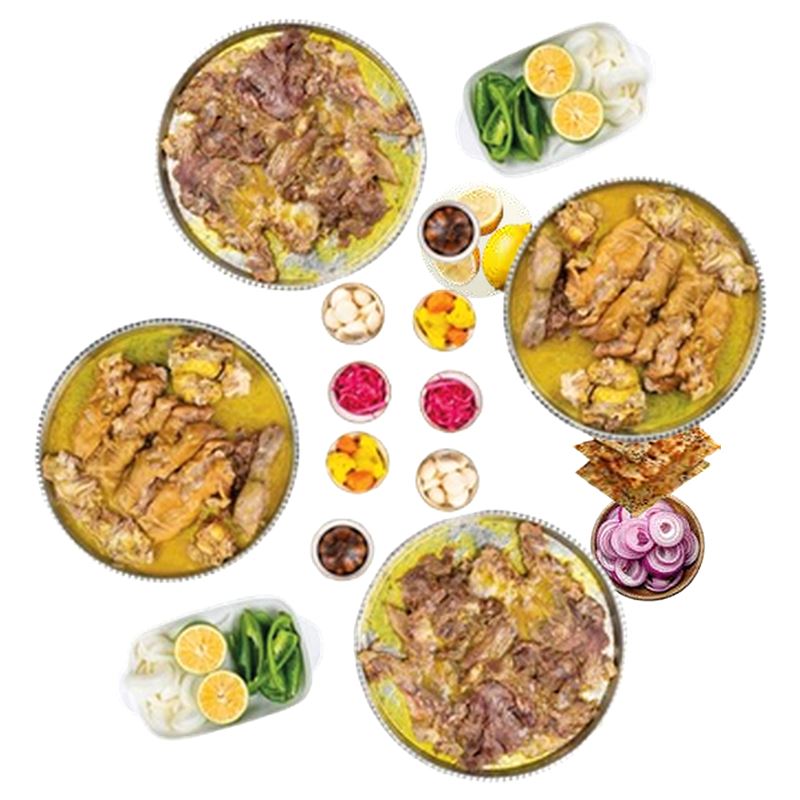
Yes, and it changes what you order. A home party is relaxed and communal: people graze, go back for seconds, mix parts on their plate, and linger over tea. You are not portioning identical boxes for a meeting room; you are laying out generous shared platters that people help themselves from. That is why our larger sharing platters, torn sangak and bowls of torshi in the middle of the table suit a home crowd so well. Order for the mood of the room, not for a headcount spreadsheet.
Which platters should you combine for a big group?
We build our menu in sharing sizes so you can scale by adding platters rather than guessing. The Full is a family platter for roughly three, and the Khan is our largest sharing platter, made for a group. For ten or more, the simplest approach is to start with one or more Khan platters as the centrepiece, then add Full platters to reach your number. Mixing sizes also lets you mix parts: pair a hearty platter with a Special Mix so first-timers can try a little tongue, cheek and more, keep a plain broth or two for gentler appetites, and add extra trotters or meat for the fans at the table. If you want the sizes explained side by side, see our guide to the Single, Double, Full and Khan platters.
How much kalle pache should you plan per person?
Appetites vary a lot with kalle pache — some people want a full bowl with everything, others just a taste of broth and bread — so plan generously and lean toward one extra platter rather than one too few. It is a forgiving dish to over-order: leftovers keep and reheat beautifully the next morning. As a rough rule of thumb, think in terms of shared platters per small group rather than exact grams per head, and remember that a big spread of bread, pickles and doogh stretches the meal further. For a fuller breakdown, our how-much-to-order-per-person guide goes deeper.
Suggested platter combinations by headcount
Use this as a starting point and adjust for how hungry your crowd runs. These are general suggestions, not fixed contents:
| Roughly how many | A good starting combination | Scale alongside |
|---|---|---|
| About 6 | One Khan platter | Sangak, torshi and doogh for the table |
| 8 to 10 | One Khan plus a Full platter | More sangak, extra torshi, a round of doogh |
| 10 to 12 | One Khan plus two Full platters, or two Khan | Add a plain broth and a Special Mix for variety |
| 14 to 16 | Two Khan plus a Full platter | Plenty of sangak, several bowls of torshi, doogh all round |
| 18 to 20+ | Two to three Khan plus Full platters to fit | Bread and sides scaled up, extra trotters or meat for fans |
How do you scale sangak, torshi and doogh for a crowd?
The sides are what turn platters into a feast, so scale them up deliberately. Order sangak generously — it disappears fast when everyone is tearing pieces into their broth — and the Special Sangak makes a nice centrepiece loaf. Put out plenty of seven-year garlic pickle and other torshi so bowls can circulate rather than being fought over, and count on a doogh or two per person, with Persian tea to finish. Our guide to sangak, torshi and doogh has more on getting the balance right.
Should you order ahead or schedule a party order?
For a gathering, ordering ahead is the difference between a scramble and a calm table. You can place a large order and schedule a future time at checkout, so everything is prepared to land together and fresh right when your guests arrive, rather than in trickles. Because our kitchen runs 24 hours a day, seven days a week, you can plan a late-night feast or an early-morning sofreh just as easily as a midday lunch. After you pay, you can follow your order status on the confirmation page, so you always know where things stand while you are busy hosting.
How does delivery work across Dubai for a big order?
We deliver across all of Dubai — 141 areas — so wherever you are hosting, the pot can come to you. At checkout you choose your area and drop a map pin so the rider finds your door, then pay securely online by card; the rider calls you when they arrive. The delivery fee is set by your area, and delivery is free over AED 300, which a table for ten or more comfortably reaches, so a big shared order often arrives with no delivery fee at all. Prefer to collect it yourself, or gather everyone at our tables instead? Pickup and dine-in are always open, and you can reserve a table for the group.
Ready to feed the whole table?
Building a spread for ten or more is genuinely easy: start with a Khan, add Full platters to your number, pile on the sangak, torshi and doogh, and schedule it to arrive together. When you are ready, order online and let the simmered-all-night pot come to your gathering, anywhere in Dubai, any hour of the day.
