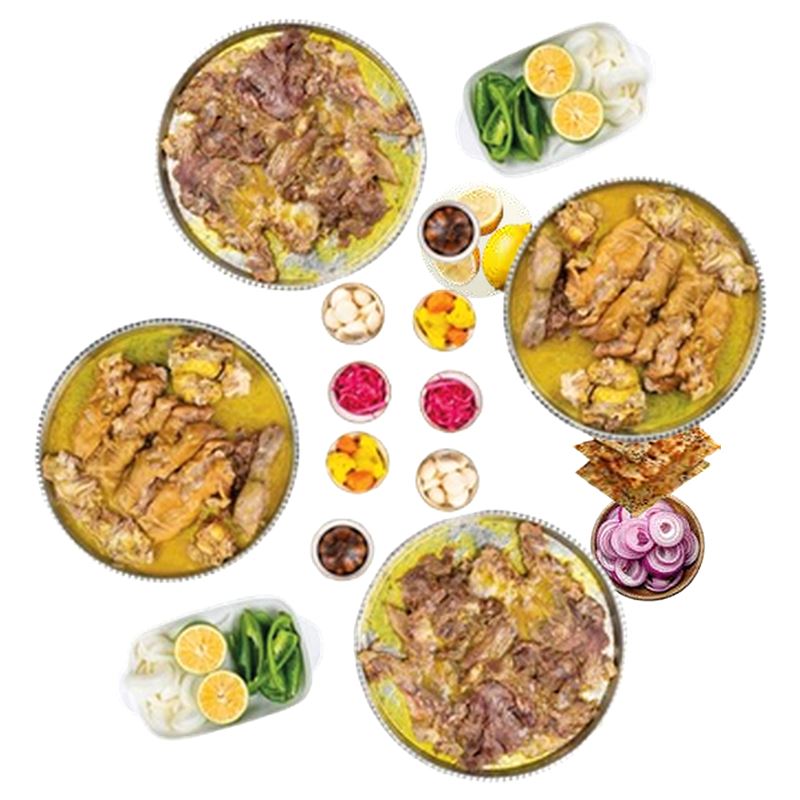
How do I host a Persian breakfast at home in Dubai?
The short answer is three lines: order the hot food, build the cold table yourself, and give the morning three hours instead of one. A Persian breakfast is not a course you serve and clear away. It is a sofreh — a cloth spread with dishes that everyone reaches into at their own pace — and the host's real work is arrangement, timing and tea rather than cooking.
What makes this easy in Dubai is that the hardest part has already been done somewhere else. At Shaun the Sheep, 64 Jumeira Street, Jumeirah 1, the heads and trotters are cleaned by hand before dawn and simmered for around fourteen hours in a copper pot with onion, turmeric and garlic, skimmed hourly until the broth is the colour of strong tea. Nobody reproduces that in an apartment kitchen between one evening and the next morning. The kitchen also runs 24 hours a day, seven days a week, so your sofreh can start at six in the morning without anyone in your household getting up at three.
What actually goes on the sofreh, and how do I lay it out?
Traditionally the cloth goes on the floor with cushions around it; a long dining table works just as well, and in most Dubai homes it is the practical choice when guests are in their sixties and up. Either way, the geometry matters more than the crockery. The rule is simple: nothing on the sofreh should be more than an arm's length from any guest. A Persian breakfast is not passed around — people lean in and take.
Work in three rings. In the centre go the communal platters and the bowls of broth, so every hand can reach the middle. In the second ring, repeat the small things every three seats rather than making one bowl travel the length of the table: mixed torshi, the seven-year garlic pickle, salt, dried lime or fresh lemon, and cinnamon for those who take it in the broth. In the outer ring go the personal items — a shallow bowl and a spoon each, a small plate and a folded napkin, because kalle pache is eaten with a spoon and with bread, not with a knife and fork.
Bread lives in the middle, torn rather than sliced, and it should be the last thing you unwrap. Sangak loses its steam in about ten minutes on a table, so keep it in its paper until the platters land.
What should I order in, and what should I make myself?
The dividing line is time, not skill. Anything that needs half a day of simmering or seven years of pickling gets ordered; anything that needs ten minutes and a chopping board is yours.
| Item | Order in or make | Why |
|---|---|---|
| Kalle pache platters (1, 2, 3 or 6 people) | Order | About fourteen hours of simmering and hourly skimming — not a home project |
| Extra plain soup or brain soup | Order | The simplest insurance for late arrivals and cautious eaters |
| Sangak and special sangak | Order | Arrives warm and is the one thing every table runs out of |
| Mixed torshi, seven-year garlic pickle | Order | Aged pickles cannot be improvised the night before |
| Doogh, tea, lemonade | Order the cold drinks, brew the tea at home | Tea must be endless and hot, so it belongs to the host |
| Feta, walnuts, butter, honey, jam | Make or buy | Ten minutes of plating, no cooking at all |
| Fresh herbs, cucumber, tomato, radish | Make | Washed and piled the night before, refreshed in the morning |
| Eggs, omelette or a simple fried tomato dish | Make, and make last | Cooked to order in the table's second act for anyone still hungry |
Building the order this way also answers the budget question honestly: you pay for the one thing that genuinely cannot be made at home, and the rest of the sofreh comes from a single supermarket run. Assemble the hot half on the menu and order page and choose delivery — the fee is set by your Dubai area at checkout — or collect it yourself if you live nearby.
How do I time the morning so everything arrives hot?
Pick the moment you want everyone eating, then count backwards from it.
- The night before. Lay the cloth, set out the bowls and spoons, wash and dry the herbs, and place the order — a large order is best scheduled for a set time so every platter is ready together rather than trickling out of the kitchen.
- Ninety minutes before. Start the tea. The first pot should be brewed and sitting over the kettle long before anyone arrives.
- Sixty minutes before. Put out the cold table: feta, herbs, walnuts, butter and honey, torshi, garlic pickle, salt and lemon. Guests always arrive early, and this is what they graze on.
- Zero. The platters and bread land. Unwrap the sangak, ladle the broth, and call people to the sofreh immediately — the first ten minutes are when kalle pache is at its best.
If the food needs holding, keep the broth in a covered pot on the lowest heat and never let it come back to a rolling boil; the softer cuts, brain above all, are easily overcooked into nothing. Ordering one extra bowl of plain soup gives you something hot to offer the guest who arrives forty minutes late without disturbing the platters. And if hosting feels like too much on the day, you can simply reserve a table and let the sofreh be laid for you.
How much bread, torshi and tea do I need per guest?
Bread is cutlery here, not a side dish, and under-ordering it is the most common mistake a first-time host makes. Plan one sangak per person as the floor, plus one extra for every three guests. Mixed torshi serves two comfortably; the seven-year garlic pickle serves three or four, because most people take a single clove and stop. Doogh is one glass each if your table drinks it.
Tea deserves its own paragraph, because it is the instrument you use to pace the morning. Brew it strong in a pot set over a kettle and pour each glass to the colour its drinker asks for — pale for some, almost black for others — topping up from the kettle rather than serving one uniform strength. Use small waisted glasses and never fill to the brim; a glass poured three-quarters full can be picked up straight away and refilled often, which is the point. Sugar cubes, rock candy or dates go beside the glass, not in it. Count one pot for every three or four guests, then expect to brew three rounds across a long morning.
How do people sit and share at a sofreh?
The oldest guests sit furthest from the door, and the host takes the seat nearest the kitchen so getting up is never an interruption. Serve broth to your guests before you pour your own, and keep an eye on the bread pile all morning — a Persian host's job is to notice what is running low before anyone has to ask.
At the table itself, nobody builds a personal plate. You take from the dish in front of you, tear bread, dip and eat, and the platters stay in the middle. The brain and the lamb cheek are traditionally offered first to the guest of honour, a piece of etiquette worth keeping even among friends. Expect the polite refusal on the way — the first offer is declined out of good manners and the second is accepted — so offer twice.
How do I pace a long slow morning for 6 to 12 guests?
Think in three acts. The first is arrival and tea, lasting thirty to forty minutes while people trickle in and eat bread, feta and herbs. The second is the hot table, forty minutes of platters, broth and refilled bread, with eggs cooked to order for anyone who wants them. The third is the long tail: fresh tea, fruit, something sweet, and an hour or more of conversation that is the actual reason people came.
For quantities, count in sixes. Six guests take one 6-person platter; eight to ten take a 6 plus a 3; twelve take two 6-person platters. If several of your guests are new to kalle pache, swap part of that for singles — tongue, lamb cheek and meat are the cuts that win newcomers — and add a Special Mix so they can taste widely without committing to one thing. The lamb is halal, as UAE law and standards require.
One last note of common sense: this is a guide to hospitality and tradition, not to health. Kalle pache is a rich dish, and if you or a guest has a dietary or medical condition, the right person to ask is a doctor. For allergies or specific ingredient questions, contact the restaurant directly before you order.
