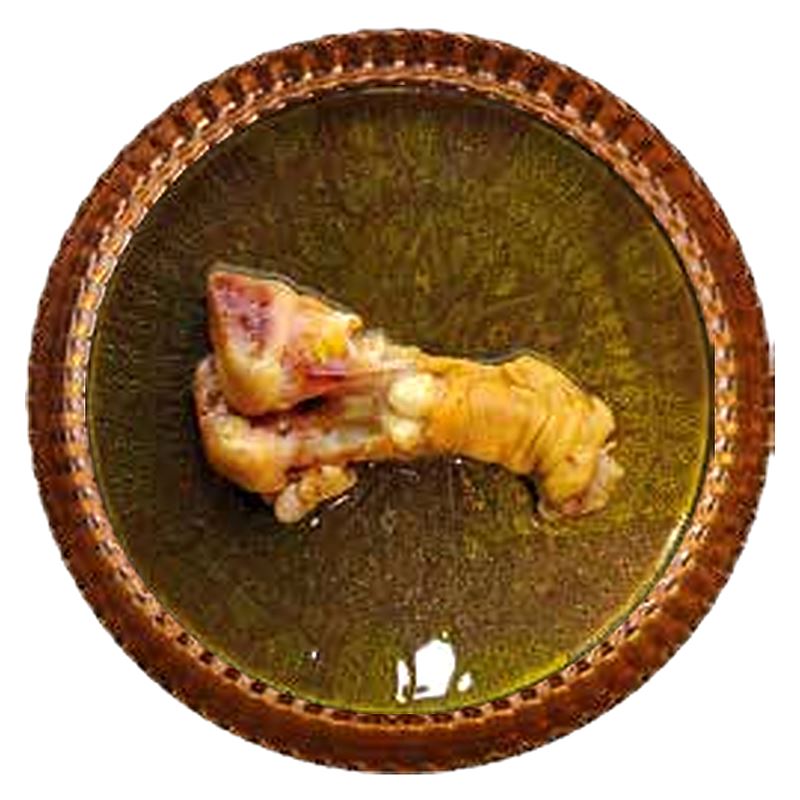
The marrow is the soft, fatty centre inside the heavier bones on the plate, and yes, you are meant to eat it: people tap the bone against the rim of the bowl, push it out with the handle of a spoon, or put their lips to the open end and draw it out. All three are ordinary at a kalle-pache table, none of them is bad manners, and when you are finished the bones go on a side plate and nobody gives them another thought.
This is the part of the meal first-timers leave behind and regulars go for straight away. Not every bone on the plate holds marrow, and the ones that do give it up more easily than they look.
What is marrow, and why do regulars go for it first?
Marrow is the soft tissue sitting in the hollow of a bone. Cooked long and slow it turns loose and glossy; it slides rather than chews. It is rich — noticeably richer than the meat around it — so a little goes a long way, and plenty of people spread it onto bread rather than eat it straight from the bone.
Regulars take it early for a practical reason: it is at its best while everything is still hot. As the plate cools the marrow firms and the broth thickens, and it stops sliding out the way it does in the first few minutes. If you know you want it, deal with it before you settle into the conversation.
Which bones carry marrow, and which are mostly collagen?
Here is the distinction that matters. Trotters — pacheh — are skin, tendon and small bones, and they are the gelatine part of the dish: what they give you is the sticky, lip-coating body of the broth, not marrow. The heavier bones, the long leg sections and the neck pieces, are the ones with a hollow centre worth working at.
And a good part of the order has no bone in it at all. Brain, tongue, cheek and eye arrive soft; there is nothing to crack and nothing to lever. If bone work is not your idea of dinner, those are the singles to lean on, and our guide to choosing a single goes through them one at a time.
| What is on the plate | What it mainly gives you | How to get at it |
|---|---|---|
| Trotters (pacheh) | Gelatine, skin and tendon — the body of the broth | Pull the skin away with fingers or a fork; the small bones stay behind |
| Heavier leg and neck bones | Marrow, where the bone is hollow | Tap on the rim, push with a spoon handle, or draw it out by mouth |
| Brain (maghz) | Soft, almost custard-like, no bone | Spoon it, or fold it into bread with torshi |
| Tongue (zaban) | Dense and clean-tasting, no bone | Slice it and eat it like meat |
| Lamb cheek (bonagoosh) | The muscle that worked hardest — tender, no bone | It comes apart under a fork |
| Eye (cheshm) | Small, rich, no bone | One bite, usually with bread |
| Soup (the broth) | The liquid from the long simmer | Drink it, or tear sangak into it |
Which bones land in your bowl varies with what you order and with the animal itself. To know what a particular dish is carrying tonight, phone 04 321 8882 and ask before you order.
How do people actually get the marrow out?
There is no technique you have to earn first. In practice three things happen at every table:
- The tap. Hold the bone over your bowl and knock it firmly against the rim once or twice. Hot marrow often drops straight into the broth, which is where a lot of people want it anyway.
- The spoon handle. Slide the thin end of a spoon into the hollow and push through. This is the tidiest method, and the one to use if you are eating in company you would like to impress — though honestly nobody is watching.
- Straight from the bone. Lips to the open end, and pull. It is the oldest way and the most efficient. It is not rude and it is not a party trick; at a kalle-pache table it is about as controversial as picking up a chicken wing.
Bread helps with all three: tear a piece of sangak, use it as a pad between your hand and a hot bone, and let it catch whatever comes out. Give the bones a minute first — they hold heat longer than the broth suggests. If the whole dish is new to you, the first-timer's guide covers the rest of the plate.
Why is the broth around the bones so thick?
Because of what comes out of the bones, skin and trotters over a long cook. The heads and trotters are cleaned and trimmed thoroughly, then blanched, and that first water is thrown away. The pot is then simmered for many hours — around fourteen — and skimmed again and again as it works. Over that time the collagen in bone, skin and trotters dissolves into the liquid, which is why the broth coats a spoon and why a bowl left to cool will set. That set is a sign the broth did its time, not a fault. There is more on this in the texture guide.
What is the etiquette once you are done with a bone?
Simple: bones go on a side plate, or on the edge of your own if there is no side plate. Fingers are normal, napkins get used, and nobody is scoring your technique. Nobody expects you to finish everything, and a bone left with meat on it is not a comment on the food.
The only real rule is to move quickly on the hot things and be generous with the bread. If someone else wants the marrow and you do not, hand the bone across; that is how these plates have always been shared.
Should you keep the bones for a second broth at home?
You can, but be realistic about the result. The kitchen has already had roughly fourteen hours with those bones, skimming as it went, so most of what was there to dissolve has already dissolved and is sitting in the broth you just drank. A second pot at home gives you something pale and thin — usable as a base under rice or in a soup, not a bowl you would serve on its own.
If you try it anyway, treat the bones like any cooked leftover: cool them quickly, refrigerate them, use them within a day or two. Do not expect it to set the way the original did, for the same reason it tastes lighter.
Is marrow good for you?
Marrow is fat-rich, and rich in a way you can feel. That is an honest description of a food, not a health claim: it does not cure, treat or prevent anything, and how much of it suits you depends on your own health, your medication and the rest of your diet. This is not medical advice — ask your doctor or a dietitian. If you are watching fat intake, have that conversation before you build a meal around bones.
What should you order if the bones are the point?
Trotters by the bowl are the direct route to the gelatine — texture and broth rather than marrow. If you want more to work through, the Full Dish covers three, and the Khan's Platter is built for six: four lamb cheeks, eight trotters, two brains, three tongues, four eyes and five breads. Order extra sangak either way; bread and bones belong together.
You can order from the homepage for delivery, pickup or dine-in, and you can reserve a table if you are eating in. No account, no sign-up — just a name and a phone number, plus your Dubai area from the list and a pin on the map for delivery. Payment is by secure online card at checkout, delivery is free over AED 300, and the kitchen is open twenty-four hours every day. You can also schedule an order up to about two days ahead. Once the kitchen confirms, you get an estimated time and your order has its own page, and the rider phones you when he arrives. If anything is unclear, 04 321 8882 is the number, and it is the only way to reach us.
