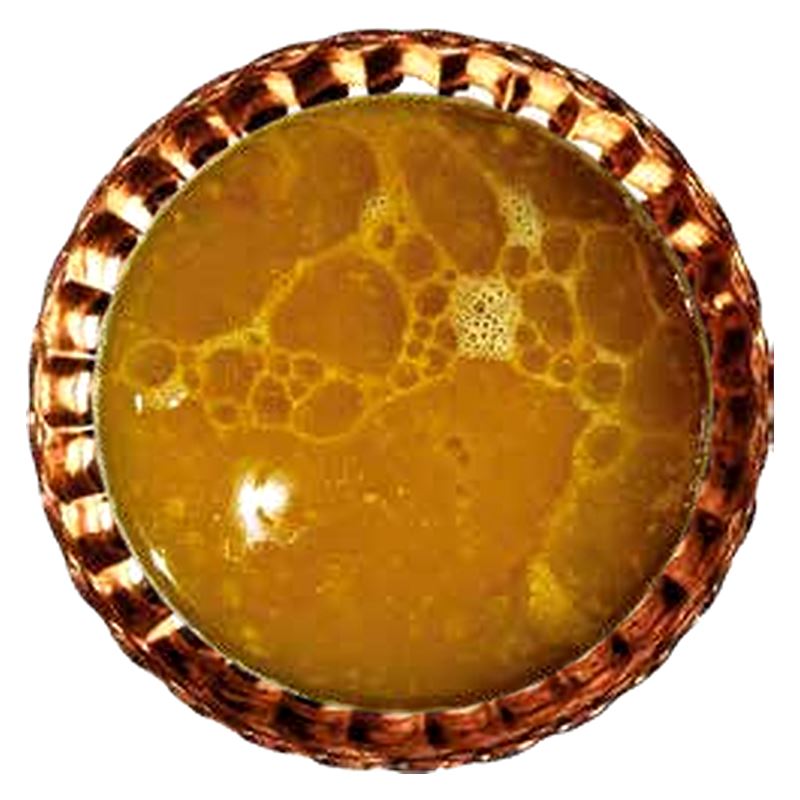
What does a well-made kalle pache broth look like?
Look into the bowl before you taste anything. A broth built properly is translucent — light amber, clear enough to see the pieces at the bottom rather than a murky grey wall. Golden fat sits on top in coins, not a heavy uniform slick.
Cloudiness is a clue, not a crime. Broth turns opaque when it is boiled hard rather than simmered: a rolling boil smashes fat and dissolved protein into an emulsion that never settles. It also dulls when the head, trotters and tripe were not scraped and rinsed thoroughly, since residue left behind stays suspended in the liquid.
How should kalle pache smell if it is done right?
The honest test happens before the first spoonful. A good pot smells savoury and rounded — lamb, onion, a whisper of warm spice. What you should not meet is a sharp barnyard note that makes you pull your head back. That comes from residue and from parts rushed to the stove, not from the lamb.
Cleaning is the unglamorous half of it: the head shaved and scrubbed, trotters cleared of hair and grit, tripe turned out and washed again and again, everything blanched and the first water thrown away. Skip any of it and no amount of cinnamon will hide the result. Kitchens that take this seriously usually keep every other habit tidy, which matters when you are judging whether a Persian kitchen cooks for locals or for tourists.
Why does good kalle pache broth turn to jelly as it cools?
This is the most reliable sign, and you can test it with whatever you take away: left to cool, the broth should thicken and set into a soft, wobbling jelly you can tilt without it running.
The reason is collagen. Trotters, along with the skin and connective tissue of the head, are dense with it. Under long gentle heat that collagen breaks down into gelatin and dissolves into the water; as the liquid cools the gelatin re-links into a loose mesh and the broth sets. One that stays watery when cold was simmered too briefly, padded out with water, or made without enough trotter. It is the same chemistry behind the collagen people associate with this dish.
What should the meat feel like?
Push a piece with the side of a spoon. Cheek and head meat should give way without resistance, separating into soft glossy pieces that still hold their shape, and trotter should be sticky at the joint. Meat that fights the spoon has not had its time; the connective tissue is intact and it chews like elastic. Meat that collapses into dry threads at a touch was boiled too hard, so the fibres squeezed out their moisture and separated. That window is wide at low heat and narrow at high heat, which is why patience matters more than temperature.
How do the spices show whether it was cooked with care?
Persian kalle pache is restrained. Onion, a little garlic, often a stick of cinnamon, sometimes dried lime or a pinch of turmeric — the aromatics round the edges of the lamb rather than replace it. The lamb should arrive first and the cinnamon a beat later, warm and in the background. If spice is the first thing you notice, ask what it is covering: heavy seasoning is the usual way to mask parts that were not cleaned well. A careful kitchen leaves salt, lemon and pepper to the table, for your own judgement.
Does the long simmer really change the result?
It changes everything. Held just below a boil overnight, the pot extracts gelatin steadily and keeps the fat separate rather than beating it into the liquid, which is why a slow broth is clearer and richer at once. Fast cooking gives the opposite: cloudy liquid, thin body, tough or stringy meat. That is also why the dish belongs to the early hours in Iran; we walk through the overnight process step by step.
At Shaun the Sheep, 64 Jumeira Street in Jumeirah 1, the pot runs around the clock with halal lamb. Eat in, collect, or have it delivered across Dubai, then judge it yourself.
