Why did my Persian dish turn bitter?
Nearly always one of three things: something scorched in a pan, something sat in the pot past its welcome, or something was already bitter before it went in. Work out which family you are in and you usually know what happened. What you will not get is a way to take it back out.
Why can you not correct bitter the way you correct salty or sour?
Every other fault has an opposite. Too salty, stretch the pot. Too sour, a pinch of sugar rounds it. Bitterness has none. Sugar does not cancel it, it sits beside it, and now the dish is bitter and sweet. Sour distracts for a spoonful and then it returns. And it does not cook off — more time usually deepens it.
Where does bitterness get into a Persian pot?
Six places, each a specific step. Hardly any are slow mistakes; they are short windows that closed while you looked away.
| Where it enters | What did it | Where you meet it |
|---|---|---|
| The garnish pan | Mint, garlic or onion taken past golden | Ash reshteh, ash-e jo, mirza ghasemi |
| The toasting pan | Noodles, flour or barberries left too long | Reshteh polo, ranginak, zereshk polo |
| The long simmer | Dried limes left in past their welcome | Ghormeh sabzi, gheime, khoresh bademjan |
| The finish | Kashk boiled hard; tea standing over heat | Ash-e jo, a stewed pot of chai |
| The shopping bag | Walnuts or pistachios past their best | Fesenjan, anything finished with nuts |
| The prep board | Aubergine unsalted or undercooked; orange pith | Kashk-e bademjan, tas kabab, shirin polo |
Which bitterness comes out of the frying pan?
Most of it. Persian cooking hangs a lot of flavour on things fried in oil for seconds, and seconds is the problem.
- Dried mint. Na'na dagh is usually bloomed in oil taken off the flame; residual heat is all it needs. Mint goes from fragrant to acrid faster than anything else on the stove.
- Garlic. Pale gold is the finish line for sir dagh, and it keeps cooking after you stop watching. Burnt garlic in mirza ghasemi is not a background note, it is the flavour.
- Turmeric. Past its bloom it goes dull khaki and genuinely bitter; our guide to zardchoobeh shows where that line sits.
- Anything toasting dry. Noodles for reshteh polo, flour for ranginak, barberries in butter. All three colour beautifully and then keep going.
Which bitterness comes from leaving something in too long?
Dried limes are the main offender. Limoo amani gives ghormeh sabzi, gheime and khoresh bademjan their smoky sourness, and then, past a point nobody can put a number on, a drying bitterness that reads as too sour until you notice it is not sour. Here the fix is real, the only real one in this article — lift the limes out. Our ghormeh sabzi recipe has them going in; when they come out is a taste-as-you-go call, not a clock one.
Kashk taken to a hard rolling boil splits and turns, and a soup finished with kashk is finished with it. Tea belongs here too: a pot standing over heat stews, and stewed tea is bitter and flat rather than strong.
Which bitterness was already there before you started?
The third family is decided before the pot is even on, which makes it the most frustrating: nothing later reaches it.
- Old nuts. A tired walnut or pistachio tastes bitter and faintly soapy long before it looks old. In fesenjan, where ground walnuts are most of the dish, one bad bag is the whole pot. Taste one before you grind, and keep them in a sealed jar, out of the light.
- Fenugreek. Shanbalileh is meant to be faintly bitter — that is what makes ghormeh sabzi taste like itself. A heavy hand carries it from signature to fault.
- Aubergine. Two faults wear one face: flesh never salted and drained, and flesh not cooked through to soft.
- Orange pith. The white under the zest is pure bitterness, which is why shirin polo blanches its peel through changes of water.
- Bruised mint. In a sharbat, mint pressed hard enough to tear gives bitterness, not perfume.
Can a bitter pot be rescued?
Usually not, and it is kinder to say so. Four honest moves; only two are repairs.
- Remove the source, if it is still an object you can reach — dried limes, a strip of peel, a scorched slice of onion.
- Remake the garnish. If the mint oil or the fried garlic is bitter and the soup underneath is clean, start again in a clean pan.
- Dilute. More broth, more base, more rice underneath. It lowers the concentration of everything, including what you wanted.
- Balance. Sugar, sour or fat. This masks; it does not remove.
The old trick of a peeled potato in the stew is worth trying. At best it takes a little off the edge; it will not save a burnt garnish.
How do you catch bitterness before it happens?
The fixes being thin, the whole game is in the warning signs, all of them sensory. Smell is the first alarm: there is a toasty stage before the bitter one, a warning rather than a verdict. Our guide to when to stir a pot and when to leave it alone reads a pot by ear and nose rather than by the clock. Colour is second: golden is the target, brown is already past it. Sound is third: a pan gone quiet has lost its moisture, and dry is where scorching begins. One habit beats all three: taste the small components on their own, because a component can be thrown away and a pot cannot.
Does a fourteen-hour broth ever turn bitter?
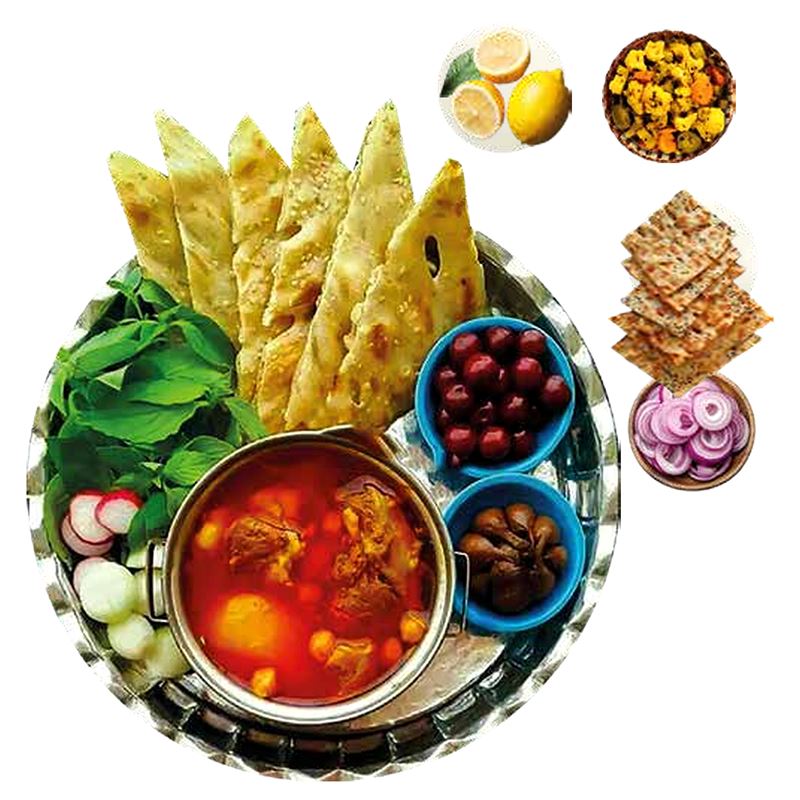
Rarely, and the reason is instructive. Kalle pache has almost none of the steps above: no fried herb garnish, no toasted anything, no dried lime in the pot, no nuts. It is lamb head and trotters, water and time; the sharp things that cut it — onion, chili, torshi — sit on the side rather than in the pot. What it has instead is a great weight of bone resting on the base of the pot for about fourteen hours, and that is the main route in: a pot that catches underneath pushes a burnt edge through the whole batch, and you cannot skim it out. Our guide to what goes wrong with home-made kalle pache covers it alongside cloudy and greasy broth.
Or skip the fourteen hours. At Shaun the Sheep, 64 Jumeira Street, Jumeirah 1, the pot runs around the clock, seven days a week, for dine-in, pickup and delivery across 141 Dubai areas, with the fee for your area shown at checkout. For anything we have not answered, call 04 321 8882 and ask.
