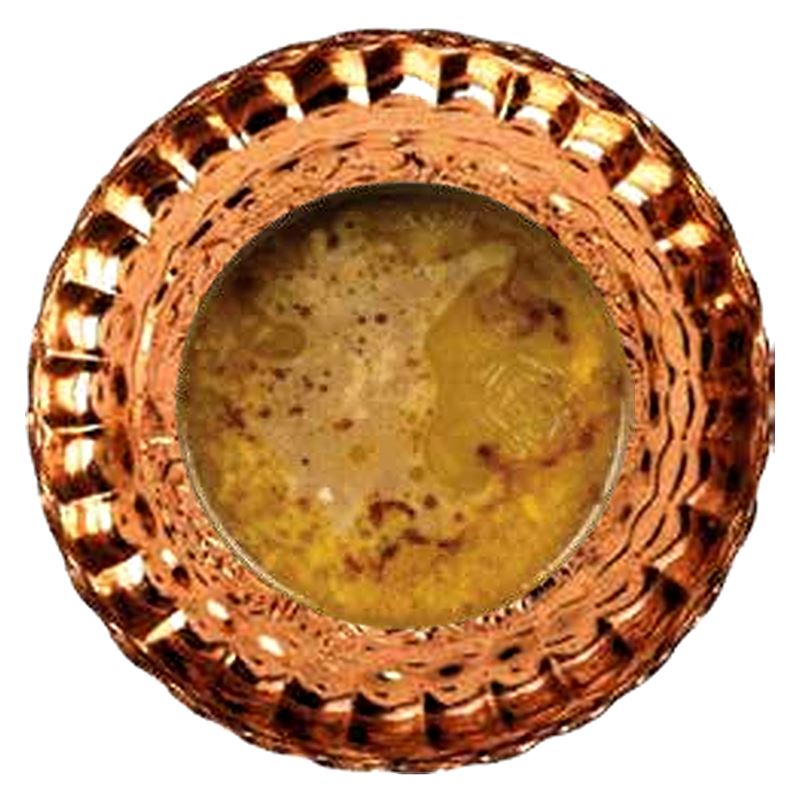
What is zardchoobeh?
Zardchoobeh (زردچوبه) is the Persian name for turmeric, and it is the ground spice that opens more Iranian recipes than anything else on the shelf. The name is literal. Zard is yellow; choobeh comes from choob, wood. Yellow wood, after the hard dried root the powder is milled from.
Persian recipes assume you already know what to do with it, and ours are no better. Our own recipes tell you to bloom the turmeric, and not one of them stops to say why oil, why first, or what goes wrong when you skip it. This page stops.
Why does almost every Persian pot start with onion, then turmeric?
Open a khoresh, an ash, a kuku, a kotlet or a breakfast pottage and the first three lines are near enough identical: fat in the pan, onion cooked down until it is soft and deep gold, then the turmeric goes in and is stirred for well under a minute before anything wet arrives.
That order is not habit. It is the only moment in the whole recipe when there is hot fat and no liquid. Once the water, the tomato paste, the beans or the lentils go in, the pan is a wet pot and stays one for the next hour. Whatever the turmeric was going to give up, it has to give up in that short window.
Our adasi, the lentil breakfast pottage, and our eshkeneh, the old onion soup, both do exactly this, and neither explains itself.
Is turmeric there for colour, or for flavour?
Mostly colour, and then a quiet note underneath it. Here is the honest test: in a well-made Persian dish you should not be able to point at the turmeric. If you can taste it as itself, there is too much of it, or it was not cooked properly.
What it does contribute is warmth and a faint earthiness that sits under lamb, lentils, split peas and beans and rounds the edge off ingredients that smell strong on their own. That is a supporting job, not a starring one, and it is why the same small measure turns up in dishes that otherwise share nothing at all. In one famous dish it does almost nothing else, because there is almost nothing else in the pot: kalle pache is left deliberately plain.
Why is turmeric bloomed in oil instead of stirred into the liquid?
Because the parts of turmeric you actually want — the colour, and what little aroma it carries — dissolve in fat and barely dissolve in water.
Stir the powder straight into a pot of broth and most of it never dissolves at all. It hangs in the liquid as a suspension, drifts to the bottom, tints unevenly, and leaves colour clinging to whatever it settles on. Stir the same spoonful through warm oil and it goes into solution almost at once. The oil turns a clear, deep gold, and when the liquid arrives that gold is carried evenly through the whole pot and into every piece of meat and every lentil.
Blooming is also how the powder loses its raw edge, which is the other half of the instruction.
What is the raw, dusty taste that tells you the step was skipped?
Ground turmeric straight from the jar tastes chalky and dry, with a flat bitterness that sits on the front of the tongue and does not move. It tastes of the cupboard rather than of the dish. In a soup or a stew it reads as a dusty film over everything, and once the pot is wet you cannot cook it out.
Judge the bloom by smell and by the oil, not by a clock. Thirty seconds to a minute of stirring is usually plenty. The powder stops smelling like a jar and starts smelling warm and faintly toasted, the rasping dryness goes, and the oil moves from cloudy mustard to clear gold.
The far side is real too. Push it and turmeric turns dull khaki and genuinely bitter, and that bitterness does not cook out either. This is a step measured in seconds, which is exactly why recipes never bother to give it a number.
Why does the dose barely move from one recipe to the next?
Across Persian recipes turmeric tends to sit between a quarter of a teaspoon and a teaspoon, and half a teaspoon is the commonest measure of all. A pot of lentils for four takes the same spoonful as a lamb stew for six.
That is because it is a colour dose, not a flavour dose. A small amount will tint a very large pot, so once the colour is where you want it, adding more gains you nothing you were after. The yellow goes muddy rather than brighter, and the bitterness starts to show. Turmeric is one of the few spices where the number in the recipe is close to the ceiling rather than a starting suggestion.
Why does Persian turmeric read so quiet next to a curry?
Same spice, opposite job. In much South Asian cooking turmeric is one voice in a large chorus, with cumin, coriander seed, chilli, ginger and a dozen other things layered over the top of it. It is a base colour under a loud arrangement, and the ground spice in the pan can run to several spoonfuls.
In a Persian pot, turmeric is very often the only ground spice in the entire recipe. Everything that makes the dish taste of something comes from elsewhere: onions cooked slowly to sweetness, herbs by the bunch, dried lime or pomegranate or verjuice for sourness, and long unhurried cooking. Turmeric is not competing with anyone, so it is never asked to raise its voice. The difference is the company it keeps, not the quantity.
If both turn a dish yellow, why is turmeric not saffron?
They are not relatives and they do not do the same work. Turmeric is a ground root that colours from underneath and adds warmth. Saffron is a flower thread, ground and then bloomed in liquid, laid over a dish for its perfume. Swap one for the other and you get a yellow dish with none of the smell you were paying attention for. Our guide to saffron, and how to grind and bloom it, sets the difference out properly.
How should zardchoobeh live in your kitchen?
Buy it ground; the fresh root plays almost no part in this repertoire. Iranian and Middle Eastern grocers around Dubai carry it, and the thing to look at is the colour. A bright, even mustard-gold powder is what you want. A dull, brownish one is old. Ground spice fades, so keep it in a sealed jar, out of the light, and judge it by how it looks and smells rather than by anything printed on the label.
One practical warning. Turmeric stains readily and stubbornly: fingers, wooden spoons, plastic boards, pale worktops, tea towels. Use a metal spoon, keep it away from anything porous, and wipe spills before they dry.
If you would rather eat the results than measure them, Shaun the Sheep is at 64 Jumeira Street, Jumeirah 1, open 24 hours a day, seven days a week, with dine-in, pickup and delivery across 141 Dubai areas, the fee for your area shown at checkout. The menu is here. For a question about what goes into a particular dish, call 04 321 8882 and ask.
