“Can I get chelo with that?”
It is one of the first questions a newcomer asks when the bowl arrives. Persian food, to most minds, means rice: saffron-tipped chelo, tahdig lifted out in one golden sheet, a stew alongside. So when kalle pache arrives with nothing but warm sangak to tear by hand, the question is fair. Where is the rice?
The honest answer: kalle pache was never a rice dish, and no kitchen in Iran has tried to make it one. That is not an oversight; it is what the meal is.
Bread is the dawn grain; rice belongs to the later sofreh
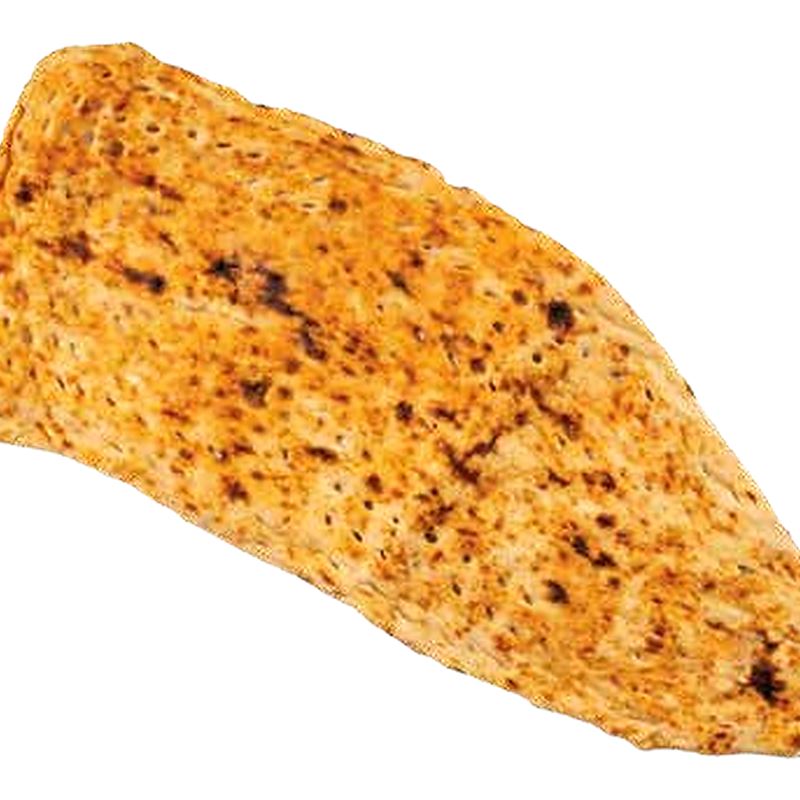
In Iran the day’s grains are divided by the clock. Morning belongs to bread — sangak, barbari, taftoon — with cheese and walnuts, with haleem, with adasi, with kalle pache. Rice belongs to the midday and evening sofreh: chelo with khoresh, polo with lamb, what a household sits down to when the working day is done.
Kalle pache is a dawn meal by tradition. It simmers through the night and is eaten early, often before work, at the hour when bread ovens are the only kitchens awake. Asking for rice with it is like asking for a rice plate at breakfast: nobody would refuse you, but you have stepped outside the shape of the meal. Dubai has loosened the clock, but the pairing came from that dawn habit and stayed.
What torn sangak does that rice cannot
This is the practical half, and the more convincing one. Kalle pache is a bowl of broth, soft meat and rendered fat; the bread is not a side dish but a tool, doing three jobs at once.
- It soaks. Sangak is baked thin on hot stones: dry-edged, with an open, uneven crumb. Torn into the bowl it drinks broth and holds it. Rice, cooked separately and steamed dry, sits in liquid instead of absorbing it: wet rice, not a richer mouthful.
- It carries fat. The fat rendered out of head and trotters over a long simmer is the best part of the bowl, and it needs something to cling to. Sangak dragged across the surface takes that film; loose grains let it slide off.
- It lifts. A torn piece works as a spoon: pinch a strip of cheek or tongue, a piece of trotter, a little brain, and eat bread and filling in one bite. Rice needs a second implement and motion.
Texture matters as well. Kalle pache is soft nearly the whole way through; the contrast on the table comes from raw onion, green pepper, torshi and lime, and from the chew at the bread’s edge. Rice adds one more soft thing to a soft bowl; bread adds structure.
One pot, eaten as one thing
A chelo-and-khoresh sofreh is built from parts cooked apart on purpose: rice seasoned on its own terms, stew on its own, assembled by the eater on the plate. That separation is the point; it is why the tahdig stays crisp while the khoresh stays loose.
Kalle pache is the opposite. Everything went into one pot and came out, about fourteen hours later, as one thing: bone, cartilage and fat broken down into a broth that seasons every piece in it. A starch cooked in another pot would sit beside that bowl rather than in it, seasoned on other terms.
If you genuinely want rice
- Split the day. Eat kalle pache with bread only and keep the chelo for lunch or dinner. That is how the two live side by side in Iran.
- Treat rice as its own plate, not a component. At the same sitting, keep it separate rather than ladling broth over it. Bread and rice in one mouthful pull the meal in two directions.
- Try the bread properly first. Tear it small, push it under the surface, let it sit a moment, then lift. Do that once before deciding the bowl needs rice.
How it comes to the table in Dubai
At Shaun the Sheep in Jumeirah we serve kalle pache as it is served in Tehran: lamb head and trotters simmered around fourteen hours, with sangak, torshi, lime, onion and green pepper. Order singles from the menu — eye, brain, meat, tongue, trotters, tripe, lamb cheek, brain soup, soup, or the special mix (mojoon) — or a platter sized to the table: Single Dish for one, Double Dish for two, The Full Dish for three, The Khan’s Platter for six.
We are open 24/7 for dine-in and delivery across Dubai, and you can pre-order for a later time. Orders on the website are paid by card in advance; there is no cash on delivery. Delivery is free over AED 300. For anything else, call 04 321 8882.
