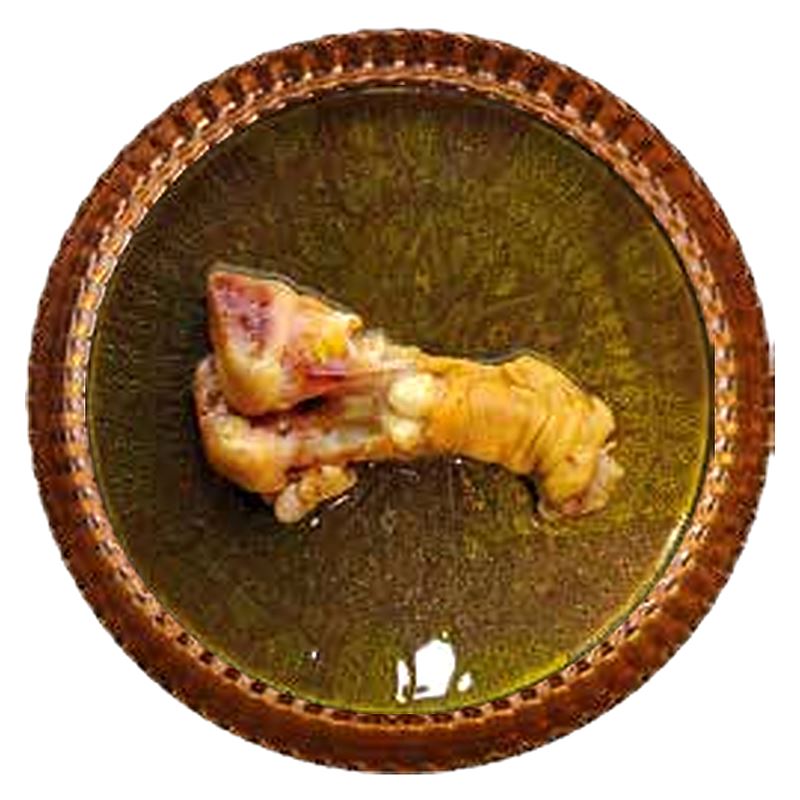
The question, asked honestly
Dubai has more Persian restaurants than anyone can list: kebab houses on every corner, ghormeh sabzi on every menu, rice worth arguing about. Yet you can eat across this city for weeks and never once be offered kalle pache. The question reaches us with a note of suspicion, as though a rule forbade the dish. There is no rule. There is only the work, and most kitchens look at it and decide, quite reasonably, that it is not for them. Here is the honest accounting of what that work is.
A simmer measured in half-days, not minutes
Almost all restaurant food is built around a service window: a kebab is minutes over coal, a stew is made in the morning and portioned all evening. Kalle pache refuses that shape. Ours sits at a bare tremble for around fourteen hours, and the number is not decoration: that is roughly where the connective tissue in a trotter surrenders and the broth thickens enough to cling to a spoon. Lift it early and you have hot water with lamb in it.
A pot and a burner stay committed for most of a full day: watched, skimmed, topped up, never boiled hard, because a hard boil clouds the broth. A kitchen that must also send kebabs out through a busy evening cannot spare it.
The unglamorous hours before the pot is lit
Before any heat there is a long stretch of cold, wet, repetitive work: heads and trotters singed, scraped, split, soaked in several changes of cold water, rinsed until the water runs clear. Nobody photographs this part. It is done at a sink, by hands that know what to look for: a hair missed or a gland left in is not a small mistake, because the pot carries that fault through the whole simmer.
Cleanliness is the flavour: a well-cleaned head gives broth that tastes of nothing but sweet lamb; a lazy one gives a smell no cinnamon or lime will cover.
Whole heads and trotters, not boxes of portioned cuts
A modern kitchen orders trimmed, portioned, vacuum-packed meat and knows what is in the box. Whole heads and trotters belong to an older, smaller trade that runs on relationships, not catalogues. You need them in steady condition, in real volume, every day.
Then there is what arrives attached: tongue, cheek, eye, brain and the tissue around them are part of the head, and a kitchen with no plan for each throws away most of what it bought. That is why our menu reads as it does: eye, brain, meat, tongue, trotters, tripe, lamb cheek, brain soup, soup, and the special mix we call mojoon. It is honest bookkeeping made visible, because nothing can be wasted.
A kitchen awake while the dining rooms are dark
Kalle pache is traditionally eaten early, before the working day begins, so the pot goes on the night before. The kitchen's hardest stretch lands when the rest of the city goes quiet, and staffing those hours is a decision a restaurant makes once and lives with. Most would rather not.
We took the other side of it. Shaun the Sheep is open around the clock, every day, so the pot never truly stops. You can eat at first light the way it is eaten in Tehran, in the small hours after a shift, or at midday because that is when you are hungry. You can also pre-order for a later time and have it ready when you arrive.
No shortcut survives contact with anyone who grew up on it
There are faster methods: pressure, powdered stock, gelatine stirred in to fake body in the broth. They photograph well and fool nobody. Someone who ate this at their grandmother's table on a Friday morning knows within one spoonful - the broth thin or oddly glassy, the meat stringy where it should give way, the smell not the smell. This dish grew up with its own judges, and no clever version gets past them.
So the choice is narrow: do it properly, with the hours and the sink work and the awkward sourcing, or leave it off. Most leave it off, and that is fair. The gap you noticed in Dubai is not a mystery - it is the shape of the work.
How we serve it
Shaun the Sheep is in Jumeirah, Dubai, open 24/7 for dine-in and delivery across the city; the phone is 04 321 8882. Every order comes with sangak, torshi, lime, onion and green pepper. To share, there is the Single Dish for one, the Double Dish for two, The Full Dish for three and The Khan's Platter for six. Orders on the website are paid by card in advance - there is no cash on delivery - and delivery is free over AED 300.
