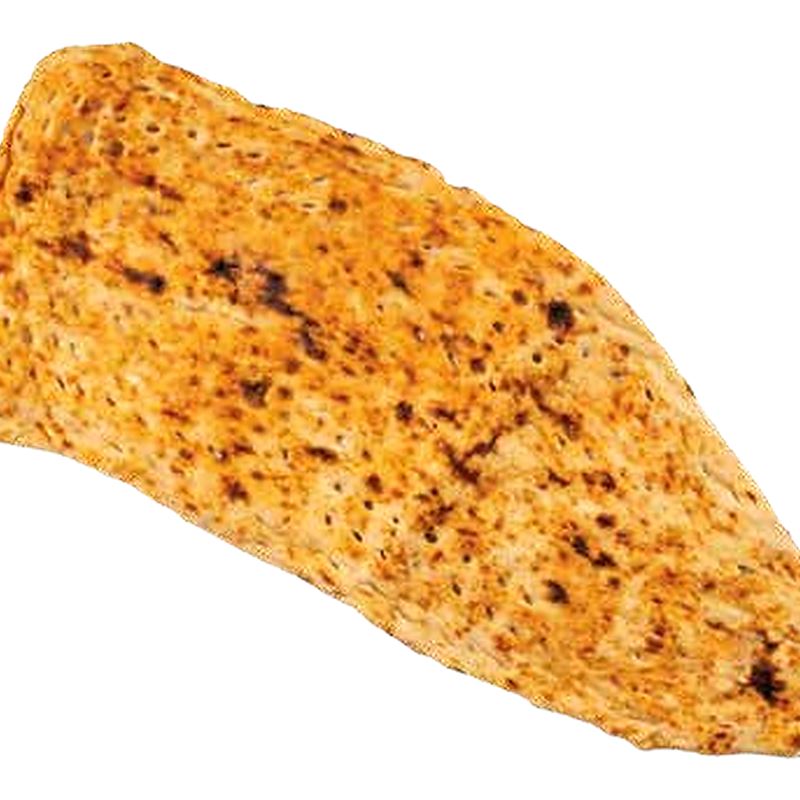
Why sangak stales differently from packaged bread
Sangak is a lean dough — flour, water, salt, a leaven — stretched thin and baked on hot pebbles. No oil, no milk, no sugar, none of the softeners and enzymes that keep a packaged loaf springy for a week. That is part of why it works against a bowl of rich broth, and why the same sheet can feel like a different bread by morning.
Two things happen. One is plain drying: the sheet is wide and thin, all surface and little crumb, and in a dry, air-conditioned Dubai flat the moisture goes fast. The other is staling proper — as the bread cools, the starch in the crumb recrystallises and stiffens even with no water lost. That generally runs fastest at fridge temperature, so the fridge is usually the wrong place for bread you mean to eat tomorrow.
Storing a sheet for today and tomorrow
Let the bread cool completely before wrapping; a sheet closed up warm traps its steam and turns leathery. Shake it out and check the underside — sangak is baked on stones, and the odd pebble can travel home with it.
For today, fold the sheet in half or in thirds and keep it in cloth or paper at room temperature, away from the air-conditioner draught: it breathes, dries slowly, keeps its character. For tomorrow, once fully cool, close it in a plastic bag or sealed box — the crust softens, but the sheet stays pliable enough to fold around meat.
Bringing a stiff sheet back with heat
Dry sangak is not finished; it wants heat and a little water. Flick a few drops over it or pass a damp hand across it, then lay it in a hot dry pan about half a minute a side. The water turns to steam inside the crumb, the bread comes back soft and the surface crisps slightly.
For a bigger batch, wrap the folded sheet loosely in foil, a few minutes in a hot oven, and open the parcel at the table. A microwave softens bread in seconds, though it generally goes hard again soon after it cools, so it suits bread you eat at once, not bread you put away. Revive only what you will finish; reheated bread tends to stale faster the second time.
Freezing, stacking and heating from frozen
Sangak freezes well: the freezer stops the staling clock instead of speeding it up. Tear the sheet into one-sitting portions, stack them with baking paper between layers so they do not weld together, press the air out of the bag and freeze it flat. Stored that way it generally holds its quality for several weeks.
Take one portion out at a time and put it straight into a hot dry pan, toaster or warm oven, unthawed; bread thawed on the counter tends to come back damp. Once a piece is brought back, eat it — it should not go into the freezer again.
The second lives of dry bread
When a sheet is past reviving, dry it on purpose. Nan-e khoshk — deliberately dried bread — is broken up and left on a rack somewhere dry until it snaps cleanly, then kept in a closed tin. Dried like that it keeps a long time and counts as an ingredient, not a leftover.
The oldest use is the simplest: tear it into the bowl and let hot broth do the work. That is tilit, the traditional way bread meets broth, which is why sangak is traditionally torn by hand rather than cut. Dry bread is also crumbled into kufte mixtures to bind them, crushed coarse for coating, or toasted in butter and eaten with cheese and herbs. The broth of a head and trotters simmered about fourteen hours is exactly the liquid it was made for, which is why kalle pache on the menu comes with sangak, torshi, lime, onion and green pepper.
The bread that is not thrown away
Iranian tradition treats bread as something that does not go into the bin. Dry pieces are traditionally kept apart from the rubbish — put in a bag by the door, passed on for animals, or dried and stored for cooking — and the custom is generally explained as respect for bread rather than thrift. It is a broad tradition rather than a rule, kept in its own way from place to place.
The same goes for a sheet that arrives with an order at home. If you take a platter for a table of six and the bread outlasts the meal, cool it, fold it and wrap it; there is another week ahead of it. Bread travels with delivery across Dubai as it travels home from a bakery, better for being unwrapped as soon as it lands.
