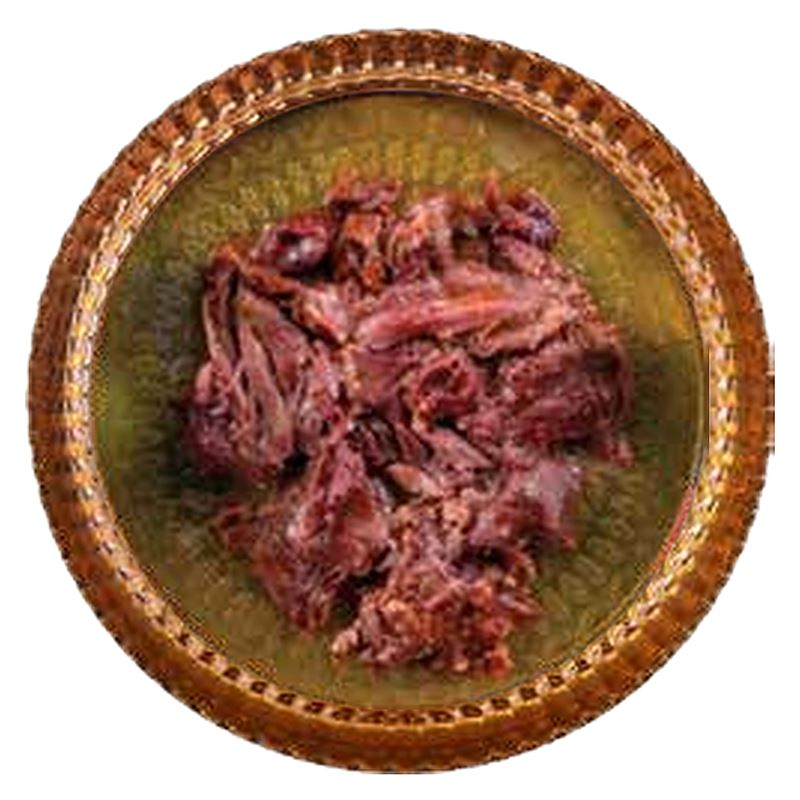
Is beryani just biryani with a letter missing?
No, and the gap between them is far wider than a spelling. Beryani — also written beryan, and said beryuni in Isfahan itself — is a lamb dish from central Iran with no rice in it at all: meat simmered until it gives way, minced, pressed into a flat round, laid on taftoon bread and eaten with more of the same bread. Biryani, the dish Dubai knows best under that name, is a layered rice dish in which the grains carry everything. One vowel apart on the page, almost nothing shared on the plate.
Dubai is where this mix-up tends to happen, because one of these words turns up on menus across the city and the other rarely does. A reader meets the Persian word, assumes somebody dropped a letter, and sits down expecting rice.
What is Isfahani beryani actually made of?
Lamb, and not much beyond it. The meat is cooked until it surrenders, then minced or pounded fine rather than left in pieces. The seasoning is quiet — cinnamon is the spice people name first, with salt and onion behind it — and the mince is packed into a small round pan and cooked flat so the outside catches and the fat works back through it.
The older Isfahani version is generally described as working lung in with the meat; plenty of kitchens now use shoulder alone, and both go out under the same name. What never changes is the ending. The round of pressed lamb is lifted straight onto taftoon, and the bread is the plate. You tear, you fold, you eat with your hands, and a glass of doogh usually sits beside it.
Where does the name biryani come from, then?
This is the part worth knowing, and it is not a clean break. Biryani's name is commonly traced back to Persian — either to beryan, meaning roasted or fried, or to birinj, meaning rice. Beryani takes its name from that same first word. So the likeliest reading is not that two unrelated words collided by accident, but that one old Persian word travelled and settled into two completely different meals.
In Isfahan it stayed with the meat and the fire and never picked up a grain of rice. On the subcontinent it fixed itself to rice cooked with spiced meat, and it is that version which came back to the Gulf and became the default sense of the word. Anyone who hands you a tidy etymology is claiming more than the record supports; dish names are argued over by people who spend careers on them. Shared root, different destinations, is as far as an honest answer goes.
How do the two dishes compare, item by item?
| Feature | Isfahani beryani | Biryani as Dubai knows it |
|---|---|---|
| Home | Isfahan, central Iran | The Indian subcontinent, and widely beyond it |
| Body of the dish | Minced lamb, cooked then pressed | Long-grain rice layered with meat |
| Rice | None at all | The whole point |
| Bread | Taftoon, underneath and alongside | On the side, if at all |
| Spicing | Quiet, with cinnamon leading | Layered masala, often with chilli |
| Format | One flat round per person | A shared pot or platter |
| How it is eaten | Torn and folded into bread | From the rice, by spoon, fork or hand |
Why does one dish build on bread and the other on rice?
Because they grew up in two different starch cultures, and each is built around the one it had. Taftoon is thin, soft and wide — a bread you can use as a surface, a wrapper and a scoop in the same mouthful. Persian tables run on several breads doing several jobs, and our guide to how sangak, barbari, taftoon and lavash compare sets them out side by side.
In biryani the rice is not an accompaniment. It is the dish, and it carries the spice, the fat and the aroma. Take the rice out and there is no biryani left. Take the bread away from beryani and you have a handful of minced lamb and nowhere to put it. That is the true difference between them: not the spelling, but which thing is doing the carrying.
If biryani is your reference point, what will surprise you?
Three things, usually. The seasoning comes first — beryani is aromatic rather than fiery, and anyone expecting layered masala meets cinnamon, salt and a great deal of lamb instead. That restraint is not laziness; it runs through the cuisine, which is the argument in what makes Persian food different from Arab, Turkish and Indian cooking.
The second is the shape. Biryani arrives as a mound to be shared out, while beryani arrives already portioned, one flat round per person. The third is the hour: in Isfahan it leans towards lunch rather than the evening, and it tends to be sold by shops that make it and very little else.
Why do Persian dish names cause this kind of mix-up?
Because Persian food names tend to describe rather than advertise. Beryan means roasted. Kalle pache names the head and the trotters that go into the pot. Abgoosht is water and meat. A name here is an inventory or a method, not a brand, which is why what Persian dish names literally mean is often the quickest way to read a menu you have never seen before.
The catch is that a descriptive word is easy to borrow. A word meaning roasted can be claimed by any number of dishes across a continent, and once it has been, the shared word stops predicting what lands on the table. Beryani and biryani are the clearest case of it: the name survived the journey, the recipe did not.
Do you serve beryani at Shaun the Sheep in Dubai?
No. We are a kalle pache house at 64 Jumeira Street in Jumeirah 1, and the kitchen does one thing properly instead of a long menu. The broth is simmered for about fourteen hours, and what goes out is Meat, Tongue, Brain, Trotters, Tripe, Lamb Cheek, Eye, Brain Soup, Soup and Special Mix, with platters from the Single Dish up to The Khan's Platter, plus sangak, torshi, doogh and tea. For the wider Persian table, Persian food beyond kalle pache is the map.
What does transfer is the habit. If lamb, bread and no rice is what drew you to beryani, that is exactly how kalle pache is eaten here: torn sangak, meat straight off the platter, a squeeze of lime, a dusting of cinnamon if you like it. The kitchen is open 24 hours, seven days a week, for dine-in, pickup and delivery across 141 Dubai areas with the fee for your area shown at checkout, and an order can be scheduled for later, including dawn. The entrance is wheelchair accessible. For anything else, call 04 321 8882 and ask.
