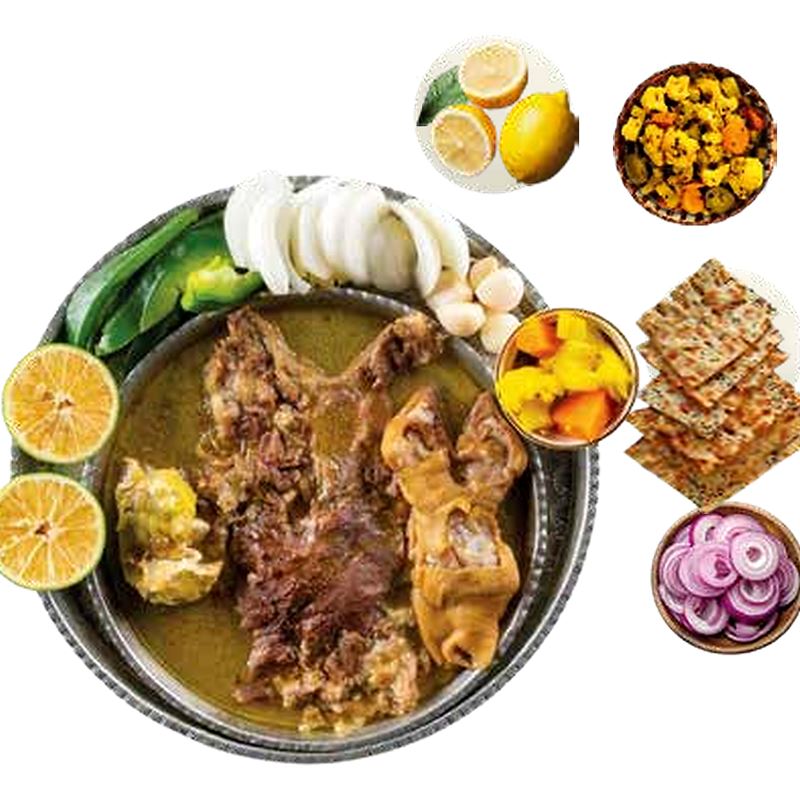
Why is Iranian food organised by shop rather than by menu?
Because the trade tends to be split by dish, not by cuisine. A shop is generally named for the one thing it cooks, and that name tells you what is in the pot, who is standing over it, and roughly when the door is open. A kalle pazi cooks heads and trotters. A jigaraki grills liver. A chelo kababi does rice and kabab and very little else. Going out for "Persian food" in the abstract is not really how it works; you go out for one dish, to the specialist who owns it.
That single habit explains something this blog asserts constantly without ever quite accounting for it: why kalle pache is a dawn food. It is not that the broth insists on sunrise. It is that the shop which makes it works overnight, and a shop built around one pot has one hour when that pot is at its best.
What is a kalle pazi, and why is it finished by mid-morning?
The head-and-trotter house. Heads and trotters are typically cleaned in the evening, the pot goes on overnight, and the shutters go up in the dark with the broth already made. The trade generally runs from before sunrise until the pot is empty, which tends to be somewhere in the middle of the morning, and then the shop closes for the day.
None of that is a rule about when the dish ought to be eaten. It is a description of when one pot of it exists. The longer version of that argument is in why kalle pache became a dawn breakfast, and the way the dish itself shifts between Tehran, Tabriz and the Gulf is in the regional styles guide.
What does a tabakhi sell?
Tabakhi is the wider cooked-food shop — the cook's place. Where a kalle pazi is defined by the head, a tabakhi generally covers the whole family of long-simmered pot food: trotters on their own, tripe, abgoosht in its clay pot, sometimes haleem in the cold months.
In practice the two words blur, and plenty of shops carry both on the board. The difference that survives is one of range. A kalle pazi has a pot; a tabakhi has a stove, and can still be ladling at midday when the head house has gone home.
What is a chelo kababi, and when does it fill up?
Rice and kabab. Skewers over coals, saffron rice, a grilled tomato, raw onion, sumac, a glass of doogh. This tends to be the trade pictured outside Iran when someone says "Persian restaurant", and it is the one shop type with a proper dining room, table service and a lunch hour.
Its clock sits at the opposite end of the day from the kalle pazi. The grill is lit before midday, works through lunch, and comes back for the evening. It tends to be a family table, and the one you would pick for a guest. The skewer most people begin with is koobideh — our kabab koobideh recipe deals with the part that actually decides whether it works, which is the onion and the mince, not the fire.
What is a jigaraki, and why is it an evening trade?
A jigaraki grills liver, heart and kidney on short skewers, usually from a narrow front with the grill facing the street. Portions are counted in skewers rather than plates, and the whole table is bread, salt and lemon.
The evening hours are practical rather than romantic. Liver is generally bought and grilled the same day, so the grill starts when the day's supply lands, and the standing crowd the trade depends on tends to gather after dark. A jigaraki is quick, loud and sociable in a way a kalle pazi never is: nobody settles in.
Who eats at an ash forushi?
The soup counter is the plainest of the six. Ash is the thick Iranian soup family — noodles, herbs, chickpeas, kashk swirled over the top — and haleem, the wheat-and-meat breakfast porridge, is commonly sold from the same window by the same family.
The hours come in two halves: haleem early, before work; ash later on, and more heavily, by most accounts, in the cold months and around Ramadan. It is a takeaway trade by nature — many ash counters have no chairs — and a pot carried home is as ordinary an order as a bowl eaten on the spot.
What actually happens at a chaykhaneh?
The tea house is the one that is not really about food. Black tea in small waisted glasses, a bowl of rock sugar, and the room's real product, which is somewhere to sit for as long as you want to sit. Some serve dizi at midday. Most serve nothing you would call a meal.
A chaykhaneh tends to keep the longest hours of any of them, open through the afternoon and late into the night, because nothing on its counter runs out. It is the place people tend to move on to after eating somewhere else.
Why does each shop own a different hour?
Read the trades side by side and the day organises itself. The hour is not tradition for its own sake; it follows the cooking.
| Shop | What it cooks | When it tends to trade |
|---|---|---|
| Kalle pazi | Lamb head and trotters | Before sunrise, until the pot is gone |
| Tabakhi | Trotters, tripe, abgoosht, haleem | Morning into the middle of the day |
| Chelo kababi | Rice and grilled skewers | Lunch, then again in the evening |
| Jigaraki | Liver, heart and kidney skewers | Evening and into the night |
| Ash forushi | Ash and haleem | Early for haleem, later for ash |
| Chaykhaneh | Tea, sugar, sometimes dizi | Almost all of it |
A dish that takes all night to make is sold in the morning. A dish that must be grilled the day it is bought is sold in the evening. A drink that never spoils is sold whenever anyone wants it. The clock is the recipe, read backwards.
Where does Shaun the Sheep sit in that list?
It is a kalle pazi. The kitchen at 64 Jumeira Street in Jumeirah 1 is built around one pot — lamb head and trotters, broth simmered about fourteen hours, with sangak and torshi alongside and a Persian breakfast menu — and it does not pretend to be a chelo kababi or a jigaraki. Ask for the Eye, the Tongue, the Lamb Cheek, Brain Soup or the Special Mix and you are asking the right shop. For the rest of the cuisine, the guide to Persian food beyond kalle pache maps out which dish belongs where.
One thing here is different from the trade it comes from, and it is the useful difference: the hour is yours rather than the pot's. The room is open 24 hours a day, seven days a week, delivery reaches 141 Dubai areas with the fee for your area shown at checkout, you can collect the order yourself, and you can schedule it for a later time — dawn included, if you want the hour the shop was built around.
