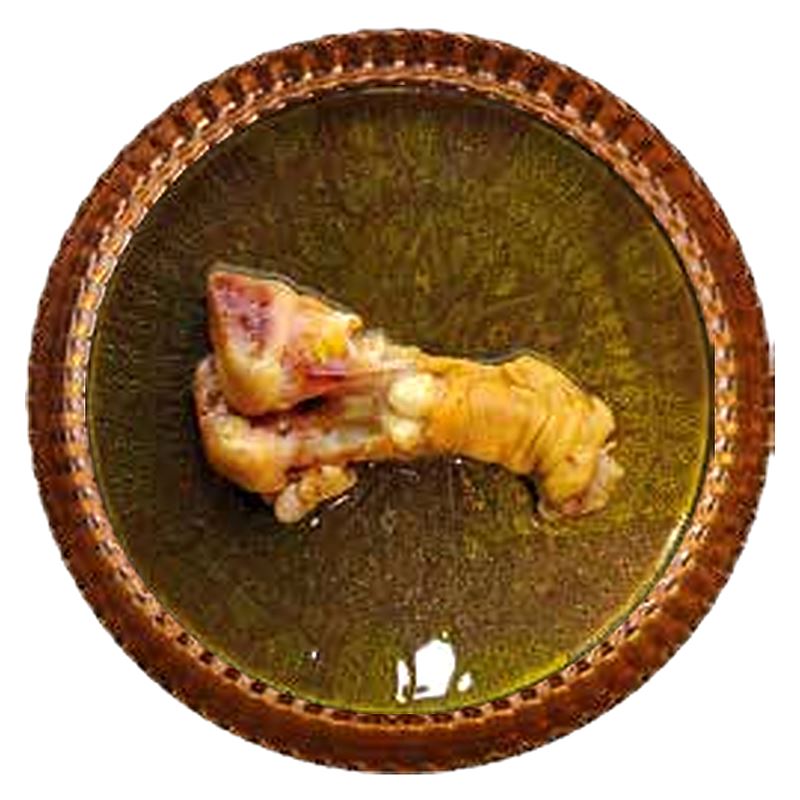
Egyptian kawareh and Persian pacheh are close cousins rather than the same dish. Both are trotters simmered for hours until the collagen loosens from the bone and thickens the broth so completely that it sets like jelly once it cools; the honest differences come down to the animal, the seasoning, and what sits on the table beside the bowl.
One thing before anything else, so nothing here gets misread: we do not cook kawareh, and we would not claim any authority on Egyptian cooking. Shaun the Sheep is a Persian kalle-pache kitchen at 64 Jumeira Street, Jumeirah 1, and everything in our pot is lamb. But if you grew up with kawareh on the table, you already understand most of what happens in our kitchen, and the single called Trotters (pacheh) is the item on our menu that sits closest to the plate you know.
Are kawareh and pacheh really the same dish?
They are cousins, not twins. Both are named after the cut itself: kawareh is simply the Arabic word for trotters, and pacheh is the Persian word for the same part of the animal. Two kitchens, working separately for a very long time, arrived at the same conclusion: that the least glamorous part of the animal, given enough hours and enough skimming, turns into one of the richest things you can put in a bowl.
The Egyptian version is most often built on beef or veal trotters, though that is not a hard rule and households differ. Ours is lamb, always. And where kawareh is generally a dish of trotters on their own, Persian pacheh is one half of a pair: kalle means head, pacheh means trotters. So a full Persian spread can include brain, tongue, cheek and eye alongside the feet. None of that is compulsory. Trotters by the bowl is a normal, complete order, and plenty of people never go any further than that. If you want the wider picture first, the plain explainer on what kalle pache is covers it without assuming you know anything.
What do the two genuinely have in common?
Collagen. That is the whole family resemblance, and it explains every sensation you already recognise: broth that coats the back of the spoon, a faint stickiness on the lips after two or three mouthfuls, and the bowl left in the fridge overnight that turns into a soft wobble and needs gentle warming before it will pour again. If the kawareh you grew up with did that, ours does it for exactly the same reason.
It also means both traditions are held to the same standard of patience. Here the heads and trotters are cleaned and trimmed thoroughly, then blanched with that first water thrown away, a step any Egyptian cook recognises instantly, and then simmered for about fourteen hours and skimmed again and again along the way. The lamb is sourced to the UAE halal standard. There is no shortcut in either kitchen, and everybody can taste a rushed pot.
The third shared thing is the clock. Both are unhurried-morning food, eaten when nobody has anywhere to be. In Iran that instinct is pushed even earlier: pacheh is famously eaten at first light, before the day properly begins. Dubai flattens the seasons but not the habit, which is one reason our kitchen is open twenty-four hours, every day of the week.
Is it true that both are "strengthening" food?
Both dishes carry that reputation at home, and it deserves careful handling rather than repeating. What we can honestly say is that it is a cultural reputation, passed down for generations in Egypt and in Iran. It is not a claim about your body, and we do not claim this food cures, treats, heals or prevents anything. This is not medical advice. If you have a health condition, if you are pregnant, or if you are watching cholesterol, fat or salt, please ask your doctor or a registered dietitian before making rich trotter dishes a habit. We cook food, not medicine.
Where do the two honestly differ?
Here is the comparison as plainly as we can put it. The kawareh column describes how the dish is commonly made and eaten; Egyptian homes vary enormously, and we are not speaking for any kitchen but our own.
| Egyptian kawareh | Our Persian pacheh | |
|---|---|---|
| Animal | Most often beef or veal | Lamb, always |
| Cut | Trotters, usually on their own | Trotters, plus head parts if you want them: brain, tongue, cheek, eye |
| Seasoning | Garlic and cumin are common, often brightened with a squeeze of lemon or a little vinegar | A long, plain, repeatedly skimmed lamb broth; the sharp note arrives at the table as torshi |
| Eaten with | Commonly bread to soak up the broth, and in many homes with rice | Sangak bread, mixed or garlic torshi, raw onion |
| Occasion | Cool mornings, weekends, family gatherings | Dawn, weekends, the end of a long night, and any hour at all, since we do not close |
Neither column is better than the other; they are two answers to the same question, shaped by two different pantries.
What will feel different at the table?
Three things, mostly. First, there is no rice on our menu. Bread does that job here, and the bread is sangak: you tear it and dip rather than spoon broth over it. Sangak Bread and Special Sangak are both on the menu, and you can tick an extra Sangak if your table eats the way most tables do.
Second, there is no lemon wedge on the tray. The acid comes from pickles instead: Mixed Torshi or Garlic Torshi. If garlic and a sharp edge are what you associate with kawareh, order the garlic torshi. It does the same job of cutting richness, in a Persian accent, and the raw onion finishes the thought.
Third, the broth is its own item. Our Soup single is the abgoosht broth on its own, the gentlest possible way in, and a good choice if someone at your table wants a first spoon before committing. Beyond the singles the platters step up: Single Dish, Double Dish, The Full Dish, and The Khan's Platter, built for six, with four lamb cheeks, eight trotters, two brains, three tongues, four eyes and five breads.
So what should you order first?
Order Trotters. It is the one item that maps directly onto what you already know, and it lets you judge our broth on ground you are sure of. Add Sangak, add Garlic Torshi, and add a Doogh if you like a salty yoghurt drink or a Lemonade if you do not. When you are ready to go further, the guide to choosing a single walks through the other bowls one by one, and the first-timer guide explains the order of operations at the table.
How do you order it in Dubai?
Through the website, in English, Arabic or Farsi, using the language switcher. There is no app, no account and no password. You give a name and a phone number, and for delivery you also choose your Dubai area from the list and drop a pin on the map, because the rider phones the number on the order when they arrive. Payment is by secure online card at checkout, which is the only method we take, and delivery is free over AED 300. If you have any question about paying, phone 04 321 8882 and ask.
You can choose delivery, pickup, or dine-in with a table reserved, and you can schedule an order for a future time up to about two days ahead, useful if you want trotters waiting early in the morning after a night shift. Once payment goes through, the kitchen confirms the order and sets an estimated time, and the order gets its own page to follow. If the kitchen cannot take an order, it is refunded automatically to the card that paid, with the reason shown on that page.
Anything the website cannot answer goes to one place: 04 321 8882. That is our only contact channel, and the kitchen is open twenty-four hours, every day.
If kawareh is the taste you miss from home, you will not find it here exactly, and we would rather say so than pretend otherwise. What you will find is its lamb cousin, cooked with the same stubborn patience, on the menu at shaunfood.com.
