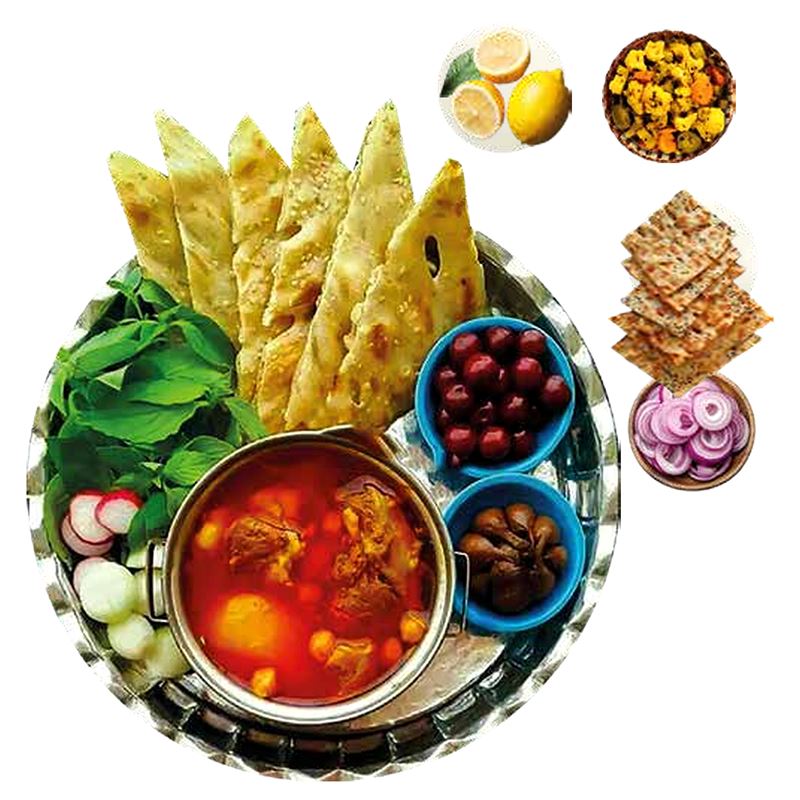
Kalle pache or dizi: which should you order from us?
Two of the slowest, most soulful dishes on our menu pull in opposite directions, and first-time guests almost always ask which one to begin with. Both are Persian classics, simmered patiently for hours until the meat surrenders the bone. Yet kalle pache — the dawn broth of lamb head and trotters — and dizi, our lamb-and-chickpea abgoosht, are nearly opposite experiences once they reach the table. This is a plain, practical guide to choosing between them: what goes into each, who each one suits, how each is eaten, and how to order the right bowl from our Jumeirah 1 kitchen.
What's the difference between our kalle pache and our dizi?
Kalle pache is built entirely from the head and feet. Across our dishes you'll meet lamb cheek (banagoosh), trotters (paye), brain (maghz), tongue (zaban) and, on the bigger platters, eye (cheshm), all suspended in a clear, collagen-rich broth. It is an offal lover's dish, prized for silkiness and depth rather than sheer bulk. Our dizi (abgoosht) is a different animal altogether: lamb on the bone, slow-cooked with chickpeas, white beans, potato, onion, tomato and dried lime, turned gold with turmeric. No offal, all familiar ingredients, and a tangy, earthy flavour that reads far more like a stew than a broth.
Which one suits a first-timer?
If you've never eaten either, dizi is the gentler on-ramp. Everything in the bowl is recognisable — lamb, beans, potato and a lime-bright broth — so there is no leap of faith to make, only a delightful new way of eating it (more on that below). It's the dish we quietly point curious guests toward when offal feels like a step too far. If you'd like the full reasoning, our guide on how to eat kalle pache as a first-timer maps out the gentler entry points, plain soup and the Special Mix sampler among them.
Which one is for the kalle-pache enthusiast?
If you grew up on kalle pache, or you're ready to go all in, this is your dish. Order a Single Dish for one (lamb cheek, a trotter, half a brain, half a bread), step up to a Double or the Full three-person Dish to range across tongue, eye and extra trotters, or bring the Khan's six-person platter for a table of devotees. You can also build a plate à la carte — brain, tongue, trotters, banagoosh, tripe (sirabi), meat — or keep it pure with the plain broth on its own. Dizi, by contrast, arrives as one complete bowl per person; there is less to customise, and that easygoing simplicity is part of its charm.
Kalle pache vs dizi: a side-by-side comparison
Both are slow-cooked and eaten with sangak, but they sit at opposite ends of the table. Here is the quick version.
| Feature | Kalle Pache | Dizi (Abgoosht) |
|---|---|---|
| What's in it | Lamb head and trotters — cheek, trotters, brain, tongue, eye | Lamb on the bone with chickpeas, white beans, potato and dried lime |
| Offal? | Yes — it's the heart of the dish | No |
| Texture | Silky, collagen-rich broth with tender morsels | Hearty broth plus a mashed paste (gusht-koobideh) |
| Flavour | Rich, meaty and deep, with a garlic-and-lime finish | Tangy and earthy from dried lime and legumes |
| How you eat it | Spooned over sangak with lime and garlic | Two parts: tilit the broth, then mash the solids |
| Best for | The enthusiast and offal lover | The first-timer and stew fan |
| Best time | Dawn or late night | Any meal — lunch or dinner |
| One or many | Platters for 1, 2, 3 or 6 | One hearty bowl per person |
| On our menu as | Single, Double, Full and Khan's platters, plus singles | Abgoosht (dizi) |
How does each one eat at the table?
The rituals are half the pleasure, and they could hardly be more different. Dizi is a two-part meal. First you strain the thin broth into a bowl, tear sangak into it and eat it as a soup — the step Iranians call tilit. Then you pound the solids in the pot with a masher (goosht-koob) into a soft, spreadable paste, and scoop it onto bread with raw onion and torshi. Kalle pache is more direct: you spoon the hot broth and pieces over torn sangak, brighten it with a squeeze of lime and a clove of our seven-year garlic pickle, and eat as you go. One is a slow, two-course ceremony; the other is warmth on bread, right away.
Should I order for one, or for a group?
This is often the question that decides it. Dizi is a natural solo order — one hearty, self-contained bowl, ideal when you want your own portion and no negotiation. Kalle pache scales for sharing: our communal platters climb from one to two, three and six people, so a group can spread trotters, tongue, brain and cheek across the table with stacks of sangak. Can't decide between them? Order both, and let the table graze between the tangy stew and the silky broth.
How do I order kalle pache or dizi in Dubai?
Shaun the Sheep is one Tehran-style kitchen at 64 Jumeira Street, Jumeirah 1 — not a chain — open 24 hours a day, seven days a week, with halal lamb. We deliver across all of Dubai (the fee is set by your area at checkout, and delivery is free over AED 300), and we also offer pickup, dine-in and pre-orders, with secure card payment online. Browse the menu and order page to send a bowl of either your way, or reserve a table to eat both the way they're meant to be eaten. Worth adding on the side: sangak or our richer special sangak, mixed torshi and the seven-year garlic pickle, with doogh, tea or lemonade to drink.
This article is about culinary tradition and is not medical or nutritional advice.
