A creek district named after a town in Iran
Walk the lanes of the Al Fahidi historical neighbourhood, on the Bur Dubai side of the creek, and you are in a quarter that Dubai called Al Bastakiya for most of the twentieth century. The name points to Bastak, a town inland from the southern Iranian coast in what is now Hormozgan province, and to the merchant families who left it and the ports around Bandar Lengeh for the Arabian shore from the late nineteenth century onward. The pull was commercial: customs duties were raised on the Persian coast, Dubai kept the creek cheap to land goods on, and trade followed the lighter tax. Households moved whole, with their carpenters, their masons and their cooks.
So the familiar line that Persian food is an import to Dubai has the sequence backwards. Iranian families were among the people who built the old town. The cooking arrived with the builders, not after them.
The wind towers are a Persian idea rebuilt in coral stone
The square towers over Al Fahidi are the plainest evidence. In Persian the device is a badgir, a wind catcher, and the Gulf Arabic barjeel is usually traced to the same root. Each tower is open on all four faces, so whichever way the air moves it is caught and dropped down a shaft into the room below. What crossed the water was the knowledge, not the material: builders here cut coral block out of the shallows and set it with gypsum and sarooj, the Persian name for the lime mortar used on both coasts. The same is true of a recipe.
Persian words are embedded in the Gulf kitchen
Gulf Arabic carries a thick layer of Persian loanwords, and the food vocabulary is especially dense: sambusa from sanbusa; nakhi, boiled chickpeas, from nokhod; turshi, the pickles, from torshi; and mahyawa, the fermented fish sauce of the southern Iranian coast, whose name is mahi and ab, fish and water. Outside the kitchen the same pattern holds, with bandar for a port and darisha for a window. This is what happens when two shores share the same boats for generations.
The traffic ran in both directions
The clearest object in this exchange is the dried lime. In Gulf Arabic it is loomi and it goes into machboos; in Persian the same lime is limu omani, the Omani lime, and it goes into ghormeh sabzi. Each shore named it after the other. Rice, saffron and rosewater came across on the dhows, while dates, dried fish and pearls went back the other way. The methods stayed distinct even as the ingredients mixed: Gulf rice is generally cooked until it absorbs its stock, while Persian rice is parboiled, drained and then steamed.
Kalle pache came at the end of that line, not the start
So why did kalle pache reach this coast late rather than early? Because it was never a dish a family could carry in its luggage. It belongs to a specialist shop that works overnight: a butcher's supply of heads and trotters, a pot large enough to hold them, and someone awake to skim and tend the fire. The dish itself is simple to describe and hard to run, and it is traditionally eaten at dawn, in winter above all. A trade like that needs a settled urban population, a night economy and a cold chain behind it. Those came with the modern city, which is why the dish followed the merchants, the towers and the words by a long interval.
What the end of that line looks like now
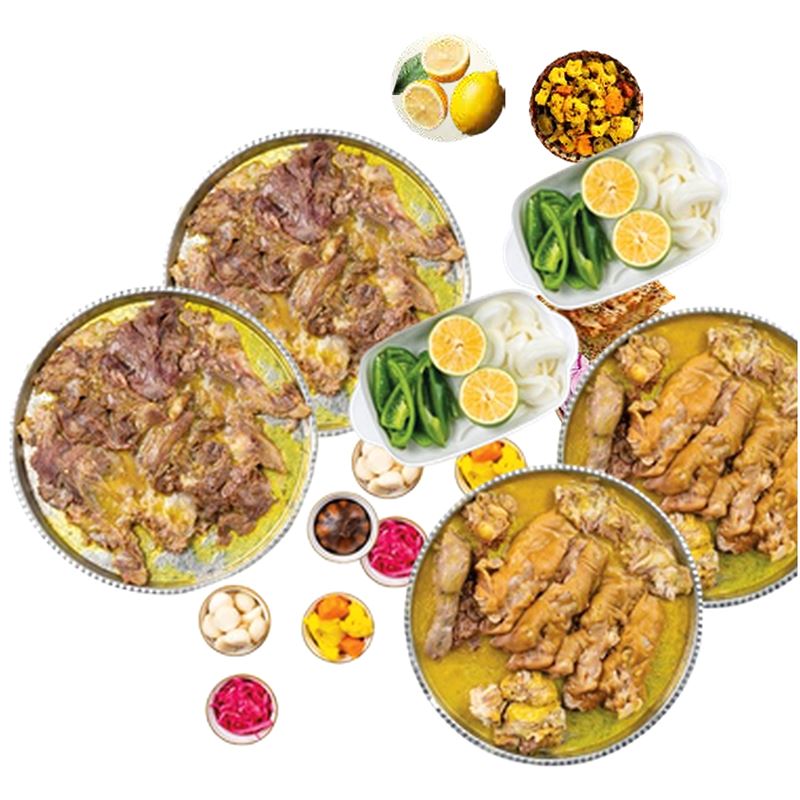
Shaun the Sheep cooks it in Jumeirah: lamb head and trotters simmered about fourteen hours, until the broth is heavy with gelatin, served with sangak, torshi, lime, onion and green pepper. The singles are eye, brain, meat, tongue, trotters, tripe, lamb cheek, brain soup, soup and the special mix, mojoon. The platters run from Single Dish for one and Double Dish for two to The Full Dish for three and The Khan's Platter for six, so one order covers a table of six. How the pot is worked through the night is its own story, and the menu lists the rest. The kitchen runs 24 hours a day, every day, so dawn is an ordinary serving hour. There is dine-in and delivery across Dubai; the broth is hottest at the table, because it cools on the way. Pre-orders for a set future hour are supported, so a gathering with a fixed start can be timed to it. Payment on the website is card prepay only; there is no cash on delivery. Delivery is free over AED 300. The phone is 04 321 8882.
