One animal, two tables
If you grew up on the Arabian peninsula, a sheep's head on the table is no curiosity. It belongs to the food culture there, cooked and eaten in its own right in many Gulf kitchens, and at a shared tray it carries a second meaning: it is traditionally set before the guest the host most wants to distinguish. The gesture is public: everyone around the tray reads it.
Persian kalle pache is built from the same animal and much the same parts, yet the occasion runs the other way. It is a quiet bowl before sunrise, eaten with bread torn by hand and a squeeze of lime, and nobody is being honoured. If you know the ingredient already, this is about the distance between the two tables.
The head as an honour at a shared tray
In Gulf hospitality the head does not arrive alone. It comes as part of a whole animal, or on a large tray of rice and meat set in the middle of the gathering, turned towards one guest. Cheek, tongue and the soft meat around the jaw are lifted off and passed along; the tray is shared, the right hand does the work, and the pace is the room's: talk, coffee, more talk. The meaning lives in the ceremony as much as in the meat, and the meal is the centre of the evening, not a stop on the way to one.
The head as a meal before dawn
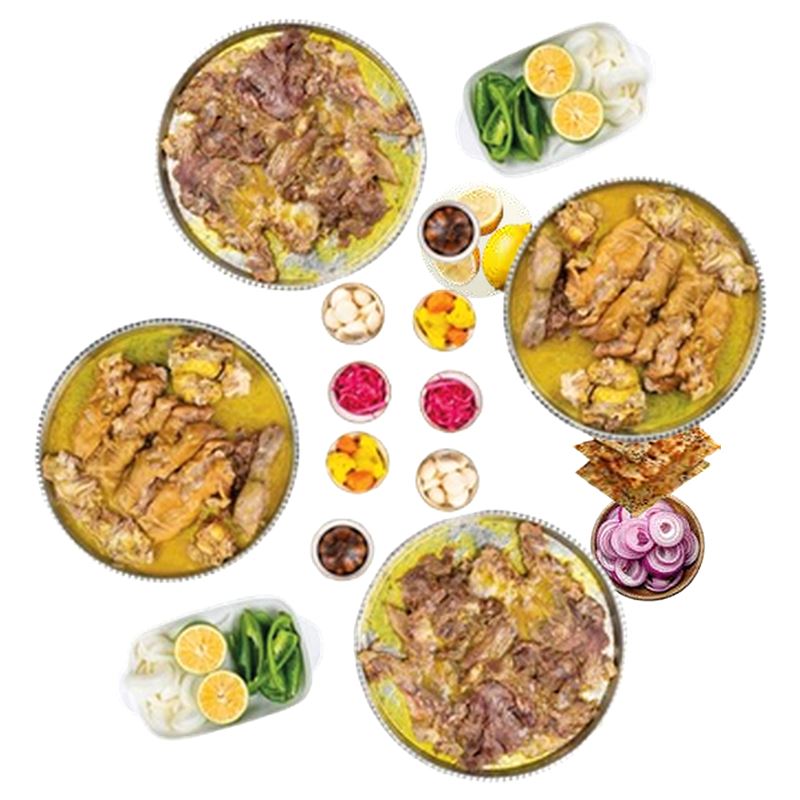
Iranian kalle pache grew up on a different clock. The pot goes on at night and works slowly until the small hours; here head and trotters simmer for around fourteen hours, long enough for the broth to thicken and for cheek and tongue to give way under a spoon. It is traditionally eaten at dawn, before the day starts, and arrives as a bowl before one person rather than a tray before a room. The bread is sangak, torn by hand and used as both scoop and spoon. Beside it sit lime, raw onion, green pepper and torshi, and the sourness is not decoration: it cuts the fat with every second mouthful. You sit, you eat, you go.
What you will recognise, and what is new
The parts will be familiar. Cheek and tongue behave the same way in any pot, trotters give the same sticky richness, and a head yields small distinct pieces, not one slab of meat. Almost everything around them changes.
| At the honour tray | In a kalle pache bowl |
|---|---|
| Centre of a gathering, often evening | Traditionally at dawn, before the day starts |
| One shared tray, eaten by hand | One bowl per person, bread and spoon |
| The head beside rice and whole cuts | The head broken into named parts and broth |
| Honour shown by who receives it | No ceremony; the eater picks the parts |
The other new thing is choice. At a tray you eat what is passed to you; on a Persian menu the parts are separated and named, so eye, brain, tongue, meat, trotters, tripe and lamb cheek can be ordered alone, or together in the special mix called mojoon. For a first choice, our guide to the single dishes goes part by part, and there is a short piece on how to eat it the first time.
Coming to it from the Gulf table
If the honour tray is your reference point, a few things help. Take the broth first, very hot; it tells you what the pot did all night. Begin with the parts you would lift off a head at home, cheek and tongue and the meat, then add brain or eye, since it is texture rather than flavour that takes a little getting used to. Keep the lime in your hand and use it often. And if you want the tray feeling, order for the table rather than yourself, so the parts arrive spread out and everyone reaches in.
Ordering it in Dubai
We cook in Jumeirah around the clock, so kalle pache here can be eaten at its traditional dawn hour or at any other. There is dine-in and delivery across Dubai, delivery is free over AED 300, and payment on the website is by card in advance, with no cash on delivery. An order can be placed for a future time if you want it to reach you before sunrise. The menu lists the singles and the platters: Single Dish for one, Double Dish for two, The Full Dish for three, and The Khan's Platter for six, the closest thing we have to a tray in the middle of a gathering. For any question, call 04 321 8882.
