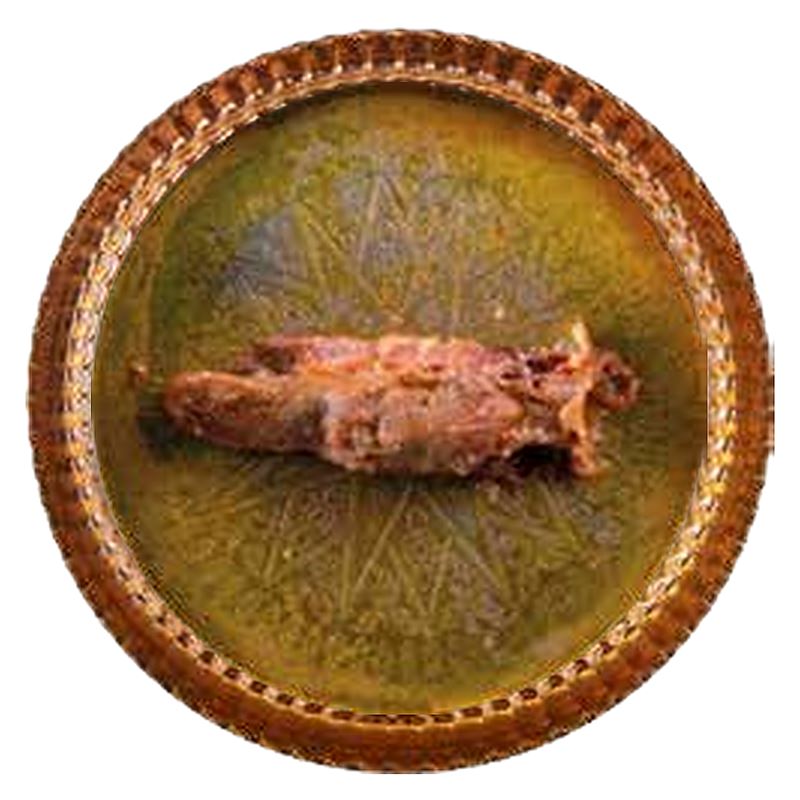
If you have eaten beef tongue, what will feel familiar about lamb tongue?
More than you expect about the idea, and almost nothing about the scale. Plenty of people in Dubai already eat tongue happily: lengua crisped for tacos, cold cured slices in a deli sandwich, thin ribbons grilled over coals at a Korean or Japanese table, lisanat in warm spices over rice. If any of those are familiar, you are not a beginner here — you have simply never met the lamb version.
What carries over is the cut. A tongue is one hard-working muscle in a tough outer skin that has to be cooked until it slips away — every cuisine that loves tongue arrives at that step, and what happens after the peeling is where traditions separate. In kalle pache, the Tehran-style dish of slow-simmered lamb head and trotters, the peeled tongue is not chopped, cured, grilled or sauced. It reaches the table warm, whole or in thick rounds, in clear broth.
How do lamb tongue and beef tongue differ in size, tenderness and richness?
Size is the first surprise, and it drives everything else. A beef tongue is a long, heavy muscle, braised for hours and then sliced across the grain into portions. A lamb tongue sits in the palm of your hand: one person's serving.
Being small, it has a finer grain and much less connective tissue, so a long simmer leaves it silky all the way through, with no need to shave it thin. Beef tongue is denser and coarser, with a fatty seam toward the thick end — the seam that gives grilled gyutan its buttery quality. Lamb tongue is the clearly leaner of the two, so it reads as clean and meaty rather than rich.
| Feature | Lamb tongue (zaban) | Beef tongue (lengua, deli, gyutan) |
|---|---|---|
| Size | Fits in the palm of a hand; one serving | Large and heavy; feeds a table |
| Grain | Fine, tender all the way through | Coarse and dense; sliced across the grain |
| Fat | Lean; just enough for flavour | Fattier, especially at the thick end |
| Flavour | Mild, gently sweet, aromatic | Deeper, more mineral; often salty |
| Usual serving | Warm in clear broth, no sauce | Crisped, or chilled and shaved, or grilled |
Is lamb tongue stronger or milder in flavour than beef tongue?
Milder — the answer that surprises people most, because lamb usually signals a bigger flavour than beef.
Two things make it so. The cut: tongue is among the mildest parts of the animal, and carries none of the strong lamb notes people brace for. And the cooking: the lamb simmers for around fourteen hours in a copper pot with onion, turmeric and garlic, skimmed hour after hour so the broth stays as clear as strong tea. A simmer that long draws off everything heavy and leaves something gentle and savoury, closer to a fine slow-cooked roast than to anything you would call gamey.
It also lands milder than the beef tongue you remember, because that memory is nearly always a seasoned one: deli tongue is brined and peppery, lengua arrives under salsa and raw onion, grilled tongue comes with salt and smoke. Kalle pache adds nothing to the meat before it reaches you, and there is no chilli heat in the dish. Our guide to what kalle pache tastes like takes the bowl piece by piece.
How is it prepared and served here compared with deli or taqueria tongue?
Follow one tongue through each kitchen and the contrast is clear: chopped small and crisped on a griddle at a taqueria; brined, chilled and shaved almost translucent for a cold sandwich at a deli; ribbons that cook in seconds over fire at a grill.
Here, nothing happens to the tongue after the pot. It cooks until the skin slips away, then it is peeled and kept whole or cut into thick rounds, and goes out warm in that amber broth — alone, or in the Special Mix beside meat, brain, tripe and trotters. No crisping, no chilling, no sauce: the dish trusts the broth and hands the seasoning to you.
What do you eat it with here — bread, lime, garlic and torshi?
All four, roughly in that order. Sangak is not a side dish but a tool: the stone-baked flatbread is torn into the bowl so it swells with broth, and that soaked bread is the heart of the meal. Lime, squeezed generously, does the job your salsa or mustard used to do. Garlic comes pickled rather than raw — seer torshi, cloves gone dark and mellow in vinegar — and mixed torshi cuts the richness between mouthfuls. A pinch of cinnamon and a little black pepper finish the bowl; the cinnamon startles first-timers, but it rounds the fat and lifts the aroma without tasting sweet.
A glass of cold, salted doogh runs alongside. If your reference point is the taqueria table, the move is from sharp and hot to warm and aromatic; our guide to seasoning at the table goes step by step.
Why is tongue the part regulars suggest to a nervous first-timer?
Ask anyone at a neighbouring table what a newcomer should order and the answer is the same. The reasons are plain:
- It looks like meat: peeled and sliced, nothing about it announces an unfamiliar part.
- It is boneless once peeled, so there is nothing to work around.
- The texture is firm but yielding — a good roast, neither soft nor spongy.
- It is lean, so a first portion never sits heavy.
- And if you have eaten lengua or deli tongue, you already have a reference point.
That last one matters most. Hesitation here is rarely about taste but about not knowing what to expect, and a beef tongue eater is not starting from zero: you are comparing one version with another, not deciding whether you like tongue at all. The bolder cuts can wait: our guide to the cuts covers those, and tongue on its own has its own guide.
How do you order lamb tongue — on its own, or as part of a mixed plate?
On its own is the cleaner experiment: a single dish lets you taste it against the beef tongue you know with nothing else on the plate, and a double dish makes it a full meal, or a comparison to share.
As part of a mixed plate is how most regulars eat. The Special Mix sets tongue beside meat, tripe, trotters and the rest, and the three- and six-person platters suit the Iranian way of eating it. Either way, add sangak, torshi and a glass of doogh; if it is your first time, our first-timer guide walks through a whole bowl.
Shaun the Sheep is at 64 Jumeira Street, Jumeirah 1, open 24 hours a day, seven days a week, and our lamb is halal, in line with UAE law and standards. Browse the menu and order page for dine-in, pickup or delivery across Dubai, with the delivery fee set by area at checkout — or pick a future time for a bowl at dawn.
