Two cities, one move
Florence has a sandwich called lampredotto: beef tripe — the fourth stomach of the cow — simmered for hours in a broth of onion, celery, tomato and parsley, then chopped and piled into a plain roll. Before handing it over, the vendor dips the top half back into the cooking liquid, and the bread goes soft and salty with the broth the meat came out of.
Persian cooking has a name for that move. It is tilit: bread torn into the broth of kalle pache and left to swell until it carries the taste of the pot. Two kitchens on different continents, with no shared history around this dish, reached the same conclusion — the bread belongs in the broth, not beside it.
A long simmer, and almost nothing added
Florentine tripe goes into water with a few vegetables and is left alone for hours; the liquid it produces is the sauce, and there is no other sauce. Kalle pache runs longer — lamb head and trotters, skimmed as they come to the boil, then about fourteen hours over low heat until the connective tissue gives way and the broth has a body you can feel on your lips.
The reasoning is the same in both kitchens. These are cuts full of collagen, from parts that worked hard. Cooked quickly they stay tough; held at a gentle heat for a long stretch, the collagen turns to gelatin, and gelatin is what makes a broth cling to the spoon. The long simmer is not a habit anyone could shorten and keep the dish — it is the mechanism.
Offal as the dish, not the leftovers
In Florence the tripe cart stands in the middle of the city, an ordinary part of the working day rather than a spectacle. Tripe there is old working food, eaten early in the day.
Persian cooking gives the head and the trotters the same standing: they are the point of the meal, not what is left when it ends. Our singles are named and served one by one — eye, brain, tongue, meat, trotters, tripe, lamb cheek, brain soup, soup, and the special mix, mojoon. Tripe sits on that list, which gives a Florentine reader a direct point of contact: the same cut, from a different animal, cooked long in a plain liquid. Our guide to the singles goes through them one at a time.
Bread is the vehicle in both
Tuscan bread is traditionally baked without salt, and that is exactly why the dipped top of the roll works: dry crumb with no seasoning of its own takes everything from the broth it goes into.
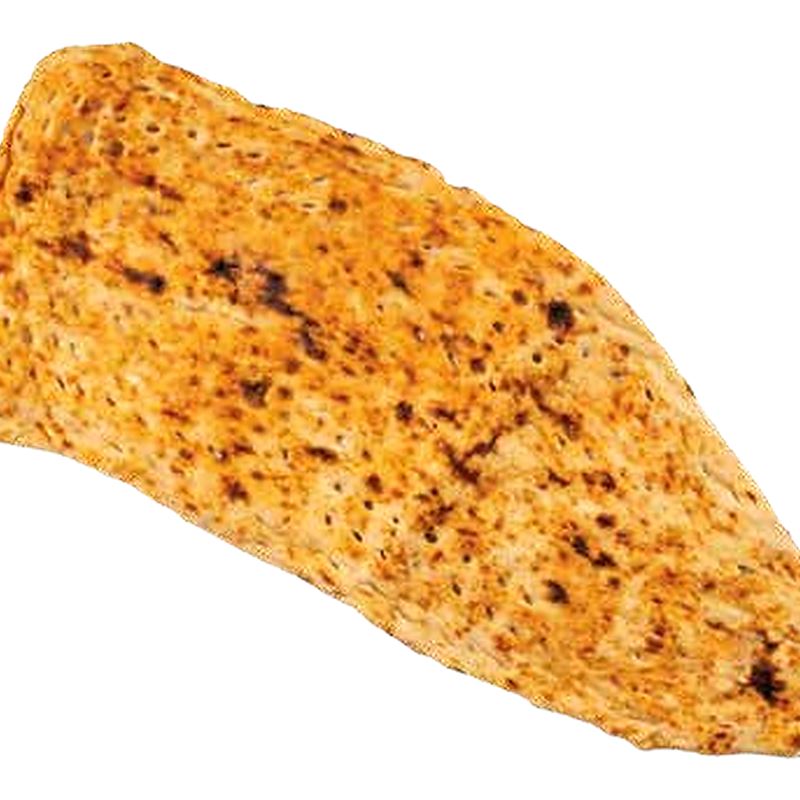
Sangak arrives at the same place from the opposite direction. It is a thin sheet baked on hot pebbles, blistered and dry, with enough structure to be torn, folded around a piece of meat, or pushed under the broth and eaten while it still holds together. Tilit is that last use taken to its conclusion — the bread breaks down into the bowl and the broth thickens around it.
The sharp thing that cuts the richness
A Florentine roll is finished with salsa verde: parsley, garlic, capers, vinegar and olive oil, chopped coarse, and sometimes chilli oil beside it. Kalle pache is finished with lime squeezed straight into the bowl, raw onion, green pepper and torshi from the jar. Different pantries, one function. Fat and gelatin coat the palate and stay there; acidity and raw onion cut through and reset it, so the fourth spoonful lands like the first.
Reading one through the other in Dubai
If lampredotto is the dish you know, you already have the grammar for this one: a long plain broth, offal at the centre, bread that goes into the liquid, acidity on the side. What changes is the animal, the spice cabinet and the hour — kalle pache is traditionally a dawn dish, and the kitchen here runs twenty-four hours a day, seven days a week.
Shaun the Sheep is in Jumeirah, with dine-in and delivery across Dubai. Portions run from the Single Dish for one person, through the Double Dish for two and The Full Dish for three, up to The Khan's Platter, which is sized for six, so one order covers a table of six. Orders can be placed in advance for a later hour, which helps when a gathering has a fixed start. Delivery is free over AED 300. Payment on the website is by card in advance; there is no cash on delivery. To see the parts side by side, read the menu, or call 04 321 8882.
