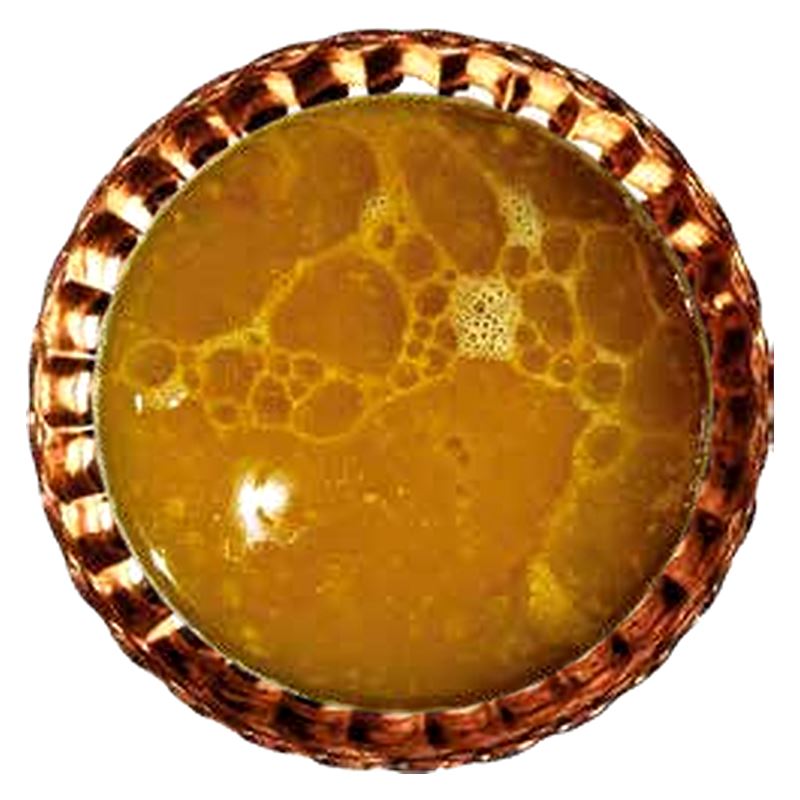
No — traditional kalle pache is not a chilli-hot dish. It is rich, deeply savoury and gently spiced: salt, a warm note from the cinnamon family, and a lift of citrus, with any real burn added by the eater at the table rather than simmered into the pot.
That is why Fresh Chili and Pickled Green Chili sit in the extras row as things you tick alongside your dish, not as a "hot version" of it. You build your own heat, spoonful by spoonful, and the person next to you builds theirs. Here is how to do that well, at either end of the scale.
Is kalle pache spicy, or is it spiced?
English squeezes two ideas into one word. Spiced means aromatic: cinnamon-family warmth, black pepper, the fragrance of a pot that has run for hours. Spicy, in everyday use, means chilli heat. Kalle pache is firmly the first and almost never the second.
The flavour of a good bowl comes from time, not chilli: lamb head and trotters simmer until the broth turns silky and the meat gives way, so what reaches you is depth, body and aroma. Most first-timers say "richer than I expected", not "hotter than I expected". If the dish is new to you, start with our guide to what kalle pache actually is.
What is doing the seasoning, then?
Three levers, none of them hot. Salt does the heavy lifting, because a fatty, gelatinous broth needs proper seasoning to taste of anything. Warm spice from the cinnamon family gives the faintly sweet edge that stops the richness feeling flat. Acid — classically citrus — goes in at the end to cut the fat.
Notice what is missing: chilli. It is not a traditional part of the pot, which is exactly what makes kalle pache good for a mixed table — the one seasoning that genuinely divides people is left in your hands.
How do you make your kalle pache hotter?
With the two chilli add-ons. On the website they sit in their own extras row next to Capsicum, Onion and extra Sangak, ticked alongside whatever you order. Nothing arrives hot by default and nothing is included automatically; if you want chilli, you tick it.
Fresh Chili is the sharper, faster, greener heat. It arrives immediately, bright rather than deep, and very little goes a long way in a bowl this rich. Slice it thinly and add a sliver at a time.
Pickled Green Chili is the more forgiving one, and the more traditional companion to a heavy Persian table. Pickling tames the raw edge and adds sourness, so it does two jobs: gentle warmth plus acidity that cuts fat.
The golden rule with both: keep the chilli beside the bowl, not stirred into it. Chilli on a side plate can be nibbled between spoonfuls, escalated as you go, or ignored. Chilli stirred into the broth is a decision you cannot take back.
Is lemon the other lever?
Yes, and it is the underrated one. Acidity does what heat cannot: it lifts. A fatty spoonful feels heavy by the middle of the bowl, and a squeeze of citrus resets your palate so the next tastes as good as the first. Plenty of people who think they want more heat actually want more brightness — they are bored, not under-burned.
One honest note: the extras row is Capsicum, Onion, Fresh Chili, Pickled Green Chili and Sangak — there is no lemon wedge on it. What the menu does have on the sides are Mixed Torshi and Garlic Torshi, which do the same acidic job with more character — the garlic one is sharper. If a lemon wedge at the table matters to you, phone 04 321 8882 and ask before ordering. At home, a lemon from your own kitchen does the job.
Why does chilli behave differently in a rich broth?
Because the compound that makes chilli hot dissolves in fat, not water. In a lean, watery soup a slice stays roughly where you put it. In a broth built on lamb fat and gelatin, the heat spreads across the whole mouth, arrives a beat later than you expect, and lingers. A chilli that tasted mild on bread can bloom once it meets a fatty spoonful.
Three practical consequences. Test it on bread before committing to the bowl. Give each addition half a minute before deciding it was not enough. And keep the antidotes within reach: Sangak Bread to absorb, and Doogh, whose dairy is the classic mouth-cooler of the Persian table. Water mostly spreads the problem around.
This is kitchen experience, not medical advice. If chilli, dairy or organ meats are a question mark for your health, ask your doctor.
How do you order for a table of timid and bold eaters?
Order the food neutral and the heat separate. That is the whole strategy.
Keep the base of the order plain. Then tick one Fresh Chili for the bold end of the table and one Pickled Green Chili for the middle ground, and put both on a side plate. Add extra Sangak: bread is both the delivery vehicle for chilli and the fire extinguisher. Steer nervous eaters towards the gentler singles — Soup, Meat or Lamb Cheek — and let the adventurous take Brain, Tongue, Eye or the Special Mix; our guide to choosing a single walks through each one.
For a big group, a platter plus separate chilli beats tuning the heat person by person. The Khan's Platter — four lamb cheeks, eight trotters, two brains, three tongues, four eyes, five breads — feeds six, and one side plate of chilli lets all six season themselves.
What should you add? A quick table
| What you want | What to add | How to ask |
|---|---|---|
| No heat at all | Nothing | Leave both chilli add-ons unticked |
| Gentle, sour warmth | Pickled Green Chili | Tick it; nibble between spoonfuls |
| Sharp, immediate heat | Fresh Chili | Tick it; slice thinly, a sliver at a time |
| A mixed table | Both chillies, side plate | Tick both; keep them out of the broth |
| Brightness, not burn | Mixed Torshi or Garlic Torshi | Add as a side; the garlic one is sharper |
| Something cooling | Doogh and extra Sangak | Add the drink; tick Sangak in the extras |
| Sweetness and crunch | Capsicum and Onion | Tick both; raw onion is traditional |
| A sensitivity or special request | A phone call | Call 04 321 8882 before you order |
What if you have a real sensitivity or allergy?
Then do not work it out from an article. Phone 04 321 8882 before you order and ask directly — that is our only contact channel, and the kitchen is open 24 hours. We will tell you what we know, but no honest kitchen can promise anything about cross-contact in a shared workspace. If any ingredient is a medical matter for you, this article is not medical advice; speak to your doctor.
How do you actually place the order?
From the Shaun the Sheep homepage. Choose your dishes, tick the extras you want — Fresh Chili, Pickled Green Chili, Capsicum, Onion, extra Sangak — and pick delivery, pickup or dine-in; a table can be reserved. There is no account and no sign-up: just your name and phone number. Delivery also needs your Dubai area from the list and a map pin; pickup needs neither. Delivery is free over AED 300, payment is a secure online card payment at checkout, and you can schedule an order up to about two days ahead.
Once you have paid, the kitchen confirms and sets an estimated time, your order gets its own page you can follow, and the rider phones you when he arrives. If the kitchen cannot fulfil the order it is refunded automatically to the card you paid with, with the reason shown on the order page. To change anything after paying — including chilli you forgot to tick — phone 04 321 8882; there is no self-service edit button.
The whole site works in English, Arabic and Farsi with a language switcher, and it remembers the language you chose on that device, dish names included. One last note: the Kettle of Tea is dine-in only and cannot be delivered. Everything else — bowls, platters, bread, torshi, Doogh and all the chilli you can handle — travels from 64 Jumeira Street, Jumeirah 1, 24 hours a day.
