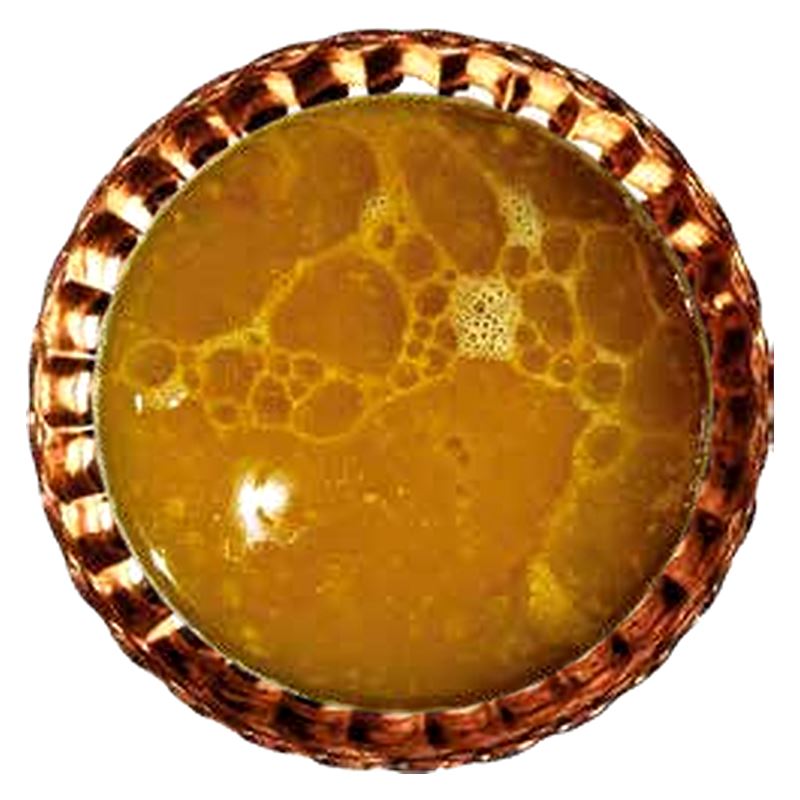
Send hot broth and bread, delivered to their door at an hour you have agreed with them in advance. A broth-forward order — Soup, or Brain Soup — with far more Sangak than you think they need is about as close to the perfect gift for a house with a newborn as food gets: nothing to cook, nothing to chop, and barely anything to wash up afterwards, which is roughly the level of effort that household can spare.
Choosing the food is the easy half. The half people get wrong is the logistics — whose phone number goes on the order, what time it turns up, and whether anyone in that flat knows it is coming at all. Most of this page is about that.
Why does broth suit a house where nobody has slept?
Because it asks nothing of the person eating it. It arrives hot and finished. There is nothing to assemble, nothing to season, nothing on a hob that needs watching. It is eaten with one spoon, it can be put down halfway through when the baby wakes, and it survives being put down.
Bread does even better. Sangak tears into strips and is eaten standing up, one-handed, walking a baby around a living room at three in the morning. Send a lot of it. In a house where meals have stopped happening at mealtimes, bread is the thing that gets picked at all day, and one-handed is the single most useful quality food can have in the first weeks.
The third argument is the sink. A gift that arrives as a set of components — things to be warmed, combined, plated — creates work, and work is the one currency that household has none of. A bowl of broth and a piece of bread create a bowl and a piece of bread.
Our broth is the slow kind. Heads and trotters are cleaned and trimmed thoroughly, blanched with that first water thrown away, then simmered about fourteen hours and skimmed again and again. The collagen that comes out of bone, skin and trotters is why the broth sets to a soft jelly as it cools and loosens again over gentle heat. If a bowl sits untouched because somebody needed carrying, it is still a bowl of broth afterwards. The lamb is sourced to the UAE halal standard.
What should you actually put in the order?
Keep it broth-forward and bread-heavy, and resist the urge to send one of everything. If you want to read around the menu first, the soup-only guide covers the lightest end of it and the singles guide explains what each bowl actually is.
| What to send | Why it suits a newborn household |
|---|---|
| Soup (abgoosht broth) | The lightest thing on the menu. Hot, spoonable, no pieces to negotiate. Can be eaten in three separate attempts and nobody minds. |
| Brain Soup | Still broth-forward and soft, with more body than the plain Soup. A useful second bowl when two adults want different things and neither wants to discuss it. |
| Sangak Bread and Special Sangak | Send more than seems sensible. Tears into strips, needs no plate, no cutlery and no free second hand. |
| A platter — Single Dish, Double Dish, The Full Dish | For a partner or a visiting relative who wants Trotters, Meat, Tongue or Lamb Cheek rather than a bowl of broth. |
| The Khan's Platter | Six portions with bread included — for the week when both grandmothers have moved in and nobody is cooking. |
| Mixed Torshi or Garlic Torshi | Sharp pickles that cut the richness. Send them as an extra, not as the point of the gift; at four in the morning not everyone wants garlic. |
| Doogh, Lemonade, Water, Tea, Black Tea | Nothing to boil, nothing to brew, nothing else to remember. Note that the Kettle of Tea is dine-in only, so it is not something you can send. |
Whose name and phone number go on the order?
Theirs — both, without exception. This is the detail people get wrong. When the rider reaches the building he phones the number written on the order. If that number is yours, and you are in another emirate or another country, nobody comes downstairs and a hot bag stands in a corridor while you try to relay directions.
So the order carries their name, their phone number, their Dubai area chosen from the list at checkout, and a map pin dropped on their actual building. Area and pin are both required for delivery, which means you need to know where they live precisely enough to place that pin — the building, not the neighbourhood. Ask them for it the day before, not while you are standing in the checkout with a half-filled form.
There is no account to create and nothing to sign up for: you type the details in once. Payment is by secure online card at checkout, which is the only way orders are paid, so the order is settled before it ever leaves the kitchen. Your friends take the bag and close the door. Delivery is free over AED 300.
Why should you warn them it is coming?
Because a call from an unknown number, followed by a knock, is exactly the sequence that ends a nap which took forty minutes to start. An unannounced delivery stops being a kindness the moment somebody has to work out who is calling and why.
Tell them the day before, or the morning of. Two sentences will do: food is coming from you, it should arrive around such-and-such an hour, and the driver will call this number. Then they can keep that phone where they will feel it and be near the door instead of being startled by it.
After you pay, the order gets its own page. The kitchen confirms it and sets an estimated time, and that page is where the estimate and the status appear — so you are the one who can pass on "it's on its way now". Being the person who takes that small piece of coordination off them is genuinely part of the gift.
What hour should you schedule it for?
An hour they have agreed to, and almost never a surprise at dawn. You can place a scheduled order for a future time up to about two days ahead, which is enough to arrange this properly rather than hoping.
Good instincts: aim for a moment when at least one adult is likely to be upright and not mid-feed — a late lunch, or the early evening before the difficult part of the night begins. If a grandmother, a sister or a friend is staying with them, ask that person instead; someone in the house can answer a phone without waking anyone.
The kitchen is open 24 hours, every day, which matters more here than it does in ordinary gifting. A newborn household's clock has gone sideways — four in the afternoon and four in the morning are no longer the different categories they used to be. If they tell you the only calm window is eleven at night, that is a completely normal time to send food from here.
How do you place a gift order, step by step?
- Ask them first: which Dubai area, which building, what hour suits, and whether anyone else is staying with them.
- Open the menu and choose delivery.
- Add the broth-forward bowls, then add more Sangak than you think is reasonable.
- Enter their name and their phone number, pick their area from the list and drop the pin on their building.
- If it is not for now, choose the scheduled time you agreed.
- Pay by secure online card. Delivery is free over AED 300.
- Tell them it is coming and roughly when, and pass on the estimated time once the kitchen confirms.
If you would rather see the ordering flow in detail first, this walkthrough goes through it screen by screen. If you are in Dubai yourself, you can choose pickup and bring it round in person — delivery, pickup or dine-in compares the three. And months from now, when they can face leaving the house, a table can be reserved for dine-in at 64 Jumeira Street, Jumeirah 1.
Do other cultures send food to a new baby's house too?
Yes, widely — the gesture is nobody's private property. In Korea, miyeok-guk, a soup made with seaweed, is the dish traditionally associated with new mothers. In many Jewish and Eastern European households the pot that turns up at the door is chicken soup. Across the Arab world and the Gulf, a neighbour arriving with a covered dish instead of a wrapped present is entirely ordinary, and Iranian families have their own version of exactly the same habit. We would not claim any expertise in traditions that are not ours, and we should be plain about one thing: we do not serve any of those dishes. Our menu is kalle pache — the bowls, platters, breads and drinks listed above — and nothing else. If a specific dish from another kitchen is what your friends are hoping for, this is not the place to order it.
We mention the custom here only as a custom. Nothing on this menu is offered as a health measure, and we make no claim that any of it helps with recovery, feeding, energy or anything else. This is not medical advice — for anything at all about a new mother's or a baby's health, diet or feeding, ask a doctor or a qualified dietitian. What we can say is narrower and duller: the food is hot, it is ready, and it needs no cooking.
What if something goes wrong with the order?
If the kitchen cannot take an order, it is refunded automatically to the card that paid, and the reason is shown on the order page, so you are not left guessing. For anything else — a question about the menu, about reaching a particular address, or a change of plan — phone 04 321 8882. It is the only way to reach the kitchen, and one call settles most things faster than any amount of typing.
Then step back and let it land. The point of sending food is that it costs the receiving household nothing: no hosting, no tidying, no conversation they are too tired to have. They open the door, take the bag, and eat standing up. That is the whole gift, and it is a good one.
