Why these nights change the shape of the meal
On an ordinary day of fasting the eating window has two fixed ends: the meal at sunset and the meal before first light. In the last ten nights those two ends stay where they are, but the rhythm between them often changes. The night often runs longer, and the gathering that matters can land in the small hours, after the night prayers and well before dawn, not at either fixed point. Practice varies a great deal from one household to another, so read this as a logistics guide, not a description of how anyone keeps the nights.
A slow dish suits that kind of night. Kalle pache is lamb head and trotters simmered for about fourteen hours, and by tradition it belongs to the hours around dawn rather than the middle of the day. A kitchen that runs around the clock can serve it at two in the morning as readily as at noon, which is the practical point when the gathering has no fixed sitting time.
Size the platter while you are still thinking clearly
Count heads early in the evening, not at one in the morning. The platters are built for that arithmetic: the Single Dish for one, the Double Dish for two, The Full Dish for three, and The Khan's Platter for six. Anything larger is a combination rather than a bigger tray.
| At the table | Straightforward combination |
|---|---|
| 3 | The Full Dish |
| 6 | The Khan's Platter |
| 8 | The Khan's Platter and a Double Dish |
| 9 | The Khan's Platter and The Full Dish |
| 12 | Two Khan's Platters |
Then add singles for whatever the platter does not cover. There are eye, brain, tongue, meat, trotters, tripe, lamb cheek, brain soup, plain soup and the special mix called mojoon. If you want the parts described one at a time first, the full menu guide walks through them. An extra soup or two is an easy addition for a mixed group, since soup and bread suit a cautious eater as well as a confident one.
Fix the hour so nothing depends on staying awake
Pre-orders for a future time are supported, and on a long night that is the most useful thing to know. Set the hour in advance, half past one or three or whatever the night is shaped around, and let the kitchen work to it, instead of arranging food when you are tired and everyone is already seated. Payment on the website is by card in advance; there is no cash on delivery, so nothing is settled at the door in the small hours.
Delivery runs across Dubai, and free delivery applies over AED 300, worth keeping in mind when ordering for a group; the delivery guide for Dubai covers the rest. Plan the night around the hour you set. If you would rather sit down than host, the kitchen in Jumeirah is open around the clock and you can reserve a table, or call 04 321 8882 for anything easier said than typed.
Build the table before anyone arrives
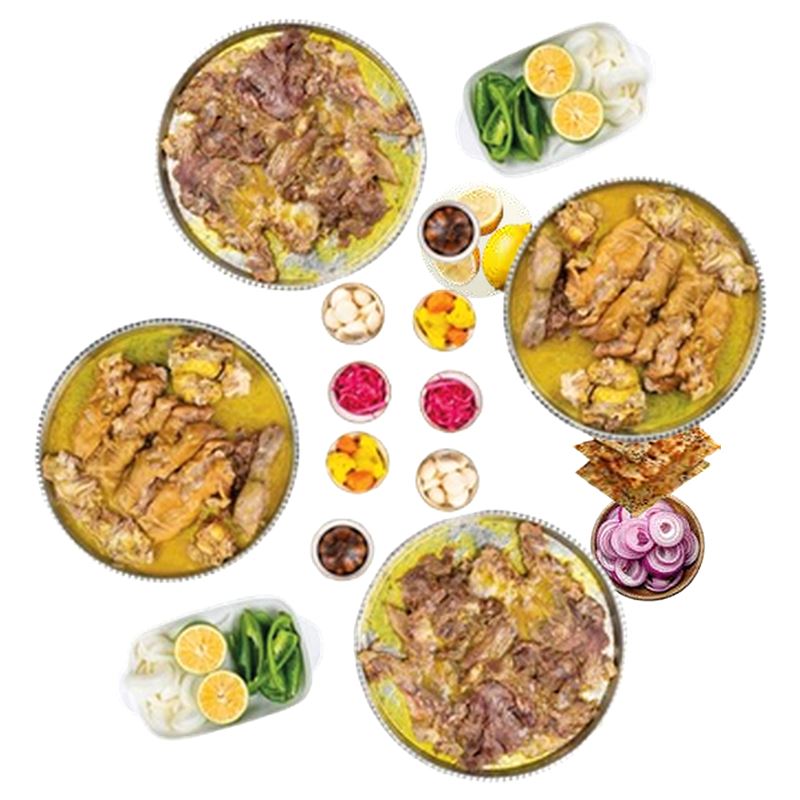
The dish comes with what it needs: sangak bread, torshi, lime, onion and green pepper. None of that is decoration. The bread is the utensil as much as the starch, lime cuts through the fat, torshi resets the palate between rich mouthfuls, and raw onion and green pepper give a sharp edge against soft meat. Look through the menu before the night begins so the order is one decision, not five.
For a late table, tear the sangak into hand-sized pieces and spread it along the table rather than stacking it at one end. Keep the broth hot and pour it late; broth loses more than anything else while a table waits.
A table for the end of a long night
If guests arrive tired, after driving across the city, start with soup rather than the platter. Warm broth is a gentle opening and buys the table a few minutes to settle before the serious eating begins.
Kalle pache is a rich dish. A long simmer draws fat and gelatin out of the bones, and a rich meal eaten quickly at three in the morning can sit heavily, so serve it in stages and leave time between them. Keep water and tea moving down the table. None of this is medical advice; if you are managing a health condition, your doctor's guidance comes first. Tea at the end, rather than a sweet course, often suits the hour.
