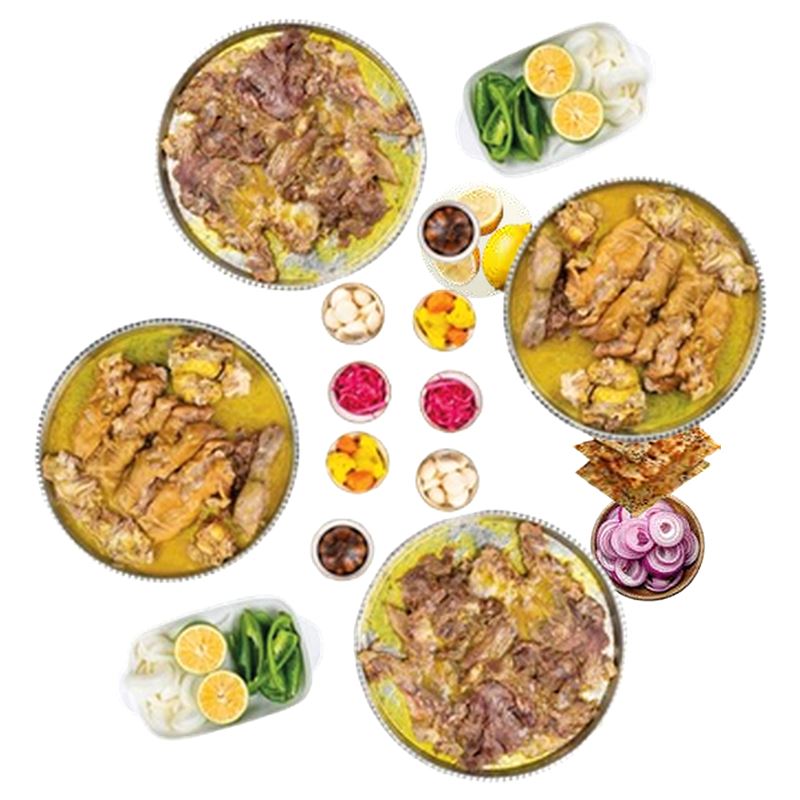
Guests have arrived and there is nothing in the house? Order one platter sized to the number of people — the Double Dish for two, The Full Dish for three, The Khan's Platter for six — and add sangak bread and torshi alongside it. That is the whole rescue: you order and pay on the Shaun the Sheep website in about two minutes, the kitchen is open 24 hours a day and delivers across Dubai, and your only remaining job is to set the table.
No shopping list. No cooking. No standing in front of an open fridge trying to negotiate with four eggs and half a cucumber. What follows is the calm version of the evening, in the order you actually need it.
Why is a shared platter the right rescue, and not four separate meals?
Because one order has to become a whole table. Four individual meals give you four people eating four different things in polite silence. A platter gives you a middle of the table that everybody reaches into. Completely different evening.
Kalle pache is built for exactly that. Lamb cooked long and slow — cheek, tongue, trotters, brain — with hot broth, torn bread and sharp pickles, all served to be shared out of the centre. It reads as hospitality rather than as takeaway, which is precisely what you want when people have turned up unannounced.
It also travels better than most food. Slow-cooked lamb and broth hold their heat in a way that crisp or fried things never do, so what arrives at your door still tastes like it came off a stove. If the dish is new to you, our introduction to kalle pache explains it properly, and the complete menu guide walks through every bowl by name.
How do I size the order in thirty seconds?
Count heads, pick the tier at or above that number, and stop deliberating. The platters are built around people rather than portions, so the arithmetic has already been done for you:
- Single Dish — one person.
- Double Dish — two people.
- The Full Dish — three people.
- The Khan's Platter — six people: four lamb cheeks, eight trotters, two brains, three tongues, four eyes and five breads.
Two rules of thumb. First, when you are caught between two tiers, go up — leftovers are a small problem and a short table is a large one. Second, if one guest looks uncertain about offal, quietly add a bowl of Meat or the abgoosht Soup next to the platter. Nobody has to announce anything; they simply find something familiar in front of them.
What exactly do I order for 2, 3, 4 or 6 guests?
Read this while everyone is still taking their shoes off.
| People who turned up | What to order | What to put on the table alongside |
|---|---|---|
| 1 (someone staying on) | Single Dish | Sangak Bread, Garlic Torshi, Tea |
| 2 | Double Dish | Sangak Bread, Mixed Torshi, two Doogh |
| 3 | The Full Dish | Special Sangak, Mixed Torshi, fresh Lemonade |
| 4 | The Full Dish plus one single bowl — Meat, Trotters or Lamb Cheek | Extra Sangak, Mixed Torshi, onion and fresh chili |
| 5 | The Khan's Platter | Garlic Torshi, extra Sangak, Doogh and Lemonade |
| 6 | The Khan's Platter (its five breads are included) | Both torshis, extra Sangak, Doogh, Water |
| 7 or 8 | The Khan's Platter plus a Double Dish | Extra Sangak, both torshis, pickled green chili |
| Someone who eats lightly | A single bowl — Soup, Brain Soup or Meat — or an Omelette | Sangak Bread and Tea |
If you would rather build the table from individual bowls, the guide to choosing a single compares them one by one. And if the number keeps climbing, the Khan's Platter guide shows what that spread actually looks like laid out.
Why do bread and torshi matter more than another main?
Because generosity on a table is mostly about coverage, not quantity of meat. Two or three pieces of Sangak Bread torn onto a board, a dish of Mixed Torshi, a small bowl of Garlic Torshi, some sliced onion and a fresh chili — suddenly the table is full, colourful and clearly prepared for guests, and you have added almost nothing to the effort.
The pickles do real work too. Kalle pache is rich, and sharp torshi cuts straight through it. Guests who are new to the dish almost always find their footing faster with bread and pickle in reach.
So the rule is simple: always order more sangak than you think you need, and never skip the torshi. Extra sangak is available as an add-on, along with capsicum, onion, fresh chili and pickled green chili. Special Sangak is the one to pick when the bread should look like part of the spread.
Does it help that the kitchen never closes?
Enormously, because unexpected guests do not check the clock first. Relatives land at midnight. A cousin's flight is delayed until two in the morning. Friends drop in after a late night out and everyone is suddenly hungry.
Shaun the Sheep is one kitchen in Jumeirah 1, open 24 hours, every day, delivering across Dubai. There is no closing time to work around and no need to apologise for the hour. Kalle pache is a dawn dish by tradition anyway, so at three in the morning it is not an odd choice — it is the correct one.
How long does the ordering itself take?
A couple of minutes, and most of that is choosing. On the website you pick delivery, pickup or dine-in. For delivery you select your Dubai area from the list and drop a map pin — both are required, because the area routes the order and the pin gets the rider to the right door rather than the right building.
Payment is a secure online card payment at checkout, prepaid, and that is how every order is placed. Once it goes through, the kitchen confirms and sets an estimated time, you can follow the order's progress on the site, and the rider calls when they arrive. Delivery is free on orders over AED 300. The site runs in English, Arabic and Farsi, so you can hand your phone to whichever guest is helping you decide. If you want the whole sequence spelled out, we have a step-by-step ordering walkthrough.
What should I do while the order is on its way?
Very little, deliberately. Put out big plates and small bowls so people can take broth separately, and warm the plates if you have a minute. Glasses and water on the table, napkins within reach, torshi in a proper dish rather than its container. Tea afterwards.
One honest note: kalle pache is a rich dish. A guest who prefers something gentler can be given the abgoosht Soup or an Omelette with bread, and nobody will feel singled out. This is general information and not medical advice — if anyone at your table has a health condition or a dietary restriction, they should ask their doctor.
What if the guests are arriving tomorrow, not tonight?
Then schedule it. You can choose a future time at checkout, up to about two days ahead, which is what makes a proper early-morning table possible: order tonight while you are thinking about it, set the delivery for dawn, and wake up to a kitchen that already did the work.
Would pickup or dine-in be easier?
Sometimes, yes. If you are already out and driving home past Jumeirah 1, order and pay on the site and collect it on the way. And if the house genuinely is not ready for visitors, take everyone out instead — you can reserve a table for dine-in, and a Kettle of Tea is dine-in only and cannot be delivered, so that is the one way to end the meal properly. If you are weighing the three up, we compared them in delivery vs pickup vs dine-in.
The whole plan, in order
- Count the people at the door.
- Pick the platter tier at or above that number, going up if you are unsure.
- Add extra Sangak Bread and at least one torshi.
- Choose your area, drop the pin, pay by card — about two minutes.
- Set the table, brew the tea, and be a host instead of a cook.
That is it. Unexpected guests stop being an emergency the moment you know exactly what to order.
