Why are these three neighbourhoods the easy ones?
Karama, Oud Metha and Satwa sit in the old middle of Dubai. Low buildings, shops on the ground floor and flats above them, pavements that people actually walk on. Families have lived in these blocks for a long time, and a good part of the city's older Iranian and Arab community put down roots there. Food like ours was being eaten on those streets long before we opened a kitchen.
The practical side matters just as much. We cook on Jumeirah Street, which is close to all three areas. That changes the advice we give. Out in the far suburbs, delivery is really the only sensible answer. From Karama, Oud Metha or Satwa, collecting the order yourself is a genuine option, and coming in to sit down is an ordinary outing rather than a journey.
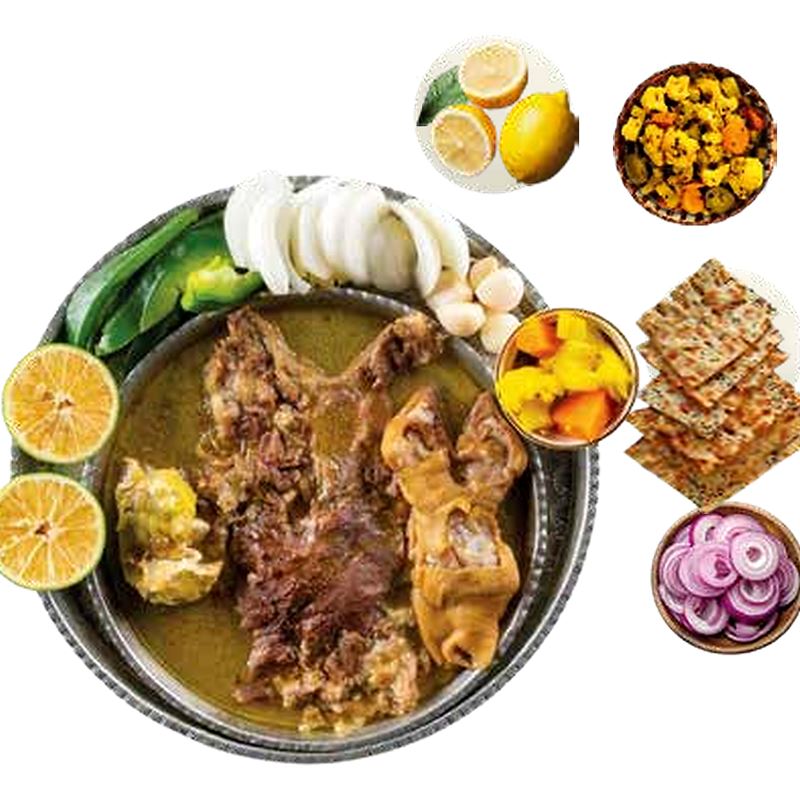
If you have never eaten this dish, read what kalle pache actually is before you order. It is lamb head and trotters, simmered slowly overnight, and it does not pretend to be something milder than it is. We would rather you knew that than be surprised by the bowl.
Delivery, pickup or dine-in from here?
All three work in these areas, which is not true everywhere in the city. Here is how we would choose.
| If this is your night | Take | Why |
|---|---|---|
| Everyone is already home and nobody wants to move | Delivery | It comes sealed and packed for the road, and the rider phones when he is downstairs |
| You are out anyway, or driving back along Jumeirah Street | Pickup | You are close. No delivery fee, and the food goes straight into the car |
| You want the soup in a proper bowl and the bread straight from the oven | Dine-in | Nothing sits in a bag, and the tea keeps coming |
| Six people and one table | Dine-in, or one order for everyone | Splitting one bill is simpler than placing five separate orders |
There is a longer version of this argument in our guide to choosing between delivery, pickup and dine-in. Most people in these areas end up doing all three at different times of the week, which is the honest answer.
How should I write my address in an old building?
This is the part that decides whether an order goes smoothly, and here it works differently from a tower with a reception desk. In these streets the building name means more than the number, and the number painted on the wall may not be the one the map knows. Write the address the way you would explain it to a friend:
- The building name, exactly as it is written on the front of the building.
- The shop underneath it, or the corner everyone uses as a landmark. Riders here navigate by shopfronts, not by numbers.
- Flat number and floor. Tell us if there is no lift — plenty of buildings in Karama and Satwa are walk-ups, and it helps to know before the climb starts.
- Which entrance you use. Some buildings are entered from the back lane, not from the street you named.
- A phone that will be answered. The rider calls on arrival rather than knocking on the wrong door.
The map pin is required at checkout, and it is worth a second of care: drop it on the door you actually walk through, not in the middle of the block. How delivery works to a villa, a flat or a hotel goes through the rest of it.
Is it worth collecting the order myself?
From these three areas, often yes. Pickup costs nothing extra, you choose your own moment to leave the house, and the food spends less time in a bag than it does on any delivery run. If you are already out, it is usually the better call.
Parking is the usual complaint and we will not pretend otherwise. Around these streets a space is harder to find at dinner time than it is late at night. At two or three in the morning the same street is quiet, which is one of the small mercies of ordering this dish at the hour it was meant for.
What should I order the first time?
Start with what suits you, not with what is supposed to be the proper way in.
- Soup — the broth on its own, and the gentlest way to begin. Brain Soup is there for people who already know what they like.
- Single Dish — one person's portion, and the thing we send to these neighbourhoods more than anything else.
- Double Dish and The Full Dish — for two people, or for a table.
- Brain, Tongue, Eye, Lamb Cheek, Meat, Trotters and Tripe can each be ordered on their own if you have a favourite. Special Mix is for when you want a little of everything.
- Sangak and Special Sangak — the platters already come with bread, so add more only if there are several of you.
- Torshi, Garlic Torshi, Doogh and a Kettle of Tea — this is the part that turns a plate into a table.
The lamb is halal. If you want to know what the first bowl is like before you commit to it, what to expect on a first order is a short read.
Why eat it at dawn?
Because that is when it has always been eaten. It cooks all night and is finished early, and an old neighbourhood wakes up early anyway. A bakery opens. Someone comes down for bread. A street that was solid with cars the evening before has two on it. The food is rich and warming and people sit over it for a long time, and half the point is the sitting.
The kitchen runs 24 hours a day, seven days a week, which suits people finishing a night shift as much as it suits people starting early. We wrote about that side of it in kalle pache for night-shift workers.
How does ordering actually work?
Everything goes through the order page. Choose delivery, pickup or dine-in, pick your dishes, and pay by card online when you order. The delivery fee depends on the area and is shown to you at checkout before you pay; over AED 300 there is no fee at all. Busy nights and traffic mean some runs take longer than others, and we would rather say that plainly than promise you a number. For a table, use the reservation page and tell us how many of you there are.
