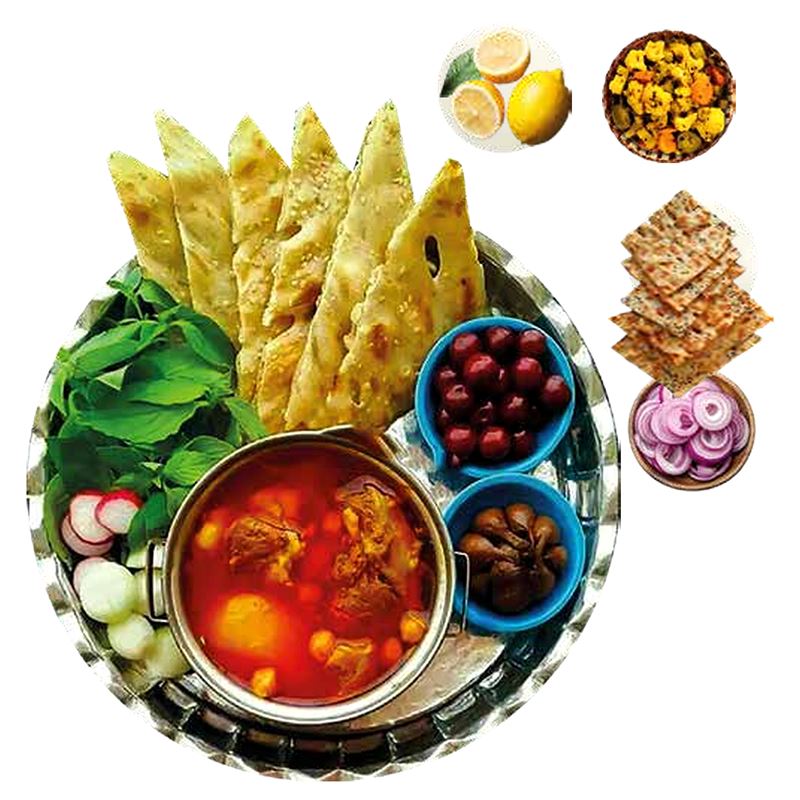
Why do traditional Persian kitchens cook kalle pache in a copper pot?
Kalle pache is, at heart, a bone broth — and a bone broth is unforgiving of an uneven pot. Copper does one thing better than almost any other kitchen metal: it moves heat. Copper conducts many times faster than stainless steel, and that speed is not about cooking quickly — it is about cooking evenly. Heat arrives from a single flame underneath, but in a copper pot it spreads sideways and up the walls almost as fast as it arrives, so the pot behaves like one warm surface rather than a scorching disc with cool edges.
That matters enormously here. The pot is packed with heavy bone, trotters, skin and connective tissue that sink and sit on the bottom. In a thin steel pot, whatever touches the base above the flame overheats, catches, and pushes a faint burnt-caramel bitterness through the whole batch — a flavour you cannot skim out or dilute later. Copper spreads the load. It also responds instantly when the cook drops the flame, which is how a fourteen-hour simmer is held at a barely-moving surface rather than left to swing between a boil and a stall.
What is the white lining inside the pot, and why does it matter?
Traditional Persian copperware is never cooked in bare. The inside is lined with a thin coat of tin, a craft called sefid-kari — literally “whitening” — and old pots go back to the tinsmith to be re-lined as the layer wears. The tin gives a neutral, non-reactive surface between the food and the copper, so long hours with onion, garlic and turmeric pick up no metallic edge. The pot people romanticise is really two materials doing two jobs: copper for the physics of heat, tin for the chemistry of flavour.
Why does slow beat fast when the goal is collagen and clarity?
Almost everything good in a bowl of kalle pache comes from connective tissue. Trotters, head and cheek are dense in collagen, and collagen is not tender — it stays tough until it slowly unravels into gelatin, the substance that gives the broth its silky weight, its lip-stickiness, and its habit of setting to a soft jelly when it cools in the fridge.
That conversion is a function of time at a moderate temperature, not of intensity. You cannot hurry it by turning the flame up, because heat above a gentle simmer starts working against you. Muscle fibres tighten and squeeze out moisture, so the meat goes stringy and dry even as it falls off the bone. And a rolling boil acts like a blender: the agitation shears surface fat into microscopic droplets and drives them into the liquid, emulsifying them permanently. That is the single most common reason a home broth turns out grey, cloudy and heavy instead of clear and clean. At a bare simmer, the fat stays where it belongs — on top, visible, liftable.
What does skimming every hour actually do to the broth?
In the first hours a slate-coloured foam rises: coagulated soluble proteins, blood residue and fine particles released from bone and marrow. Left alone, that foam does not simply sit there. It is fragile, and the movement of the pot eventually breaks it apart and disperses it back through the liquid, where it clouds the broth and leaves a muddy, faintly livery smell.
Skimming is therefore not decoration. Each pass removes material permanently, before it can redissolve. Doing it hourly — rather than once at the start — matters because the pot keeps releasing new fat and protein for hours as the tissue breaks down. Every round takes out a little more fat as well, which is why a properly skimmed broth tastes rich without coating the roof of your mouth. Colour is the timer the cook actually watches: hour after hour the liquid deepens from pale grey to a transparent amber, and it is finished when it reaches the colour of strong tea. At Shaun the Sheep, everything is hand-cleaned before dawn and then simmered roughly fourteen hours with onion, turmeric and garlic, skimmed every hour, until it hits exactly that colour.
Can you shortcut kalle pache with a pressure cooker?
You can make the meat soft. You cannot make the same dish. A pressure cooker works above the boiling point, so it does break down tissue in a fraction of the time — but its sealed lid removes the three things the long method depends on.
| What the cook needs | Pressure cooker | Copper pot, ~14 hours |
|---|---|---|
| Skimming | Impossible — lid stays sealed | Hourly, throughout |
| Fat behaviour | Violently emulsified into the liquid | Rises, held on top, lifted off |
| Broth clarity | Cloudy, greyish | Clear, colour of strong tea |
| Body and gelatin | Present but thinner; no reduction | Slow reduction, silky weight |
| Aroma | Trapped, then vented at once; flatter | Onion, turmeric and garlic mellow gradually |
| Tasting and adjusting | Only after depressurising | Any hour, all night |
| Meat texture | Soft, sometimes shredded and watery | Yielding but still whole on the bone |
Does a modern stainless pot work at home?
Yes, within reason — a heavy pot with a thick clad base gets far closer than a thin one, and patience matters more than the metal. What genuinely cannot be substituted is the schedule: a low flame, an open surface, and someone returning to the pot every hour through the night.
How can you taste the difference in the bowl?
Look first. A long-simmered broth is translucent, not milky, with a few clean beads of gold fat rather than a slick. Tilt the spoon: it should coat, not run off like water. Then the lips — real gelatin is slightly tacky, and it lingers. Finally the aroma, which should read as warm onion, sweet garlic and earthy turmeric, with no sour or metallic note underneath. Any of that missing usually means the pot was hurried.
Where can you eat a fourteen-hour copper-pot broth in Dubai?
At Shaun the Sheep, 64 Jumeira Street, Jumeirah 1, the pot never really goes cold — we are open 24 hours a day, 7 days a week, and the lamb is halal in line with UAE law and standards. You can order singles such as trotters, tongue, lamb cheek, brain or tripe, a plain or brain soup, or a communal platter for one, two, three or six people, with sangak bread, mixed torshi and seven-year garlic pickle alongside. See everything on the menu and order page, or reserve a table if you would rather sit down to it. Delivery covers Dubai with the fee chosen by area at checkout, and pickup and dine-in are always available.
One note: everything above is cooking craft and culinary tradition, not medical or nutritional advice. If you have a health condition or a specific diet, speak to your doctor, and if you have an allergy or ingredient question, contact us directly before ordering so we can answer it properly.
