The worry usually goes unsaid, so let us say it plainly: this is somebody else's food, and I will get it wrong in front of people who know better. That is a reasonable thing to feel, and the answer is short: yes, you can eat kalle pache whether or not you are Iranian, and nobody is checking.
A one-word answer rarely settles nerves, though. What settles them is knowing what the dish is, what happens after you order, and the few words that make the menu read easily.
Is kalle pache only "for" Iranians?
No, and food history is firmly on your side. Simmering a lamb's head and trotters for hours is one of the oldest ideas in cooking: take the parts that need time, give them time, and something plain turns rich. Versions turn up almost everywhere sheep have been kept, from kelle sogus in Turkiye and bouzellouf in Morocco to the thick trotter broths of Egypt and the Levant, barbacoa in Mexico and smalahove in Norway. Cooks in distant places reached the same conclusion separately, because it works.
The Iranian version has its own clear character: the long broth, the parts served separately, sangak bread, sharp pickles, and the habit of eating it early in the day. That is worth knowing on its own terms, but distinct is not the same as closed. A dish is a technique and a set of flavours, not a membership card. For background, what kalle pache actually is covers it.
Does it make sense to eat this in Dubai?
Dubai is close to the ideal place for this worry to dissolve. Food travels because people travel, and in a city built out of arrivals, most of us eat somebody else's home cooking most days of the week. That is not a failure of authenticity; it is how every cuisine you already love came to exist.
Practically it is simpler still. An order here is a name, a phone number and, for delivery, an area from the list plus a pin on the map. Nothing asks where you are from, because it has never had anything to do with how the food is cooked.
Is it disrespectful to eat food that is not "mine"?
Some readers arrive with the opposite hesitation: not "will they let me?" but "should I?". The honest answer is that sharing is the whole point. Nobody puts a pot this size on the heat to keep it to themselves.
What stings when a food travels is not outsiders liking it. It is being mocked for it, or watching it renamed and sold back as somebody else's invention. Ordering it, asking what a word means and enjoying yourself are on nobody's list of offences.
What if I am Iranian but have never actually tried it?
Then you are in the same place as everyone else reading this, and far from alone. Plenty of people grew up outside Iran, or in a family that never cooked it, and now feel they are supposed to know something they do not. That feeling holds people back far more than the food does. Nobody is quizzing you at the door.
Will anyone judge me for ordering the wrong thing?
There is no wrong order, and barely any opportunity for anyone to judge one. Ordering happens on the website: you tap what you want, you never have to pronounce anything, and there is no account, no sign-up and no password. Dine-in is arranged through the same site and a table can be reserved, so the choosing is finished before you arrive.
What do people actually worry about, and what really happens?
| What you are worried about | What actually happens |
|---|---|
| "Everyone will know it is my first time." | Nothing asks. You choose items, give a name and phone number, and pay by card. |
| "I will order the wrong combination." | There is none. Singles are sold by the bowl so people can build the plate they want. |
| "I will be expected to finish all of it." | One bowl of Soup on its own is a complete, entirely normal order. |
| "Someone will tell me I am doing it wrong." | Online there is no conversation at all, and for dine-in the ordering is done before you sit down. |
| "I will mispronounce everything." | The menu is written out in English, Arabic and Farsi. You tap the item. |
| "I will not like it and the meal is wasted." | Possible. That is why Soup exists: broth and bread, before you commit to texture. |
Which words are worth knowing?
Not to pass a test, just so the menu reads smoothly. Six words cover most of it, and every item is written in plain English too, so you never actually need the Persian word.
| Word | What it means | Where you will see it |
|---|---|---|
| kalle pache | Head and trotters, the whole dish | The dish itself |
| pacheh | The gelatinous lamb feet | Trotters |
| maghz | Brain, soft and mild | Brain, Brain Soup |
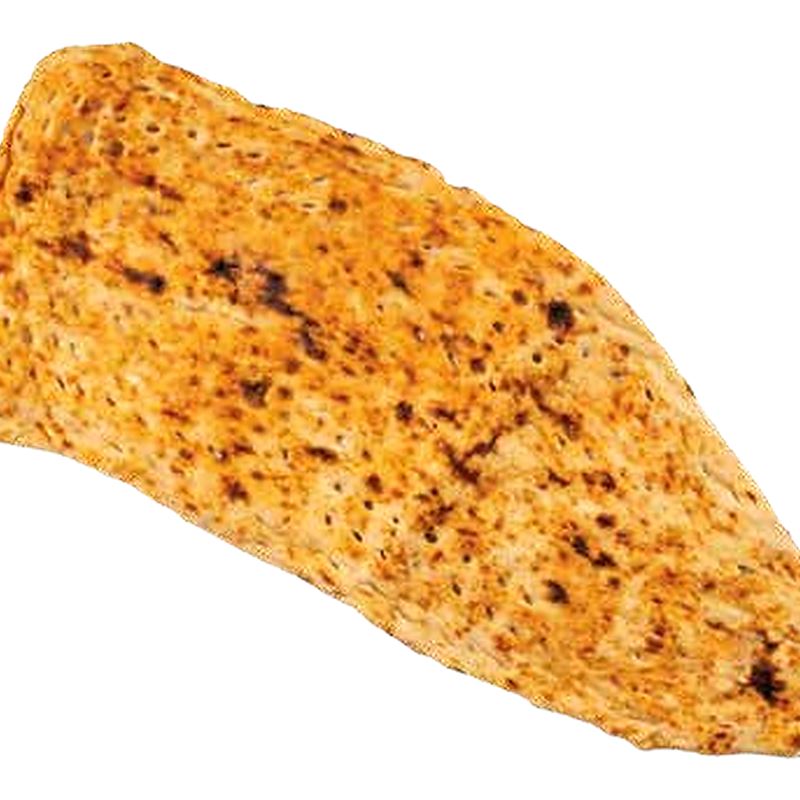
| sangak | The flat Iranian bread | Sangak Bread, Special Sangak |
| torshi | Sharp pickles that cut the richness | Mixed Torshi, Garlic Torshi |
| doogh | Salted yoghurt drink | The drinks list |
What should I expect the first time?
Expect richness rather than heat. This is a gentle, savoury, deeply lamb-y dish, not a fiery one. The singles are sold one part at a time: Soup, Trotters, Brain, Tongue, Lamb Cheek, Tripe, Meat, Eye, Brain Soup and the Special Mix, so you control exactly what arrives. If you would rather not decide, the platters decide for you: the Single Dish, the Double Dish, The Full Dish, and The Khan's Platter, built for six.
Bread and pickles are the usual companions, with doogh, lemonade or tea alongside. For the step by step there is how to eat kalle pache for the first time, and a plain description of the flavour in what it actually tastes like.
What if I try it and it is not for me?
Then it is not for you, and that is an ordinary outcome. Offal is not to everyone's taste and no amount of encouragement changes that. The gentlest way to find out is the smallest one: order Soup on its own, broth with bread, and judge the flavour before committing to texture. That approach has its own guide at the soup-only start, and if organ meat is the sticking point, this one helps.
Is it heavy? How often can I eat it?
It is a rich dish, and pretending otherwise would be silly: long-cooked lamb, gelatine from the trotters, fat in the broth. How often it fits into your eating is a question about you, not about the dish. This is not medical advice and we are not qualified to give any. If you have a reason to watch fatty food, cholesterol or digestion, ask your doctor or a dietitian rather than a restaurant blog. We make no claim that this dish treats, prevents or cures anything.
On another question that comes up: the lamb is sourced to the UAE halal standard. Beyond stating that plainly, we will not issue religious rulings or tell anyone what their practice requires. That is yours to decide.
Can I read and order in the language I think in?
Yes. The site runs in English, Arabic and Farsi with a switcher, and the ordering steps are identical in all three.
So how do I actually order?
Start with the menu on the homepage and choose delivery, pickup or dine-in. Add what you want, give a name and phone number, plus your Dubai area from the list and a pin on the map if it is coming to you, and pay securely by card at checkout. Delivery is free over AED 300.
The kitchen then confirms and sets an estimated time, and your order gets its own page you can keep open. The rider phones on arrival. If the kitchen cannot take an order, it is rejected and refunded automatically to the card you paid with, and the reason is shown on that page. You can also schedule an order up to about two days ahead. The kitchen is open 24 hours, every day.
If you would rather ask a person first, phone 04 321 8882. It is the only contact channel, and "I have never had this before, what should I get?" is a completely normal thing to say into it.
