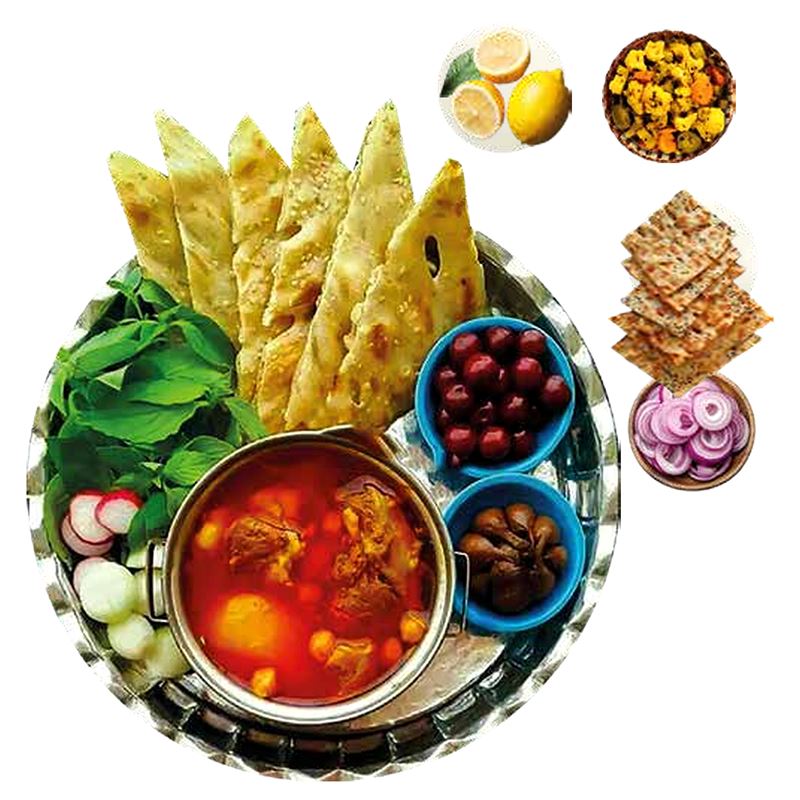
What is Persian food beyond kalle pache?
If your first taste of Iranian cooking in Dubai was a dawn bowl of kalle pache, you have started at one of its most storied corners — but the cuisine stretches far wider. Persian food is built on fragrant long-grain rice, char-grilled kababs, slow herb stews, and a signature love of sour, bright notes that cut through richness. This guide maps the dishes a newcomer is most likely to meet, explains how a Persian meal is put together, and shows where kalle pache — the traditional dawn specialty — sits within the whole picture.
How is a Persian meal usually structured?
Rice is the quiet centre of most Persian tables. Plain steamed rice (chelo) is prized for its separate, buttery grains and the golden crust at the bottom of the pot called tahdig; mixed rice (polo) folds in herbs, beans or fruit. Around the rice you will usually find a stew or a kabab, a plate of raw herbs (sabzi khordan), flatbread, yoghurt or the salted drink doogh, and something sour — pickles (torshi), dried lime, sumac or pomegranate. That balance of rich and sour, warm and fresh, is the thread running through the entire cuisine, kalle pache included.
Which Persian dishes should a newcomer try first?
If you are new to the food, kababs are the friendliest entry point. Kabab koobideh is seasoned minced lamb or beef pressed onto skewers and grilled over charcoal, served with rice and a grilled tomato. Jujeh kabab is chicken marinated in saffron, lemon and onion, then grilled until juicy. Both are approachable, deeply savoury and a fair measure of a kitchen's skill. From there, the stews open up a more complex, layered side of Persian cooking.
| Dish | What it is | Flavour | Easy first try? |
|---|---|---|---|
| Kabab koobideh | Grilled minced-meat skewers | Smoky, savoury | Yes |
| Jujeh kabab | Saffron chicken skewers | Bright, mild | Yes |
| Ghormeh sabzi | Herb, bean and dried-lime stew | Herbal, tangy | Yes |
| Fesenjan | Walnut and pomegranate stew | Rich, sweet-sour | Adventurous |
| Abgoosht / dizi | Lamb, chickpea and bean pot | Hearty, comforting | Yes |
| Ash reshteh | Noodle, herb and legume soup | Thick, tangy | Yes |
| Kalle pache | Slow-simmered lamb head and trotters | Deep, silky | Adventurous |
What are the classic Persian stews (khoresh)?
Ghormeh sabzi is often called Iran's national stew: a dark, herb-heavy braise of parsley, fenugreek and other greens with kidney beans, tender lamb and dried limes that lend it a distinctive sour edge. Fesenjan is the special-occasion showpiece — chicken or duck simmered in ground walnuts and pomegranate molasses until the sauce turns deep and glossy, sweet and tart at once. Both are spooned over chelo and are best understood slowly, one layered bite at a time.
What about one-pot and comfort dishes?
Abgoosht, also called dizi after the stone crock it cooks in, is lamb, chickpeas, white beans and potato simmered together; the broth is poured off and sipped with bread first, then the solids are mashed into a paste eaten with herbs and pickles. Ash reshteh is a thick, warming soup of noodles, beans, herbs and tangy kashk, popular at Nowruz and on cold evenings. Tahchin is a saffron-and-yoghurt rice cake, crisp outside and soft within, often layered with chicken — proof that rice itself can be the star.
Where does kalle pache fit in Persian cuisine?
Kalle pache lives in a category of its own: it is the traditional dawn food, eaten early and slowly, long associated with cold mornings and gatherings that begin before the city wakes. Where kababs and stews belong to lunch and dinner, kalle pache belongs to first light. At Shaun the Sheep on Jumeira Street, this is exactly the tradition we focus on — Tehran-style lamb head and trotters, hand-cleaned before dawn and simmered for about fourteen hours in a copper pot with onion, turmeric and garlic, skimmed hourly until the broth is the colour of strong tea. You can see how it is served — as communal platters for one, two, three or six, or as singles such as trotters, tongue, lamb cheek and the Special Mix — on the menu and order page.
How do the flavours connect across the cuisine?
Even though kalle pache sits apart on the clock, it speaks the same flavour language as the rest of Persian cooking. It is finished at the table with lime and cinnamon, torn sangak bread stirred into the broth, sharp mixed torshi and seven-year garlic pickle on the side, and doogh or hot tea to drink — the very same interplay of rich broth and bright, sour accents you meet in a bowl of abgoosht or a plate of ghormeh sabzi. Learn to love that balance and the whole cuisine begins to make sense.
How can I try authentic Persian food in Dubai?
The easiest way to begin is to taste one dish properly rather than a little of everything. If you want to explore the dawn specialty, Shaun the Sheep is open 24 hours, 7 days a week at 64 Jumeira Street, Jumeirah 1 — with dine-in, pickup, and delivery across all of Dubai, the fee set by your area at checkout and free on orders over AED 300. Being in Jumeirah 1 keeps us close to Jumeirah, Al Wasl, City Walk, Downtown, DIFC, Business Bay and La Mer. Browse everything on the menu and order page, or reserve a table and make a slow morning of it. The lamb is halal, in line with UAE law and standards.
