What khaneh tekani asks of a household
Khaneh tekani, literally "shaking the house", is the Iranian cleaning that runs through the weeks before Nowruz. It is not a tidy-up. Carpets go out to be beaten or sent away to be washed, cupboards are emptied onto the floor, curtains come down, and everything that has sat quietly all year is pulled into the light. The work spreads over days, and it ends with the kitchen, which is scrubbed last and hardest: the hood degreased, the oven emptied, the spice shelf taken down and wiped jar by jar.
In Dubai the custom travels intact. The flats are different, the carpets go to a cleaner rather than onto a roof, and the timing folds into a working week, but the shape holds. By the last stretch before the equinox the house is in pieces and the family is still living in it.
The bind: the room being cleaned is the room you cook in
This is the practical problem the custom creates and rarely mentions. The kitchen is left until last because it is the hardest room and because you want it clean going into the new year. It is also the only room that feeds anybody, and a household eats every day whether or not the hood is in pieces.
Frying in a kitchen you have just degreased undoes a full afternoon of work with one pan. Rice wants a pot, a colander and a burner you would rather not splash. So the cooking either happens before the scrubbing, which means cooking twice, or it stops, and the house eats what can be brought in without anything touching the stove.
Why a long-simmered dish fits the cleaning weeks
Kalle pache is lamb head and trotters simmered for about fourteen hours, and that number matters here. It is not a dish you start at nine in the evening in a kitchen with the shelves in boxes; it belongs to a pot that went on the day before. How that simmer actually works is a longer story, told in what kalle pache is.
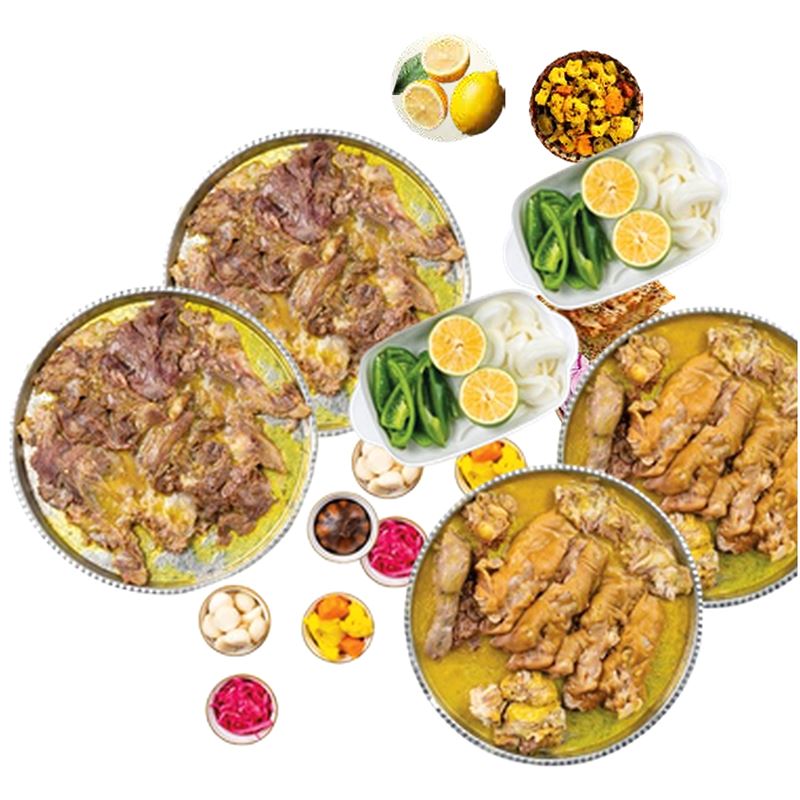
It also arrives as a table rather than as ingredients. Sangak bread, torshi, lime, onion and green pepper come with it, so the only thing that has to reach the counter is plates. Nothing is fried at home, nothing is boiled down, and no oil goes near the hood you spent Saturday on.
Our kitchen runs 24 hours a day, seven days a week, which matters during khaneh tekani for a plain reason: the work keeps no office hours. Carpets can be rolled at six in the morning, and cupboards finished at one in the morning, if that is the only free stretch in the week.
Ordering for a set hour
Pre-orders for a future time are supported, and a cleaning day is exactly when that matters, because the difficulty of feeding a household mid-khaneh tekani is not hunger but timing: food landing while the carpet is still rolled against the wall leaves nowhere to sit and no clear surface to set it on. Pick the hour you expect the floor to be back down, and order for that hour instead of for now.
Payment on the website is card prepay only. There is no cash on delivery and no money changes hands at the door, which on a day when your wallet is inside a box somewhere is one thing fewer to find. Delivery is free over AED 300 and covers Dubai; the practical side of that is set out in our guide to delivery in Dubai.
Sizing the order to the people doing the work
The platters are built around headcount, so the arithmetic is simple. The Single Dish is portioned for one, the Double Dish for two, The Full Dish for three, and The Khan's Platter for six, so one order covers a table of six without counting portions. If you would rather build the plates yourself, the singles are listed one by one on the menu: eye, brain, meat, tongue, trotters, tripe, lamb cheek, brain soup, soup, and the special mix known as mojoon.
Or leave the house to itself
The other route is not to bring food into a half-dismantled home at all. We are in Jumeirah and open around the clock, so a table works at whatever hour the cleaning stops, after the carpets go off to be washed or before the shopping for haft-sin. Broth is hottest at the table, because it cools on the way. If the break between jobs has a fixed end, book a table for that hour; the phone is 04 321 8882.
