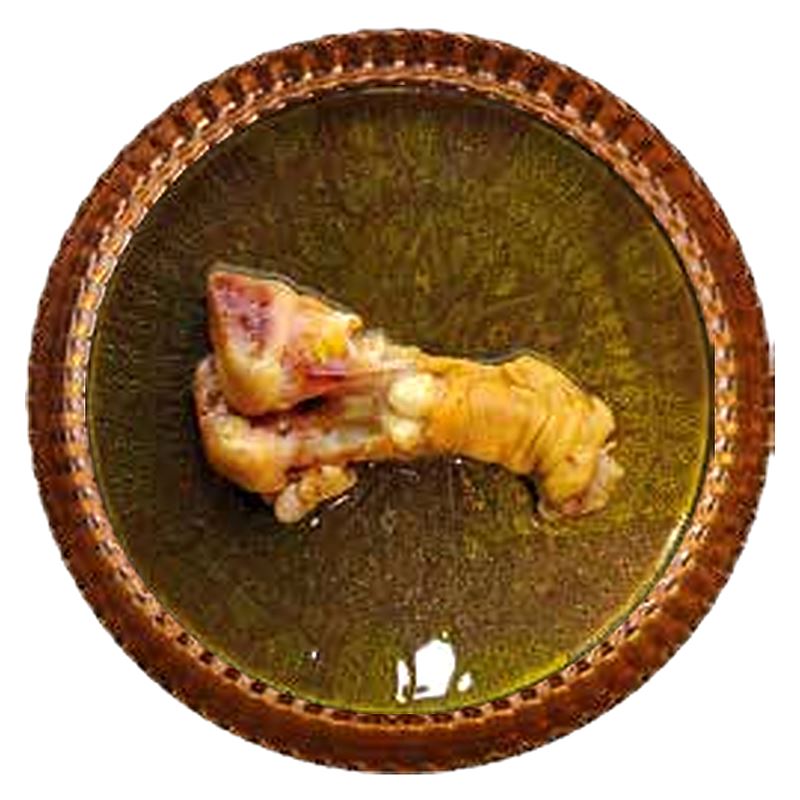
What is the difference between real kalle pache broth and packaged bone broth?
The gap is not marketing, it is chemistry and time. A carton of bone broth or a dissolved stock cube gives you a seasoned brown liquid; a bowl of kalle pache gives you what fourteen hours of gentle simmering pulls out of a real lamb's head and trotters. One is flavoured water designed to sit on a shelf for a year; the other is cooked before dawn and served the same day, its body coming from collagen and gelatin that have slowly melted off the bone rather than from a thickener or a flavour compound. At Shaun the Sheep on Jumeira Street the pot has been running since long before you wake up, and that is the whole point.
What does fourteen hours of simmering actually extract from head and trotters?
Trotters (paye) and the bones of the head are unusually rich in connective tissue, and connective tissue is where collagen lives. Hold it at a low, steady simmer for hours and that collagen slowly converts into gelatin — the substance that makes a good broth coat your lip, cling to the spoon and, when cold, set to a soft jelly. That body is not added; it is coaxed out. Along the way the marrow, cartilage and skin release their own fats and savoury compounds, onion and garlic mellow into sweetness, and turmeric tints the whole pot the colour of strong tea. We skim it hourly so what is left is clean rather than muddy. The result is a broth with genuine weight on the tongue, built entirely from the animal and three aromatics.
Why can't a stock cube or a carton do the same thing?
Because both are engineered for shelf life, not for extraction. A stock cube is mostly salt, dried flavourings, fat and flavour enhancers pressed into a tablet; a shelf-stable carton is a thin stock that has been filtered and heat-treated hard enough to survive months at room temperature — a process that strips much of the delicate aroma and most of the fragile gelatin along with it. You can stir powdered collagen back into a carton, but you cannot rebuild the layered, meaty, faintly sweet depth that only comes from real head and trotters cooked slowly and eaten fresh. The shortcut saves fourteen hours; it also skips everything those fourteen hours were for.
Isn't the "bone broth" wellness trend the same idea?
The trend is a rediscovery, and Tehran got there first — by a few centuries. Long before bone broth appeared in glossy jars, the kalle-pazi was quietly doing exactly what the wellness world now describes: simmering heads and trotters overnight into a rich, gelatinous broth and serving it at dawn as restorative food. The tradition never called it a superfood; it simply called it breakfast. What is sold today as an innovation is, in the Persian kitchen, an ordinary Friday morning. If anything, the packaged version is the diluted copy and the original is the thing sitting in our copper pot.
We should be honest about the framing, though: we describe collagen, gelatin, protein and warmth as culinary qualities of the dish, not as medical promises. The nutrition of any given bowl depends on the cuts and the portion you choose.
Real broth vs stock cube vs carton — what actually differs?
| Feature | Real kalle pache broth | Stock cube / bouillon powder | Carton "bone broth" |
|---|---|---|---|
| How it is made | ~14 hours simmering real head and trotters, skimmed hourly | Salt, fat, dried flavourings and enhancers pressed dry | Thin stock, filtered and heat-treated for shelf life |
| Source of body | Natural gelatin melted from bone and connective tissue | A thickener, or none — usually thin | Often thin; sometimes added collagen powder |
| Flavour | Layered, meaty, faintly sweet, aromatic | Uniform, salty, one-note | Mild, flattened by heat processing |
| Freshness | Cooked before dawn, served the same day | Powder, months to years | Sealed, months at room temperature |
| Texture when cold | Sets to a soft jelly | Stays liquid | Usually stays liquid |
| Salt | Seasoned to taste in the kitchen | Very high | Variable, often high |
| What you are really buying | A cooked meal | A flavouring shortcut | A convenience liquid |
Why does "cooked daily" beat "shelf-stable"?
A broth's most delicate qualities — its aroma, its clean fat, its live gelatin — are also its most perishable, which is exactly why they cannot be bottled for a year without loss. Shelf stability is achieved by taking those qualities out. Cooking daily does the opposite: the batch that reaches your bowl was skimmed a few hours earlier, so the aroma is still lifting off the surface and the gelatin still has its full body. Being open twenty-four hours a day, seven days a week, is not a slogan for us; it is what lets every bowl be a fresh one, whether you order it at five in the morning or five in the afternoon.
How can you tell real broth from a reconstituted one in the bowl?
Three quick tests. First, look: real kalle pache broth is clear amber, the colour of strong tea, not a flat opaque brown. Second, feel it on your lip — genuine gelatin leaves a faint stickiness that thin stock never does. Third, let a little cool at the edge of the bowl; real broth begins to gel while cube-based liquid stays watery. Tear in fresh sangak, add a squeeze of lime, a pinch of cinnamon and some seven-year garlic pickle, and the difference between a cooked broth and a flavoured one becomes impossible to miss. You can build your own bowl from the singles and platters on the menu and order page.
Where can you taste real kalle pache broth in Dubai?
Shaun the Sheep is a Tehran-style kalle pache house at 64 Jumeira Street, Jumeirah 1, open twenty-four hours a day, seven days a week, with halal lamb in line with UAE law and standards. Order singles like trotters, brain (maghz) or tongue (zaban), or a communal platter for one, two, three or six people, with sangak, torshi and doogh alongside. We deliver across all of Dubai — the fee is set by area at checkout and delivery is free on orders over AED 300 — with pickup and dine-in also available. Being in Jumeirah 1 keeps us close to Jumeirah, Al Wasl, City Walk, Downtown, DIFC, Business Bay, La Mer and Jumeirah Bay. See current dishes and order on the menu and order page, or reserve a table to taste the broth the way it is meant to be served.
This article is about culinary tradition, not medical or nutritional advice. If you have a health condition affecting how you eat rich, fatty or high-cholesterol foods, please speak to your doctor.
