Peasant food or delicacy? Both answers are true
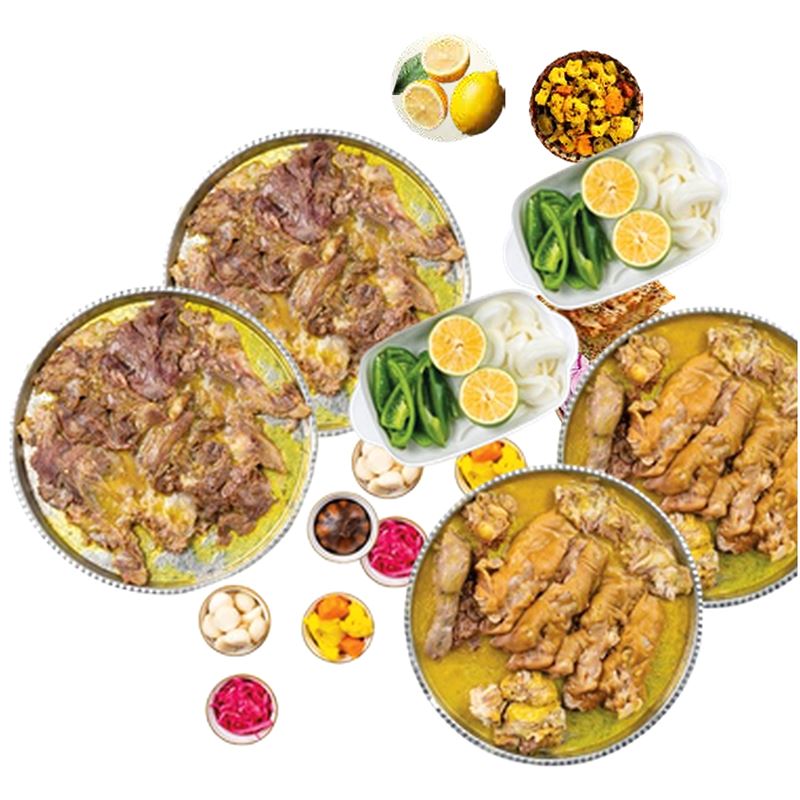
It is a fair question and deserves a straight answer, not a slogan. Kalle pache was never only one thing. Head-and-trotter cookery appears in the kitchens of rulers and in small shops that opened before sunrise for men on their way to work — in the same centuries, often in the same cities. A dish can be cheap to buy and expensive to make, and this is one of those. If you want the plain description of the food before the history, this is what kalle pache is.
Persian cooking has a long written record of treating the whole animal — head, feet, tongue, brain — as material worth a recipe, and neither picture cancels the other out.
The ingredient was cheap. The work never was.
A head and four trotters cost less than a leg of lamb; that much of the sceptic's case is true. What follows the purchase is not cheap at all. The wool has to be singed off over flame and the skin scraped clean. The pieces are soaked and rinsed through several changes of water. The skull is opened so the brain comes out whole, the tongue trimmed, the trotters split at the joint.
Only then does the pot go on, and then it stays on. Ours runs about fourteen hours over a low fire, skimmed as it goes, until the collagen in skin, joints and bone turns into the gelatin that gives the broth its body and the meat its softness. Fuel, time and someone awake to watch the pot were expensive in every century. That is why head cookery became a trade of its own rather than a dish made at home, and the full method shows where those hours go.
Before refrigeration, a head could not wait
Here is the food logic that explains more than any theory about class. Muscle meat can hang for a day or more in a cool room. Heads, trotters and organ meats cannot. They carry more blood and soft tissue, they have far more exposed surface for their size, and brain is delicate by nature. Without cold storage they had to be handled within hours of butchery, and close to where it happened.
So the head and feet did not travel. They went from the slaughter yard to the nearest pot, and whoever kept that pot cooked them. That is not sentiment about the poor; it is a constraint of temperature.
Which is why the dish belongs to the dawn
Butchery was done at night so meat could reach the morning market fresh. The parts that could not wait went into the cauldron in the evening or the small hours. A pot lit late at night is ready around sunrise, and a simmer that long can be neither hurried nor held back. A shop opening before first light was not being picturesque; it sold the pot at the hour the pot was finished.
That is why kalle pache is traditionally eaten at dawn, and why in Persian the hour and the dish are still spoken of together. Refrigeration removed the necessity long ago, but the timetable stayed.
Status shifted later, for reasons outside the kitchen
The assumption that offal is automatically humble is younger than the dish. Industrial butchery, refrigeration and long-distance transport made boneless muscle cheap, uniform and available everywhere, and once the easy cuts were plentiful the difficult ones were re-read as leftovers. Before that the ranking often ran the other way. There is one brain, one tongue and two cheeks per animal, and scarcity generally sets value. A well-cooked lamb cheek is not a consolation prize.
The same logic, in Jumeirah
At Shaun the Sheep the kitchen is open 24 hours a day, seven days a week, so the dawn bowl and the late-night one come out of the same long simmer. The pot is served as singles — eye, brain, meat, tongue, trotters, tripe, lamb cheek, brain soup, soup, and the special mix known as mojoon — or as platters: the Single Dish for one, the Double Dish for two, The Full Dish for three and The Khan's Platter for six. Sangak bread, torshi, lime, onion and green pepper come alongside. The menu sets it all out, and if you are weighing one single against another, this guide compares them.
We serve dine-in in Jumeirah and deliver across Dubai, with free delivery over AED 300. Payment on the website is by card in advance, and an order can be set for a later hour if you want the dawn bowl without the dawn alarm. The phone is 04 321 8882.
