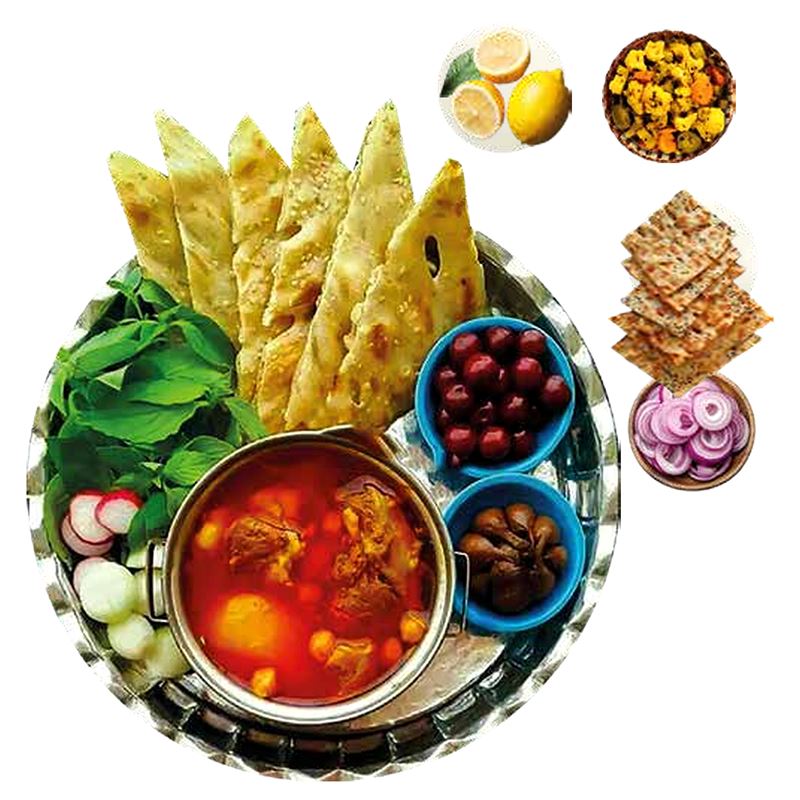
What is khoresh karafs, the Persian celery stew?
Khoresh karafs (Persian: خورش کرفس) is one of Iran's most beloved herb stews: tender lamb or beef braised slowly with golden onion and turmeric, then finished with batons of fried celery and a generous, fragrant fry of fresh parsley and mint that Persians call na'na-ja'fari. What sets it apart from a heavier meat khoresh is its brightness — the signature sourness comes from lime juice or dried Persian limes, and the celery stays green and just-tender rather than dissolving into the sauce. It is a spring and early-summer favourite, comforting yet fresh, and it is very achievable in a Dubai kitchen where good celery and herbs are easy to find.
An honest note first: this is a home recipe. Our kitchen on Jumeira Street is a Tehran-style kalle pache house, so we do not cook khoresh karafs ourselves — we simply want to show you how to make it properly at home.
Why fry the celery and herbs separately?
This is the single technique that separates a great khoresh karafs from a muddy one. If you tip raw celery straight into the pot it collapses into strings and the stew turns grey. Instead, fry the celery batons on their own in a little oil until the edges catch a light gold but the centre still has a bite — they finish cooking gently in the sauce and keep their shape and colour. The parsley and mint deserve the same respect: fried slowly in oil until they darken and turn deeply aromatic, they give the stew its unmistakable perfume. Raw, unfried herbs make a flat, grassy stew; properly fried ones make a fragrant one.
What ingredients do you need for khoresh karafs?
These quantities serve four to five people over rice. Lamb shoulder or neck is the classic choice because it stays succulent through a long braise; stewing beef works just as well.
- 500 g lamb (shoulder or neck) or stewing beef, cut into 3–4 cm cubes
- 1 large bunch celery, about 600–700 g (6–8 stalks), cut into 4–5 cm batons; keep the tender leaves
- 2 large bunches fresh parsley (about 200 g), finely chopped
- 1 bunch fresh mint (about 100 g), finely chopped — or 2–3 tablespoons dried mint
- 1 large onion, thinly sliced
- ½ teaspoon ground turmeric
- 3–4 dried Persian limes (limoo amani), pierced — or the juice of 1–2 fresh limes, or both
- 4–5 tablespoons oil, for frying (divided)
- Salt and freshly ground black pepper
- About 2–3 cups hot water or light stock
How do you make khoresh karafs step by step?
- Warm 2 tablespoons oil in a heavy pot and fry the sliced onion over medium heat until soft and golden, about 8–10 minutes. Stir in the turmeric for 30 seconds until fragrant.
- Add the meat and turn it in the onion until it is sealed and no longer pink on the outside. Season with salt and pepper.
- Pour in enough hot water to just cover the meat, bring to a gentle simmer, cover, and cook low and slow for 1 to 1½ hours (lamb) until the meat is almost tender. Add the pierced dried limes for the last 30 minutes.
- While the meat braises, fry the herbs. Warm 2 tablespoons oil in a frying pan over medium-low heat and fry the chopped parsley and mint for 8–12 minutes, stirring often, until darkened and fragrant. Do not let them scorch, then set aside.
- In the same pan, fry the celery batons over medium-high heat in a little oil for 5–8 minutes, turning, until the edges are lightly golden but the pieces still hold their shape.
- Stir the fried herbs and celery into the meat pot. If using fresh lime, add its juice now. Partly cover and simmer gently for another 30–40 minutes, until the celery is tender but intact and a layer of oil rises to the surface.
- Taste and balance: it should be pleasantly sour, not sharp. Add salt, a little more lime, or a pinch of sugar if it is too tart. Rest off the heat for 10 minutes, then serve over rice.
Which souring agent should you use?
The sourness is the soul of this khoresh, and you have a few authentic options. Use this guide to choose.
| Souring agent | Flavour | How to use |
|---|---|---|
| Dried Persian lime (limoo amani) | Deep, earthy, slightly bitter | Pierce 3–4 and simmer whole; remove or squeeze before serving |
| Fresh lime juice | Bright and clean | Stir in near the end, to taste |
| Both together | Rounded and layered | Dried limes in the braise, fresh juice to finish |
| Verjuice (ab-ghureh) | Mild, tangy, traditional | Add a splash toward the end instead of lime |
What are the most common khoresh karafs mistakes?
A few avoidable slips account for most disappointing pots:
- Adding raw celery to the stew. It turns to mush and greys the sauce. Fry it separately first.
- Not frying the herbs. Unfried parsley and mint taste flat and raw. Fry until dark and fragrant.
- Over-stirring at the end. Once the celery is in, stir gently so the batons stay whole.
- Rushing the meat. A fast boil makes it tough; a low, slow simmer makes it silky.
- Unbalanced sourness. Add lime gradually and taste; a pinch of sugar rescues an over-tart pot.
How is khoresh karafs served?
Khoresh karafs is always served over Persian rice, ladled beside a mound of steamed fluffy chelo, and it is even better if you manage a golden tahdig underneath. A dish of torshi pickles and a bowl of plain yogurt on the side round out the meal. Celery and fresh herbs make this a relatively light, vegetable-forward stew, but the exact nutrition depends on the cut of meat and the oil you use; this is general information, not medical advice, so please consult a doctor or dietitian about your own diet. And if a slow-simmered pot is not what you feel like cooking tonight, you are always welcome to order authentic Tehran-style kalle pache, sangak and doogh from our menu for delivery across Dubai — free over AED 300, with the fee shown by area at checkout — or reserve a table to eat with us.
